

When applying for a mortgage, approval is never based on just a single factor. Lenders use many details about an individual to evaluate the entire picture, ensuring both the borrower’s reliability and the overall security of the loan. At the center of this process is the need to maintain investor confidence while accurately assessing a new or existing borrower’s profile. To achieve this, industry professionals widely consider the tri-merge credit report approach to be the best standard for determining these risks when it comes to loan eligibility.
Unlike single or bi-merge methods, the tri-merge method incorporates credit data from different sectors and uses the median score to evaluate a borrower. This approach reduces uncertainty and provides a more holistic representation of a borrower’s financial behavior and reliability. Relying on only one or two sources can cause inconsistencies, putting at risk approval decisions and loan pricing.
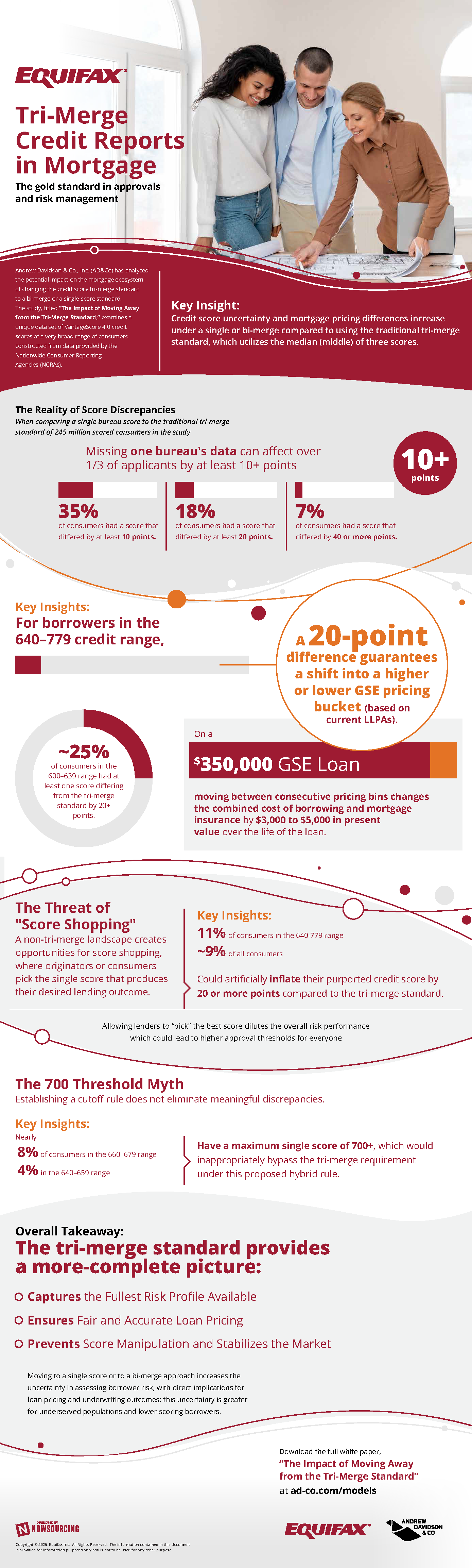
Studies have shown that omitting even one piece of the data puzzle can shift a borrower’s score by 10 points or more. Additionally, about 35% of consumers experience differences of at least 10 points between the bureaus, 18% see differences of 20 points or greater, and 7% see differentiation of a staggering 40 points or more. Putting this into perspective, for individuals with mid-range credit scores, even a 20-point swing can shift them into a different pricing tier. This shift can ultimately translate into detrimentally higher or lower borrowing costs, causing potential variations of thousands of dollars over the life of a loan.
If tri-merge reporting is not consistently applied, the potential for “score-shopping” increases. This phenomena occurs when either lenders or borrowers are able to be selective with their score choices. This leads many to choose the most favorable score from a limited set of data to achieve a desired outcome. Although this has the potential to benefit individuals on a case by case basis, it more broadly risks negatively altering the entire lending environment for borrowers as a whole. With risks like inflated scores being the leading outcome of score-shopping, many borrowers may have a limited view of true risk, leading lenders to tighten approval standards across the board. As a result, the entire borrowing population risks facing stricter requirements.
Additionally, the standard of the “700 credit score threshold” is often misunderstood. While it may seem like a clear threshold for loan qualification or better rates, relying on such a cutoff does not account for each individual borrower’s needs. Additionally, it does little to mitigate any inconsistencies that exist between credit reports. Because of this, a more nuanced and all-encompassing evaluation method, such as the tri-merge method, offers a fairer and more accurate assessment of credit worthiness.
Adopting the tri-merge standard benefits both individual borrowers, lenders and the mortgage industry as a whole. It delivers a more complete view of financial standing, supports equitable loan pricing and minimizes manipulation and self-serving actions. Especially as the financial landscape continues to strive for stability, this method helps to streamline and improve the lending process for all involved.
Source: Equifax


 WebProNews is an iEntry Publication