
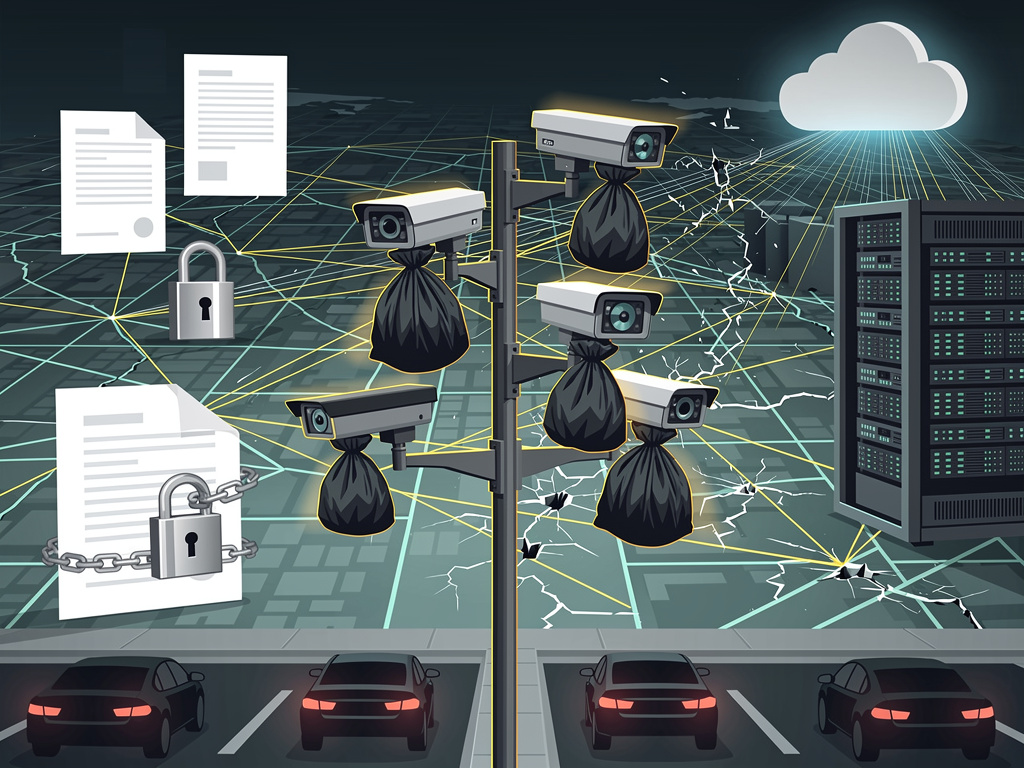
In Dayton, Ohio, black trash bags now flap over license plate readers. Police there aren’t sure the cameras have stopped working. City officials don’t know if they can simply take them down under their contract. So they improvised. Low-tech barriers against a high-tech system that has quietly spread across thousands of communities.
This scene repeats elsewhere. Evanston, Illinois, did the same last year. Cities cancel contracts with Flock Safety yet find themselves tangled in agreements that make swift removal difficult. The bags signal deeper frustration. They mark growing alarm over a private firm that collects vehicle data on a massive scale, stores it in its own cloud, and makes that information searchable by law enforcement nationwide.
Flock Safety operates thousands of automated license plate readers. The company pulls readings into centralized servers. Even small-town departments gain access to a vast database of movements. Critics describe this as mass surveillance conducted not by government but by a corporation that profits from it. The data reveals patterns of daily life. Where people live. Where they work. Who they visit. And Flock sells access to that insight.
Recent reporting shows the scale of concern. 404 Media documented Dayton’s bagged cameras as a stop-gap after an audit uncovered thousands of immigration-related searches. Deputy city manager Joe Parlette explained the police worked with public works to cover the devices until full removal. Similar actions followed revelations that Flock’s network fed data to ICE despite local policies against such cooperation.
But the problems run deeper than one contract dispute. The Electronic Frontier Foundation spent 2025 investigating Flock’s network. Their findings paint a troubling portrait. Agencies used the system to track participants in protests. Searches targeted Romani communities with overtly discriminatory terms such as “roma” or “g*psy.” Officers in Texas queried data under false pretexts while pursuing abortion-related cases. The abuses flow from the architecture itself. No software patch fixes a business model built on perpetual, interconnected tracking. (EFF)
And then there are the security failures. Independent researchers repeatedly exposed vulnerabilities. One YouTuber demonstrated how easily live feeds could be accessed. Another called the compromised cameras “Netflix for stalkers.” Hackers obtained police logins. Some accounts lacked basic protections like multifactor authentication. Feeds from law enforcement cameras appeared openly on the internet. Flock has called many issues configuration errors and said fixes followed. Yet the pattern persists. A private company holding sensitive location data for millions carries risks that seem to outpace its safeguards. (The Guardian)
Terms of service changes added fuel. Flock recently removed language assuring customers it does not own or sell their data. The company called the edit redundant. Residents and officials saw it differently. The shift coincided with expanded rights to use captured images for AI training. In Dunwoody, Georgia, residents packed council meetings. One told officials the police appeared too trusting of the vendor. “You and I both know the next time Flock is misused in our city, you will turn a blind eye because none of you are trustworthy with our records,” said resident Joe Hirsh. The mayor expressed frustration with the contract language. Several California cities terminated agreements outright. Others paused programs after audits revealed unauthorized federal searches.
Garrett Langley, Flock’s founder and CEO, has met criticism with hostility. In a December email sent to law enforcement clients, he framed opposition as a coordinated assault. “Flock, and the law enforcement agencies we partner with, are under coordinated attack,” Langley wrote. He accused privacy advocates of wanting to “defund the police, weaken public safety, and normalize lawlessness.” He suggested they produce “YouTube videos with misleading headlines” and aim to “let murderers go free.” The message backfired. Staunton, Virginia’s police chief pushed back, calling citizen concerns “democracy in action.” Charlottesville’s chief affirmed that communities have a right to debate policing. Staunton later terminated its contract. (ACLU)
Langley’s tone reveals an executive unwilling to accept legitimate debate over the trade-offs of pervasive tracking. His company has grown rapidly. Flock claims cameras in thousands of communities across most states. It performs billions of scans monthly. The firm markets not only to police but to homeowners associations and private property owners. Data flows into the same national pool. A neighborhood watch camera can feed the same database that lets distant agencies reconstruct someone’s movements.
This private surveillance infrastructure raises constitutional questions. The Fourth Amendment protects against unreasonable searches. Yet Flock’s system creates a standing database of location information available without warrants in many cases. Courts have begun to scrutinize it. Public records battles continue. Some cities tried to claim Flock-held data falls outside open records laws. Washington state courts rejected that argument, affirming the data’s public character.
Expansion continues despite the backlash. Flock moves beyond still images. New cameras capture video. AI tools let officers search with natural language. “Landscaping trailer with a ladder” becomes a query. So could descriptions of people or behavior. The company has explored connections to data brokers that offer “people lookup” services. License plates link easily to names and addresses. The claim that Flock tracks only vehicles, never individuals, collapses under basic scrutiny. (ACLU)
Advocates warn of chilling effects. Protesters tracked. Patients followed to clinics. Neighbors monitored. Immigrants located through local police acting as proxies. One Colorado lawsuit accuses Boulder police of illegal mass surveillance via Flock. Harris County, Texas, renewed its contract even as skepticism grows. The technology delivers arrests in some cases. Supporters highlight stolen vehicles recovered and suspects identified. But those successes do not erase the architecture of constant observation.
Cities covering cameras with trash bags capture the moment. Officials bought the pitch. They signed contracts. Now many realize the system they purchased creates dependencies and risks they cannot easily escape. Data lingers. Networks interconnect. A private firm sits at the center, collecting, storing, and monetizing American movement patterns.
Public pushback has forced some retreats. More than a dozen cities terminated deals in recent months. State lawmakers propose restrictions. Federal lawmakers have opened inquiries. Yet Flock presses forward. Its CEO lashes out at critics rather than addressing root concerns about scale, security, and accountability. The trash bags are temporary. The cameras, the database, and the company behind them remain. Americans are watching a private surveillance network take root in plain sight. Many now ask whether it should have been allowed to grow this far unchecked.


 WebProNews is an iEntry Publication