
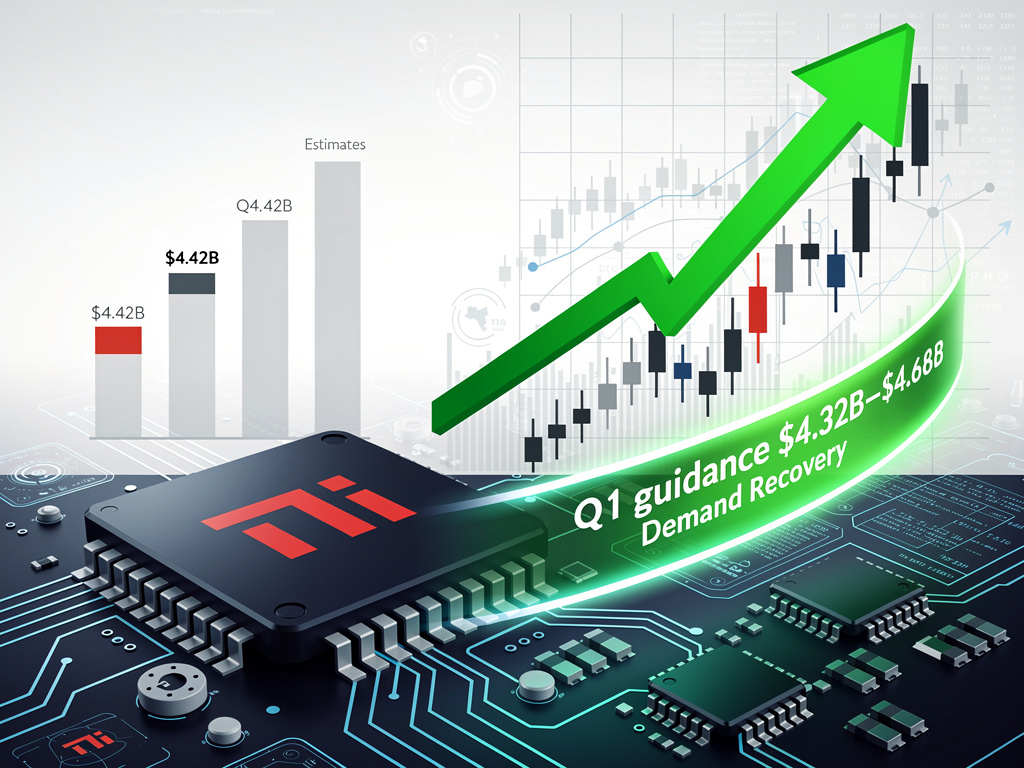
Texas Instruments Inc. shares surged more than 9% in after-hours trading Tuesday after the analog chip giant issued first-quarter revenue guidance that exceeded Wall Street expectations, overshadowing a modest miss on fourth-quarter results. Revenue climbed 10% year-over-year to $4.42 billion, just shy of the $4.44 billion consensus estimate, while earnings per share came in at $1.27, below the $1.30 anticipated by analysts. The upbeat outlook for the March quarter—revenue projected at $4.32 billion to $4.68 billion against estimates of $4.42 billion—signaled stabilizing demand in key end markets.
Chief Executive Haviv Ilan highlighted the company’s cash generation prowess in the official release, stating, “Our cash flow from operations of $7.2 billion for the trailing 12 months again underscored the strength of our business model, the quality of our product portfolio and the benefit of 300mm production. Free cash flow for the same period was $2.9 billion.” Over the past year, TI returned $6.5 billion to shareholders through $5 billion in dividends and $1.5 billion in repurchases, including a quarterly dividend of $1.42 per share declared recently (PR Newswire).
The stock reaction underscored investor focus on forward momentum. Shares hit $215 intraday after closing at $196.59, reflecting optimism about a semiconductor demand upturn (CNBC). On X, traders noted the disconnect: “Q4 Print (Rearview): Revenue: $4.42B (Miss vs $4.44B est) EPS: $1.27 (Miss vs $1.30 est). Q1 2026 Guide (Windshield): Revenue Outlook: $4.32B – $4.68B (Midpoint $4.5B beats consensus)” (@k2__investment).
Analog Strength Powers Sequential Dip
Analog revenue, TI’s largest segment, reached $3.62 billion, up 14% from a year earlier, while embedded processing added $662 million, a 8% increase. These gains offset a 34% drop in the other category. Net income stood at $1.16 billion, down from $1.21 billion last year, with EPS including a 6-cent charge not in prior guidance (Wall Street Journal).
Full-year 2025 revenue totaled $17.68 billion, with net income of $5.00 billion and EPS of $5.45. Trailing 12-month operating cash flow hit $7.15 billion, yielding $2.94 billion in free cash flow after $4.6 billion in capital expenditures—a 96% year-over-year jump. This resilience came amid a multi-year inventory correction in analog chips (StockTitan).
Guidance for Q1 EPS of $1.22 to $1.48 brackets the $1.26 consensus, but the revenue midpoint of $4.50 billion tops estimates, hinting at seasonal recovery. Analysts at BNP Paribas noted a restocking cycle in industrial semiconductors, which could span several quarters and favor TI (Reuters).
Demand Signals from Factory Floors to Roads
Industrial and automotive markets, comprising about 70% of TI’s sales, showed early rebound signs. Demand for chips in factory automation and vehicles picked up after a slump triggered by pandemic overstocking. Bloomberg reported chip demand is “beginning to rebound,” with TI’s outlook reflecting this shift (Bloomberg).
TI’s emphasis on 300mm wafer production bolstered margins and cash flows, positioning it for long-term growth. The company invested $3.9 billion in R&D and SG&A alongside capex, supporting a shift toward application-specific solutions ramping in 2026. X users highlighted free cash flow beats: “Free Cash Flow Beat FCF: $1.33B vs $884.7M est” (@CHItraders).
Despite the Q4 EPS miss, TI outperformed on cash metrics, with Q4 free cash flow at $1.33 billion. This discipline addresses prior concerns over elevated inventories, now stabilizing around 215 days versus a historical 130-150 range.
Capex Cliff Looms for Cash Surge
TI’s multi-year fab expansion nears completion, with 2025 capex at $5 billion and 2026 eyed at $2-5 billion. This “capex cliff” could unleash free cash flow per share to $8-9 even in low-revenue scenarios, per prior management scenarios. Investors.com noted the Q1 guide above views drove the stock pop (Investors Business Daily).
Benzinga captured the market’s pivot: shares surged as Q1 guidance “shines,” with after-hours gains at 5% to $206.80 on the news. Peers like Qorvo also moved, but TI led amid broader semi optimism (Benzinga).
On X, sentiment focused on the forward view: “Investors are aggressively buying the 2026 recovery story. Guidance dictated the price action.” This aligns with TI’s role as a bellwether for non-AI semis, where industrial restocking trumps hype cycles.
Shareholder Returns Anchor Strategy
TI’s commitment to returning all free cash flow via dividends and buybacks remains firm, subject to capex and valuation. The $1.42 quarterly payout yields over 2.8% at recent prices, with trailing returns totaling $6.48 billion. Shacknews observed stock climbing to $215.93 post-earnings despite misses.
Analysts eye 2026 as a “harvest year,” with moderating capex unlocking FCF growth from $3 per share in 2025 to $7+ in 2026. TI’s U.S.-centric fabs mitigate geopolitical risks, enhancing dependability amid tariffs and supply shifts.
While Q4 profit slipped 4% to $1.16 billion, sales rose amid sequential weakness typical for the quarter. The guidance beat reinforces TI’s navigation of cyclical pressures, setting up for expansion as end markets normalize.
Sector Bellwether Points Upward
TI’s performance offers a litmus test for analog peers facing similar inventory overhangs. Recovery in calculators to data centers bodes well, with data center revenue potentially hitting $1-1.2 billion annually. X posts affirmed: “Q1 Guidance (In-Line): Revenue: $4.32–$4.68B vs. $4.42B cons” (@tenet_research).
Challenges persist—China softness and tariff uncertainties—but TI’s $670 million CHIPS Act benefit in 2025 bolsters the balance sheet. Sequential revenue dip of 7% reflected seasonality, yet year-over-year gains signal trough passage.


 WebProNews is an iEntry Publication