
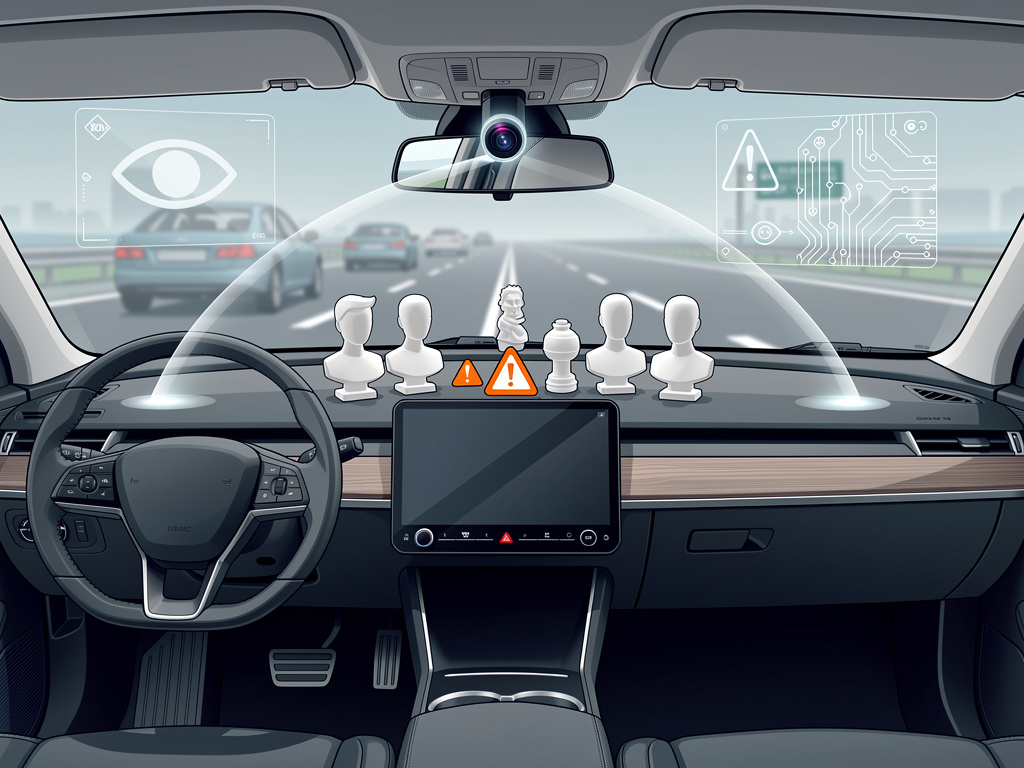
Chinese Tesla owners have found a remarkably simple way to outwit the company’s driver monitoring system. They buy miniature plastic heads — often replicas of celebrities like Dwayne “The Rock” Johnson — and perch them on the dashboard or rearview mirror. The tiny figures fool the cabin camera into believing an attentive driver sits behind the wheel.
But the drivers? They nap. Scroll phones. Or simply look away for long stretches. All while Autopilot or Full Self-Driving keeps the car moving down highways and city streets. The practice has grown into a small but visible market. Vendors sell these heads for as little as $10 to $40. Some versions come with blinking LED eyes to further simulate life.
The Cottage Industry of Bypass Gadgets
A thriving side business now offers not just plastic heads but also printed celebrity photos, small screens that display looping videos of eyes or faces, and other homemade contraptions. One anonymous Model 3 owner in China told reporters his miniature head works perfectly. He declined to give his name, fearing Tesla might restrict his vehicle’s features.
The gadgets exploit the limitations of Tesla’s interior camera. The system primarily checks for a human-like face and some head movement. It doesn’t always demand sustained eye contact or complex behavior. So a static or slightly animated bust suffices. Drivers mount the heads high enough to align with where a real person’s face would appear in the camera’s view.
And the trend isn’t isolated. Reports from the past few years show Tesla owners worldwide have tried sunglasses, hats, or even taped photographs. But the scale and creativity in China stand out. E-commerce platforms there list dozens of variations. Some mimic specific stars. Others offer generic male or female faces with adjustable features. Sales listings highlight compatibility with the latest Autopilot versions.
Tesla has updated its driver monitoring repeatedly. The company stresses that Autopilot and FSD require constant driver attention. Hands on the wheel. Eyes on the road. Yet enforcement relies heavily on that single cabin camera and steering wheel torque sensors. When both register “normal” activity, the system relaxes its warnings.
But the plastic heads reveal how brittle that check can be. A 2021 report from The Drive already showed early versions could be tricked by still photos. Consumer Reports tests found Tesla’s system less insistent than rivals like Ford’s BlueCruise, which shut down assistance more aggressively when attention wandered.
Fast forward to June 2026. A WIRED investigation documented the plastic head phenomenon in detail. It described a cottage industry of figurines, blinking screens, and DIY gadgets helping drivers bypass distracted-driving controls. The story noted how these tools let owners disengage completely while the car handles steering, acceleration, and braking.
Similar tricks have surfaced before. In 2019, researchers at Tencent’s Keen Security Lab used simple road stickers to make a Tesla change lanes unexpectedly, even toward oncoming traffic. That CNBC report highlighted how minor visual deceptions could alter vehicle behavior. The plastic heads take the deception inside the cabin.
Why China? The country leads global EV adoption. Tesla sells hundreds of thousands of vehicles there annually. Many buyers opt for FSD packages despite regulatory hurdles. Local rules require drivers to remain responsible even when assisted systems operate. Yet enforcement lags. Traffic cameras focus outward. Police rarely pull over cars that appear to drive themselves properly.
Owners speak of long commutes. Fatigue after 12-hour workdays. The temptation to let the car do more while they rest grows. One seller of the heads claimed buyers use them “just for safety” during highway runs. The irony lands hard. These tools exist because the safety system itself feels inadequate to some users.
Tesla doesn’t comment on every bypass method. The company pushes over-the-air updates that tweak camera algorithms and add random prompts. Recent software has increased nags for eye tracking and wheel torque. But determined owners adapt faster. They adjust head positions. Add subtle motors for movement. Or combine the bust with a weighted steering wheel attachment.
Industry watchers see broader lessons. Vision-only driver monitoring has limits. Cameras struggle in low light, with certain skin tones, or when drivers wear masks and glasses. Infrared illumination helps, but clever physical spoofs still succeed. Carmakers like Mercedes and GM use multiple sensors — steering, eye tracking, even cabin radar — to build redundancy.
Yet Tesla bets on cameras and software smarts. Its approach scales cheaply across millions of vehicles. Data from the entire fleet trains the models. That same data, however, now includes patterns of bypassed monitoring. The company can see when drivers ignore prompts for extended periods.
Regulators watch closely. China has forced Tesla to recall vehicles over Autopilot issues before. A 2024 action covered 1.6 million cars for software fixes. U.S. authorities have investigated crashes linked to misused Autopilot. The plastic head stories add fuel to debates about whether current systems qualify as true driver assistance or something closer to partial automation that still demands full attention.
Safety advocates worry most about the normalization. If enough drivers adopt these tricks, accidents will follow. A distracted owner might miss the moment when Autopilot fails to handle construction, a pedestrian, or sudden traffic. The plastic head won’t brake. The real driver, half-asleep, might react too late.
But. Some owners insist the gadgets improve safety on their routes. They stay more alert knowing the car won’t suddenly nag them. They keep the fake head as backup while they monitor traffic themselves. The rationalizations vary. Results do too.
Recent online discussions on X show the story spreading quickly after the WIRED piece. Users shared videos of the heads in action. Others mocked the low-tech solution to a high-tech problem. A few defended it as practical ingenuity in a market where full autonomy remains years away.
Tesla continues to roll out FSD improvements in China. The company navigates strict mapping and data rules there. Local competitors like XPeng and Li Auto push their own advanced driver assistance with different monitoring approaches. The competition may force faster evolution.
For now the plastic heads persist. Cheap. Effective. Widely available. They expose not just a flaw in one company’s camera but a tension at the heart of partial automation. Cars grow smarter. Humans stay distractible. And the gap between promise and reality invites workarounds.
Whether Tesla closes this particular loophole soon remains unclear. The company has surprised before with rapid fixes. Yet the creativity of owners suggests any patch will face new tests. Miniature celebrity busts might give way to projected faces or AI-generated video feeds. The cat-and-mouse game has only begun.


 WebProNews is an iEntry Publication