
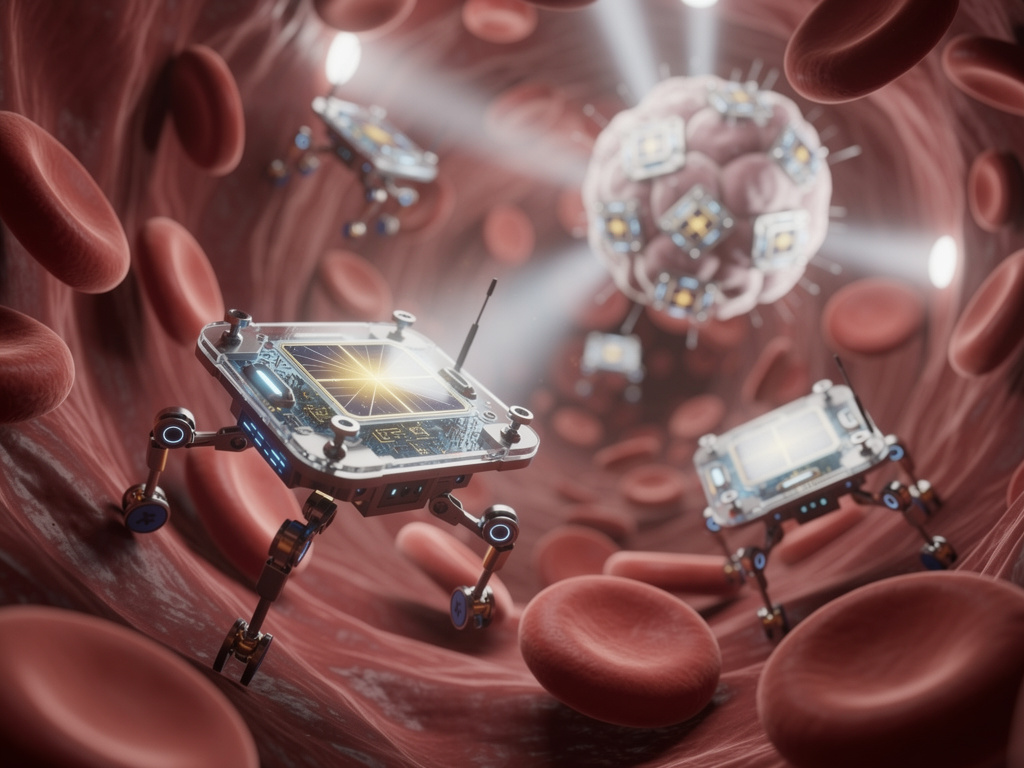
Microscopic Pioneers: Robots Venturing Inside the Human Form
In the rapidly evolving realm of medical technology, a groundbreaking development is poised to redefine how we approach diagnostics and treatment within the human body. Scientists have unveiled a minuscule robot, smaller than a grain of salt, capable of navigating the intricate pathways of our physiology. This innovation, detailed in a recent report by Futurism, features an onboard computer, solar cells for power, and a propulsion system that allows it to sense and respond to its surroundings. The robot’s design draws inspiration from natural microorganisms, enabling it to traverse blood vessels, tissues, and even delicate organs with unprecedented precision.
This tiny marvel isn’t just a feat of engineering; it represents a leap toward minimally invasive medicine. Researchers envision deploying swarms of these devices to deliver targeted therapies, such as chemotherapy drugs directly to cancer cells, or to perform real-time monitoring of internal conditions without the need for surgery. The propulsion mechanism, often powered by magnetic fields or ultrasound waves, mimics bacterial movement, allowing the robot to “swim” through bodily fluids. Early prototypes have shown promise in laboratory settings, where they’ve successfully navigated simulated human environments, avoiding obstacles and adapting to changing conditions.
The implications for healthcare are profound. For patients suffering from chronic conditions like interstitial cystitis—a painful bladder disorder affecting millions—these robots could offer relief by delivering medications precisely where needed, reducing side effects from systemic treatments. As reported in an article from CU Boulder Today, engineers at the University of Colorado Boulder have developed microrobots several times smaller than a human hair, targeting such ailments with laser-focused accuracy. This shift could dramatically cut recovery times and hospital stays, ushering in an era where invasive procedures become relics of the past.
Engineering Marvels at the Micro Scale
Building these robots involves cutting-edge nanotechnology, where components are assembled at the atomic level. The onboard computer processes environmental data in real time, making decisions on navigation or task execution without external input. Solar cells harvest energy from light sources, potentially even from within the body via biocompatible illumination, ensuring the device operates autonomously for extended periods. This self-sufficiency is crucial for applications in hard-to-reach areas, like the brain or deep within the gastrointestinal tract.
Challenges in development include ensuring biocompatibility to prevent immune responses and refining control systems for safe operation. Recent advancements, as highlighted in a piece from NIH News in Health, show medical robots varying in size and function, from surgical assistants to these microscopic explorers. Integration with AI enhances their capabilities, allowing predictive analytics for disease detection before symptoms manifest.
Public sentiment on platforms like X reflects excitement mixed with caution. Posts from users discuss nanobots swimming through veins to combat diseases, echoing futurist predictions of extended lifespans through such tech. One influential post likened them to an internal army patrolling cells, hunting viruses and cancer, underscoring the transformative potential while hinting at ethical concerns about privacy and long-term effects.
Applications Transforming Patient Care
In oncology, these robots could revolutionize treatment by identifying and neutralizing tumors at their earliest stages. Imagine a device that detects abnormal cell growth, administers a payload of therapeutic agents, and reports back via wireless signals—all without a single incision. This vision aligns with insights from Hopkins EP Online, which explores how robotics is advancing healthcare innovation through educational programs preparing engineers for these challenges.
Beyond cancer, applications extend to neurology. Tiny implants sending light-based messages to the brain, as described in a ScienceDaily report, enable mice to interpret artificial patterns as signals, paving the way for human therapies in conditions like Parkinson’s or epilepsy. These devices use micro-LEDs to create neural patterns, bypassing traditional sensory inputs and offering new avenues for rehabilitation.
Cardiovascular health stands to benefit immensely. Robots navigating blood vessels could clear blockages or deliver stents with pinpoint accuracy, reducing risks associated with current catheter-based procedures. A Washington Post article, referenced in X posts, notes progress toward rewiring damaged nerves and delivering medicines without surgery, highlighting a future where such interventions become routine outpatient affairs.
Overcoming Hurdles in Deployment
Despite the promise, scaling these technologies faces regulatory and technical barriers. Ensuring safety through rigorous clinical trials is paramount, as any malfunction inside the body could have dire consequences. Developers are working on biodegradable materials that dissolve harmlessly after completing their mission, minimizing long-term risks.
International efforts are accelerating progress. In Japan, where an aging population drives innovation, technology is addressing dementia through robotic aids, as covered in a BBC article. While not directly microscopic, these initiatives complement body-traversing robots by integrating AI for elder care, potentially combining external monitoring with internal interventions.
On X, discussions often cite Ray Kurzweil’s predictions of nanobots linking human intelligence to the cloud by the 2030s, expanding cognitive capabilities. Posts share visuals of nanobots aiding sperm motility or repairing tissues, fueling debates on whether this heralds a utopian or dystopian future. Skeptics point to hype versus reality, urging tempered expectations amid rapid advancements.
Integration with Broader Tech Ecosystems
The synergy between these microrobots and AI-assisted surgery is reshaping operating rooms. A study in PMC details how robotics and AI enhance precision and outcomes, with adoption rates soaring in modern healthcare. Surgeons could guide swarms of tiny robots remotely, performing complex procedures with minimal invasion.
Educational institutions are pivotal in this evolution. Programs at Johns Hopkins, as mentioned earlier in the Hopkins EP Online source, train the next generation of engineers to lead these innovations, focusing on ethical design and practical implementation.
Real-world implementations are emerging. A CWRU article lists five medical robots improving care, including those for rehabilitation and diagnostics, which could integrate with body-traversing models for comprehensive treatment protocols.
Ethical and Societal Implications
As these technologies mature, ethical questions arise. Who controls the data collected by robots inside our bodies? Privacy concerns loom large, especially with potential cloud connectivity. Industry insiders debate balancing innovation with safeguards, ensuring equitable access across socioeconomic lines.
Global perspectives vary. In regions facing healthcare shortages, such robots could democratize advanced medicine, delivering care to remote areas. X posts from health tech enthusiasts highlight genomics and nanotechnology’s role in precision care, with AI and VR enhancing mental health therapies.
Futurists like those posting on X envision a world where disease is preempted by constant internal surveillance. However, this raises issues of consent and over-medicalization, prompting calls for robust regulatory frameworks.
Pushing Boundaries in Research
Ongoing research pushes the envelope. A recent Washington Post piece, building on the Futurism report, describes a robot that can sense, think, and act autonomously, advancing toward clinical trials. This device, equipped with a miniature solar-powered computer, represents a milestone in bioengineering.
Collaborations between academia and industry are key. Events like the Humanoids Summit, as reported in AP News, gather experts to discuss integrating humanoid and microscopic robotics, fostering innovations that blur lines between external aids and internal explorers.
X conversations often reference shape-shifting robots that walk, fly, and morph, inspiring designs for versatile medical applications. While humanoid forms grab headlines, the true revolution may lie in their microscopic counterparts, quietly transforming human health from within.
Future Horizons and Innovations
Looking ahead, combining these robots with gene editing tools like CRISPR could enable on-site genetic repairs, tackling hereditary diseases at their source. Prototypes already demonstrate tissue repair capabilities, as seen in posts depicting nanobots delivering drugs systemically.
Challenges in energy efficiency and navigation in dynamic environments persist, but breakthroughs in materials science are addressing them. For instance, biocompatible polymers allow longer operational lifespans without rejection.
As adoption grows, economic impacts will follow. Healthcare costs could plummet with preventive interventions, shifting focus from treatment to maintenance. Industry analyses predict a multibillion-dollar market, driven by aging populations and rising chronic disease rates.
In wrapping up this exploration, the advent of body-traversing robots marks a pivotal moment in medical history. From the tiny device unveiled in Futurism’s coverage to broader integrations discussed across sources, these innovations promise a healthier, more resilient humanity. As research progresses, the line between science fiction and reality continues to blur, offering hope for tackling some of medicine’s toughest challenges.


 WebProNews is an iEntry Publication