
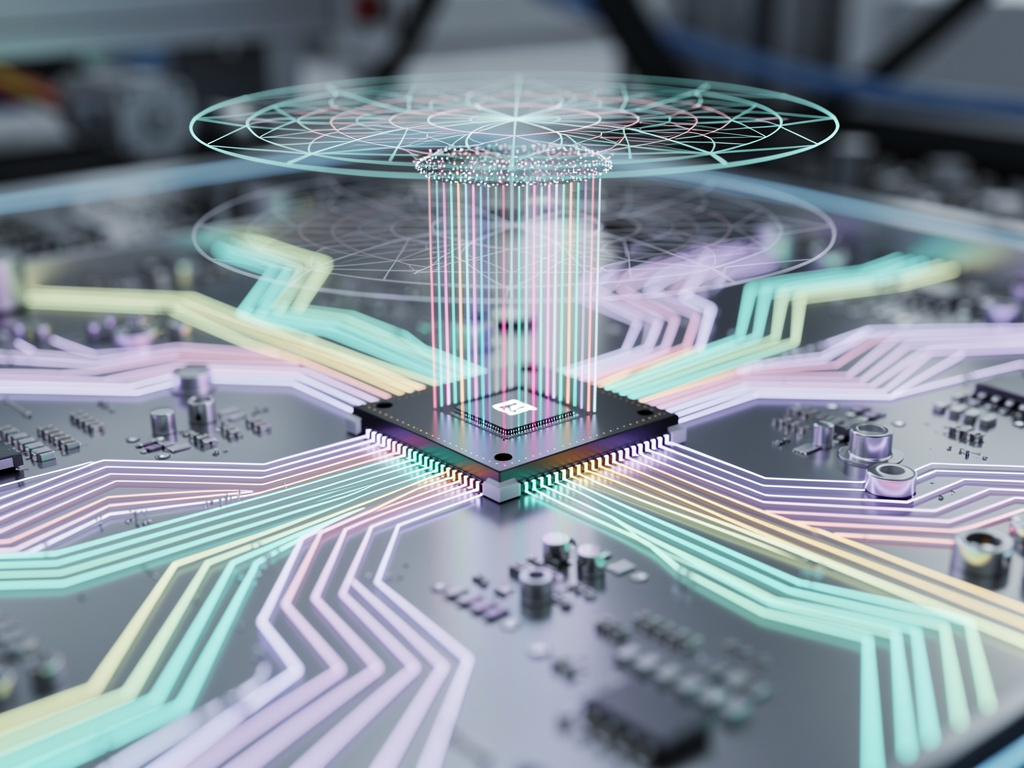
The Microchip Revolutionizing Quantum Computing’s Horizon
In the rapidly evolving field of quantum technology, a groundbreaking development has emerged that promises to reshape how we build and scale quantum computers. Researchers have unveiled a minuscule chip capable of controlling laser frequencies with unprecedented precision, all while consuming significantly less power than existing systems. This innovation, detailed in a recent study, leverages standard semiconductor manufacturing processes, paving the way for mass production and potentially unlocking quantum machines of immense scale and capability.
The chip, no larger than a microchip, addresses one of the most persistent challenges in quantum computing: the need for stable, precise control over quantum bits, or qubits. Traditional setups rely on bulky, power-hungry equipment that limits scalability. By integrating advanced frequency control into a compact form factor, this device could enable the creation of quantum processors with thousands or even millions of qubits, far surpassing current limitations.
Drawing from insights in ScienceDaily, the technology’s compatibility with existing chip fabrication techniques means it can be produced at scale without the need for custom, expensive builds. This shift could democratize access to quantum computing, allowing more companies and research institutions to experiment and innovate.
Precision Control in Miniature Form
Industry experts are buzzing about the implications. The chip’s ability to manage laser frequencies with extreme accuracy is crucial because qubits are notoriously sensitive to environmental noise and fluctuations. Even minor instabilities can cause errors that cascade through computations, rendering results unreliable. This new design minimizes such issues by embedding control mechanisms directly onto the chip, reducing the footprint and energy demands.
Comparisons to classical computing revolutions are inevitable. Just as the microprocessor transformed personal computing in the 1970s, this quantum chip could catalyze a similar leap. Reports from Live Science highlight a related breakthrough where scientists achieved 99.99% fidelity in a silicon-based quantum processor, underscoring the momentum in silicon-compatible quantum tech.
Moreover, the power efficiency aspect cannot be overstated. Current quantum systems often require cryogenic cooling and massive power inputs, making them impractical for widespread use. By slashing energy requirements, this chip opens doors to more portable and cost-effective quantum devices, potentially integrating them into data centers or even edge computing environments.
Scaling Up Through Modular Architectures
Posts on X from users like Dr. Singularity emphasize recent progress in linking multiple small quantum chips to achieve scalability. One such post notes that researchers at UC Riverside demonstrated how modular architectures can tolerate imperfections, allowing quantum computers to grow without perfect hardware. This aligns perfectly with the new chip’s mass-producibility, suggesting a future where quantum systems are assembled like Lego blocks.
Further web searches reveal that companies like IonQ are aggressively acquiring technologies to bolster their quantum capabilities. According to The Quantum Insider, IonQ’s acquisitions in 2025, including Oxford Ionics for ion-trap-on-a-chip tech, aim at fault-tolerant systems with over two million qubits by 2030. Such moves indicate a competitive race where chip-level innovations like this one could tip the balance.
The international dimension adds another layer. A post from China Science on X describes a breakthrough in integrated photonic quantum chips, achieving continuous-variable entanglement on-chip. This suggests that global efforts are converging on similar goals, with China making strides in photonic approaches that complement the laser-control chip’s advancements.
Breakthroughs in Fidelity and Coherence
Delving deeper, the pursuit of higher fidelity is a recurring theme. SciTech Era’s X post reports on Silicon Quantum Computing’s silicon chip hitting 99.99% accuracy across 11 qubits, a feat verified in a Nature study. This level of precision is vital for error-corrected quantum computing, where multiple physical qubits represent a single logical one to mitigate errors.
Princeton researchers, as mentioned in another X post by Dr. Singularity, have developed superconducting qubits with coherence times in milliseconds—orders of magnitude better than microseconds. Integrating such qubits with the new frequency-control chip could amplify performance, potentially making quantum processors 1,000 times more efficient, as speculated in related discussions.
Google’s contributions are noteworthy too. Their Willow chip, highlighted in a post from Google Quantum AI on X, achieves error suppression through surface codes, a milestone built over nearly 30 years. Web news from Google’s blog details further 2025 advancements, including the Quantum Echoes algorithm, reinforcing the ecosystem where this tiny chip fits.
Global Race and Commercial Transitions
The United Nations’ designation of 2025 as the International Year of Quantum Science and Technology, as noted in articles from The Conversation, underscores the timeliness of these developments. Governments and private sectors worldwide are investing heavily, recognizing quantum’s potential in fields like medicine and materials science.
SpinQ’s industry trends report, accessible via SpinQ, describes 2025 as an inflection point, with transitions from theory to commercial reality. This includes hardware bets on specific architectures, cloud growth, and security focuses, all of which could benefit from the scalable, low-power chip design.
On X, The Sirius Report points to China’s delivery of a superconducting quantum measurement system supporting over 1,000 qubits, signaling that quantum computing is arriving sooner than anticipated. Such systems could incorporate the new chip to enhance control and scalability.
Interconnects and Networking Innovations
MIT’s work on photon-shuttling interconnects, as shared by Dr. Singularity on X, enables direct communication among multiple quantum processors. This is crucial for distributed quantum computing, where the tiny chip’s precision laser control could ensure seamless data transfer without decoherence.
Stanford’s breakthrough in quantum signaling at room temperature, reported in Stanford Report, entangles light and electrons without extreme cooling. An X post from user illya discusses this alongside CMOS silicon nanophotonic chips distributing entanglement over long distances, hinting at quantum networks that might rely on such compact control devices.
Tech Signals’ X post on chiplet-based approaches for trapped-ion processors illustrates modular strategies that reduce fabrication limits. By fabricating chiplets separately and integrating them, this method allows optimal material choices, directly complementing the mass-producible nature of the new chip.
Implications for Critical Sectors
The broader impacts extend to critical sectors. Enhanced quantum computing could revolutionize drug discovery by simulating molecular interactions at unprecedented speeds. In cryptography, as explored in Quantum Frontiers’ blog post from Quantum Frontiers, we’re entering a “second quantum century” where secure communications become paramount.
Investment data from The Quantum Insider’s 2025 trends article, found at The Quantum Insider trends, shows a narrowing focus on hardware architectures, with cloud services expanding access. This environment favors innovations like the tiny chip, which could lower barriers to entry.
Mack’s X post echoes the excitement around the chip’s potential to accelerate quantum progress through mass production, aligning with the original MSN article’s focus on MSN’s coverage of the device.
Future Horizons and Challenges Ahead
While optimism abounds, challenges remain. Maintaining qubit stability over larger scales requires ongoing innovations in error correction and materials. The integration of this chip with existing quantum hardware will demand rigorous testing, as hinted in various web sources.
Collaborations between academia and industry, such as those involving Google Quantum AI and Princeton, are accelerating progress. As per Live Science’s report on silicon-based architectures, achieving scalability with high fidelity is now within reach, but commercial viability hinges on cost reductions enabled by chips like this.
Ultimately, this tiny chip represents a pivotal step toward practical quantum computing. By enabling precise, efficient control in a manufacturable package, it could usher in an era where quantum advantages become routine in solving complex problems, from climate modeling to financial optimization. As the field advances, keeping an eye on these incremental yet transformative developments will be key for insiders navigating this dynamic arena.


 WebProNews is an iEntry Publication