
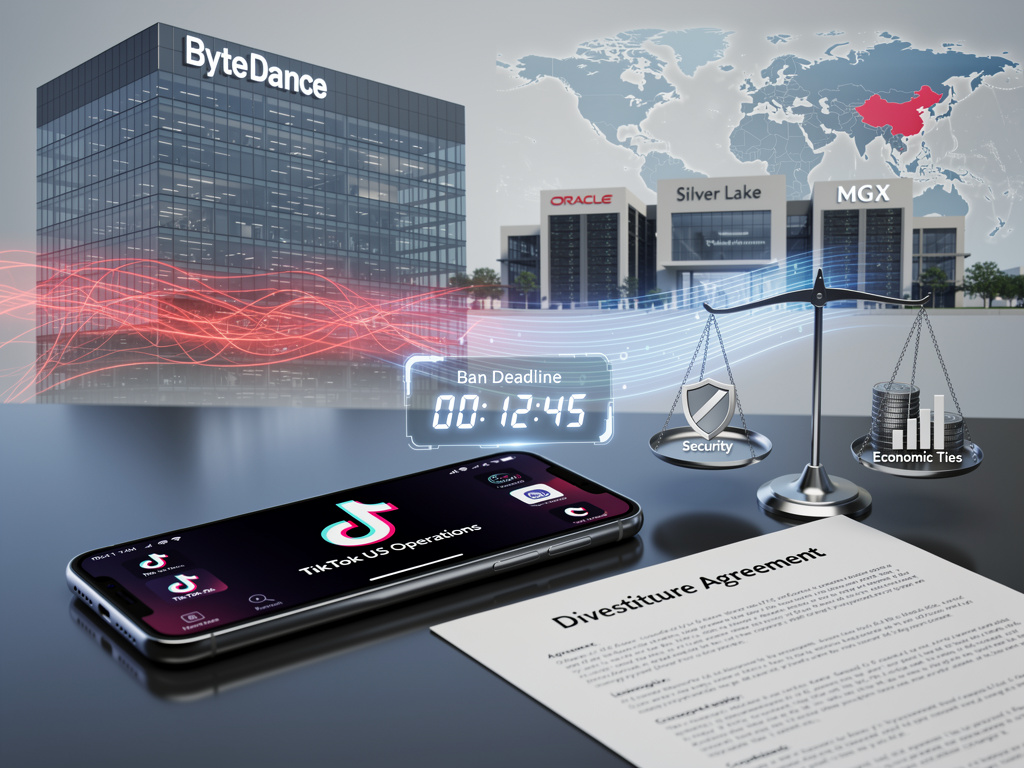
ByteDance Ltd. has inked binding agreements to spin off its U.S. TikTok operations into a new joint venture, handing majority control to American investors including Oracle Corp., Silver Lake Management and MGX in a high-stakes bid to dodge a looming ban. The move, announced via an internal memo from CEO Shou Zi Chew, caps years of regulatory pressure and political maneuvering over national security concerns tied to the app’s Chinese ownership.
Under the structure detailed in the memo, Oracle, Silver Lake and MGX will collectively hold 45% of the U.S. entity, while ByteDance retains about 20% ownership, according to an Axios report on the document. A consortium of additional U.S. investors takes the remaining stake, ensuring no single foreign entity dominates. The deal, which awaits final regulatory nods, positions the platform to keep humming in the world’s largest market, with operations expected to close next month, per The Hollywood Reporter.
Mr. Chew assured employees in the memo that the arrangement safeguards TikTok’s core operations, emphasizing continuity amid uncertainty. ‘This is a major step forward,’ he wrote, as reported by CNBC.
Roots of the Forced Separation
The saga traces back to 2020, when then-President Donald Trump issued an executive order demanding ByteDance divest TikTok’s U.S. assets over fears of data access by Beijing. Legislation passed in 2024 set a January 19 deadline for divestiture, or face an app store ban, escalating the pressure as TikTok amassed 170 million U.S. users.
Negotiations intensified post-election, with President Trump signaling openness to a deal involving familiar players like Oracle, which had been tapped years earlier as a ‘trusted technology partner.’ Recent reports confirm the consortium’s bid, backed by the administration, averts immediate shutdown.
Oracle’s involvement extends beyond equity; it will continue managing U.S. user data on its secure cloud servers, a concession won after prior shutdown threats, according to posts on X from industry observers.
ByteDance’s Grip on the Money Machine
Despite ceding operational control, ByteDance maintains sway over revenue engines. The Financial Times reviewed a memo revealing U.S. entities under ByteDance’s direct oversight for e-commerce, advertising and marketing—segments driving billions in annual sales. TikTok Shop alone generated over $20 billion globally last year, with U.S. growth exploding.
This hybrid setup raises eyebrows among critics. Sen. Elizabeth Warren condemned it as a giveaway to ‘Trump and his billionaire buddies,’ per The Guardian. Yet proponents argue it balances security with innovation, isolating sensitive data while preserving economic value.
The Financial Times memo specifies ByteDance’s U.S. units retain authority on these drivers, potentially allowing algorithmic influence on monetization despite divestment claims.
Investor Lineup and Financial Stakes
Silver Lake, a tech-focused private equity giant, leads the investor group alongside Oracle’s enterprise muscle and MGX, an Abu Dhabi-based fund with deep tech ties. Reuters notes the trio’s binding pacts mark a pivotal shift, ending ByteDance’s outright ownership.
Oracle stock surged 5% on the news, reflecting bets on deepened TikTok ties, as covered by Investor’s Business Daily. Valuation whispers peg the U.S. entity at $40-60 billion, though terms remain confidential amid antitrust scrutiny.
MGX’s role underscores Gulf capital’s rising tech footprint, complementing U.S. heavyweights in a bid blending Silicon Valley and sovereign wealth.
Operational Overhaul Under New Ownership
The joint venture, dubbed TikTok USDS in some reports, will retrain core algorithms on U.S. data by January 22, isolating them from ByteDance’s global tech stack, per an X post citing internal details. Interoperability and global revenue sharing persist, ensuring seamless user experience.
Employees received assurances of job stability, with Mr. Chew stressing the deal’s role in ‘securing TikTok’s future in America.’ PBS News highlighted the memo’s optimistic tone amid layoffs elsewhere in Big Tech.
This restructuring sidesteps full code handover, a ByteDance red line, by ring-fencing U.S.-specific models while linking to parent tech for non-sensitive features.
Regulatory Hurdles and China Approval
China’s nod remains the wildcard; Beijing previously nixed similar deals citing export controls on recommendation algorithms. Axios sources indicate concessions smoothed the path, though tensions linger.
U.S. agencies like CFIUS must greenlight the structure, scrutinizing data flows and minority stakes. The Hill reports bipartisan wariness, with House Republicans probing revenue retention clauses.
Posts on X from venture reporter Dan Primack flag lingering questions on enforcement, echoing 2020 false starts.
Implications for Tech and Policy
For Oracle, it’s a crown jewel: exclusive data custody bolsters its government cloud ambitions. Silver Lake eyes lucrative exits, potentially via IPO. ByteDance sacrifices control but preserves cash flows from a crown asset.
TikTok’s ad machine, projected at $15 billion U.S. revenue in 2025, stays intertwined, per CNBC analysis. E-commerce ambitions, rivaling Amazon in short-form sales, hinge on ByteDance’s playbook.
BBC frames it as a template for decoupling, where full breaks prove elusive in interconnected tech empires.
Market Ripples and User Impact
Users face minimal disruption; content moderation shifts to U.S. oversight, addressing bias claims. Advertisers welcome stability after ban scare wiped $10 billion in value.
Competitors like Meta Platforms and Snap eye fallout, as TikTok’s algorithm edge endures under hybrid governance. ABC News reports the deal’s U.S.-centric board ensures compliance.
Longer term, it tests divestment efficacy—can partial ownership neutralize risks without stifling growth?


 WebProNews is an iEntry Publication