
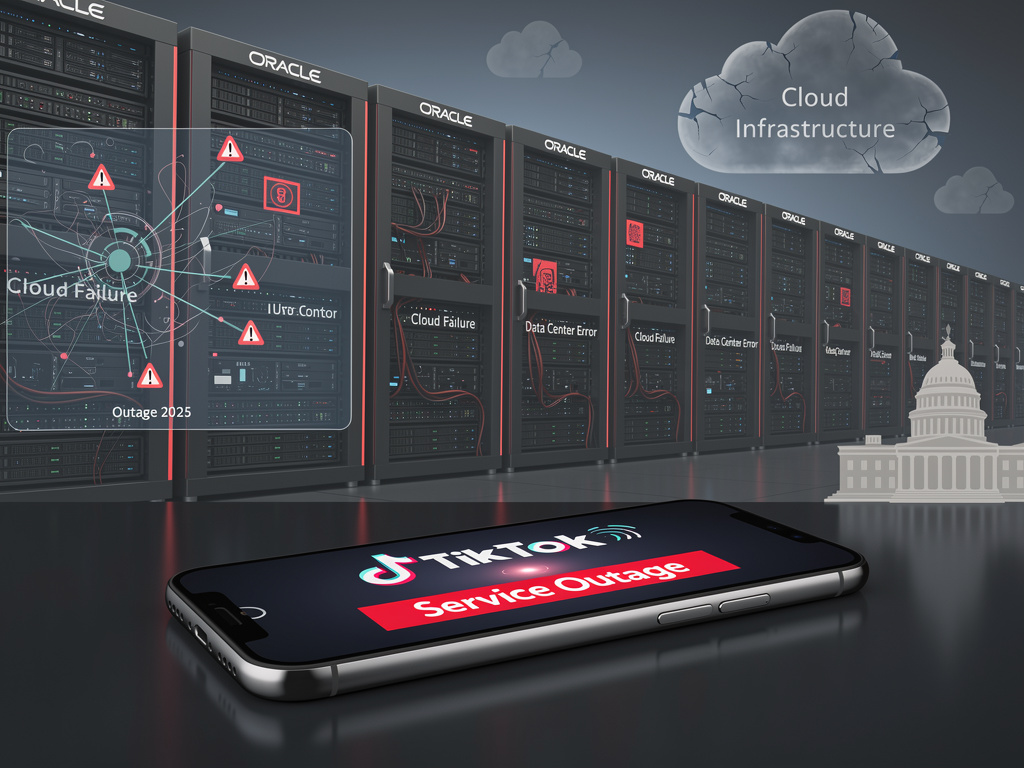
When TikTok went dark for millions of users on June 16, 2025, the immediate assumption among many was that the outage was tied to the app’s ongoing political and regulatory struggles in the United States. Instead, the culprit turned out to be far more mundane — and arguably more concerning for enterprise technology buyers: another failure at an Oracle data center.
The outage, which left users unable to load videos, access their feeds, or interact with the platform for several hours, was the second major TikTok disruption in recent months linked to Oracle’s cloud infrastructure. According to reporting by TechRadar, the incident was attributed to problems at an Oracle data center facility, echoing a similar failure that struck earlier in 2025. The pattern has prompted industry observers to ask pointed questions about Oracle’s ability to handle one of the world’s most demanding workloads.
A Relationship Born of Political Necessity
TikTok’s relationship with Oracle dates back to the first Trump administration, when national security concerns about the app’s Chinese parent company, ByteDance, led to a forced arrangement under which TikTok’s U.S. user data would be stored and processed on Oracle’s cloud infrastructure. The arrangement, known as “Project Texas,” was designed to address fears that the Chinese government could access data on American users. Oracle was selected as the trusted technology partner to host and audit TikTok’s operations on American soil.
The deal was a significant win for Oracle, which had been working aggressively to expand its cloud infrastructure business and compete with larger rivals Amazon Web Services, Microsoft Azure, and Google Cloud. Hosting TikTok — an application with more than 170 million U.S. users generating enormous volumes of video data — represented both a marquee client and a stress test of Oracle’s data center capabilities. As the recent outages suggest, that stress test has produced some troubling results.
What Happened on June 16
According to user reports aggregated on Downdetector and confirmed by multiple technology publications, TikTok became largely inaccessible starting in the late morning hours on June 16, 2025. Users reported seeing error messages, blank feeds, and failures to upload or view content. The disruption affected users across the United States and in several other markets.
TikTok did not immediately issue a detailed public statement on the root cause, but sources familiar with the matter told TechRadar that the outage was traced to an Oracle data center issue. Oracle, for its part, has not publicly commented in detail on the incident. The company’s public cloud status page showed intermittent issues during the same time window, though Oracle has historically been reticent about disclosing the specifics of outages affecting individual clients.
A Troubling Pattern Emerges
What makes the June 16 outage particularly notable is that it was not an isolated event. Earlier in 2025, TikTok experienced a similar disruption that was also linked to Oracle infrastructure problems. That earlier incident drew attention from both the technology press and from lawmakers who had championed the Oracle arrangement as a safeguard for national security. If Oracle cannot keep TikTok reliably online, critics argue, questions arise about whether the infrastructure partnership is fit for purpose.
The repeated failures also come at a sensitive time for TikTok’s operations in the United States. The app narrowly avoided a nationwide ban in early 2025 after the Supreme Court upheld a law requiring ByteDance to divest its ownership or face prohibition. A last-minute executive order from President Trump granted extensions to allow negotiations over a potential sale or restructuring. Throughout this period, the Oracle hosting arrangement has been presented as a key element of any plan to keep TikTok available to American users while addressing data security concerns.
Oracle’s Cloud Ambitions Under Scrutiny
Oracle has invested tens of billions of dollars in expanding its cloud infrastructure in recent years. Chairman Larry Ellison has repeatedly touted the company’s data center buildout, including plans for massive new facilities powered by next-generation hardware. Oracle reported strong cloud revenue growth in its most recent quarterly earnings, with cloud infrastructure revenue climbing significantly year-over-year. The company has positioned itself as a credible alternative to the hyperscale cloud providers, particularly for enterprise workloads that require high performance and data sovereignty controls.
Yet the TikTok outages threaten to undermine that narrative. Enterprise buyers evaluating cloud providers pay close attention to uptime guarantees and track records. Two high-profile outages affecting the same flagship client within a matter of months is the kind of pattern that can erode confidence, particularly among organizations considering migrating mission-critical applications to Oracle’s cloud. Industry analysts have noted that while all major cloud providers experience occasional outages, the concentration of failures around a single, highly visible workload raises specific concerns about capacity planning and redundancy at Oracle’s facilities.
The Broader Implications for Cloud Reliability
The TikTok-Oracle situation highlights a broader tension in the cloud computing industry. As more of the world’s digital activity migrates to a relatively small number of cloud providers, the consequences of infrastructure failures become increasingly severe. A single data center issue can cascade into outages affecting hundreds of millions of users, disrupting not just entertainment platforms but also business operations, communications, and financial services.
Amazon Web Services, Microsoft Azure, and Google Cloud have all experienced significant outages in recent years, some lasting hours and affecting major swaths of the internet. The difference, analysts say, is that those providers have built extensive redundancy across dozens of geographic regions and availability zones, allowing workloads to fail over automatically in many cases. Oracle’s cloud infrastructure, while growing rapidly, does not yet match the geographic breadth or redundancy depth of its larger competitors. For a workload as large and latency-sensitive as TikTok, that gap can become a single point of failure.
Political Dimensions Add Complexity
The outages also carry political weight. Members of Congress who supported the Oracle arrangement as a national security measure may face uncomfortable questions if the partnership proves unable to deliver reliable service. Senator Mark Warner of Virginia, who chairs the Senate Intelligence Committee, has been among the most vocal advocates for ensuring that TikTok’s U.S. data is handled by a trusted American company. Repeated infrastructure failures could give ammunition to those who argue that a full divestiture — rather than a hosting arrangement — is the only viable solution.
Meanwhile, ByteDance and TikTok face their own pressures. Every outage erodes user trust and drives engagement to competing platforms like Instagram Reels, YouTube Shorts, and Snapchat Spotlight. Content creators who depend on TikTok for their livelihoods are particularly sensitive to downtime, as even a few hours of inaccessibility can cost them significant revenue and audience reach. Some prominent creators have publicly expressed frustration over the recurring disruptions, with several noting on X (formerly Twitter) that the outages seem to be growing more frequent.
What Comes Next for the Partnership
Neither TikTok nor Oracle has indicated any plans to alter the fundamental structure of their hosting arrangement. TikTok has continued to migrate data and operations onto Oracle’s infrastructure as part of the Project Texas initiative, and Oracle has continued to build out capacity to support the workload. However, industry sources suggest that discussions about additional redundancy measures and failover capabilities have intensified in the wake of the recent outages.
Oracle’s next quarterly earnings call, expected in September 2025, will likely draw questions from analysts about the TikTok outages and the company’s broader cloud reliability metrics. Investors have rewarded Oracle’s stock in recent quarters based on the strength of its cloud growth story, but sustained reliability concerns could temper that enthusiasm. The company’s ability to demonstrate that it has addressed the root causes of the recent failures will be closely watched.
For TikTok’s hundreds of millions of users, the technical details of data center failures and cloud infrastructure contracts are largely invisible. What they see is an app that sometimes stops working — and in an era of fierce competition for attention, that may be the most consequential outcome of all. The question now is whether Oracle can deliver the kind of infrastructure performance that a platform of TikTok’s scale demands, or whether the recurring outages signal a deeper mismatch between ambition and execution.


 WebProNews is an iEntry Publication