
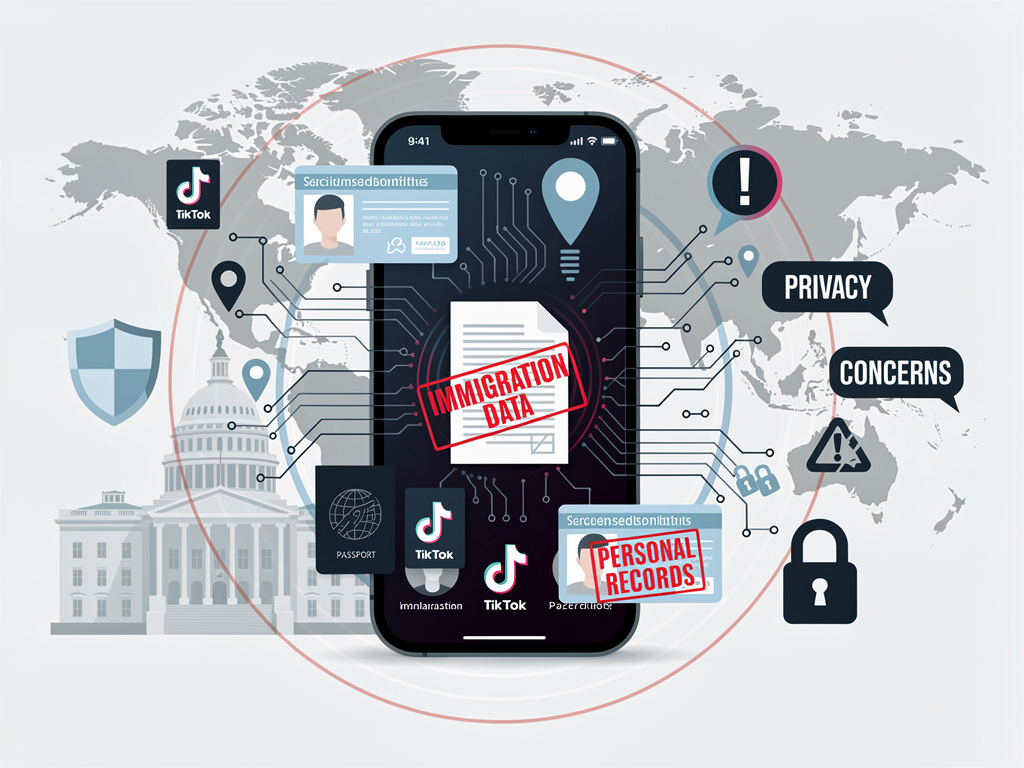
NEW YORK – TikTok, the social media behemoth owned by Beijing-based ByteDance, ignited a fresh firestorm this week after a quiet update to its privacy policy revealed it would begin collecting users’ immigration status. The change, which rolled out to users in the United States and European Union, has triggered widespread alarm among its billion-strong user base, drawn sharp condemnation from civil liberties advocates, and placed the company squarely back under the intense scrutiny of Western governments.
The policy shift, first detailed in a report by TechCrunch on Friday, January 23, 2026, was discovered after users began receiving notifications prompting them to update their demographic profiles with the new information. The prompt, which currently appears optional, asks users to select their status from a dropdown menu that includes categories such as “Citizen,” “Permanent Resident,” “Visa Holder,” and “Other.” The immediate backlash online was palpable, with hashtags like #TikTokPrivacy and #DeleteTikTok trending globally as users expressed confusion and fear over the purpose of such a sensitive data request.
A Vague Policy Sparks Widespread Alarm
In a statement, a TikTok spokesperson said the data collection is part of a broader effort to “comply with evolving global regulations and enhance advertising transparency.” The company claims the information will help it serve more relevant ads and content, particularly for services related to finance, education, and employment. However, the explanation has done little to quell the growing public anxiety. The policy’s language lacks specifics on how the data will be stored, who will have access to it, and how it will be protected from potential government requests, both domestic and foreign.
This ambiguity is at the heart of the criticism. Privacy advocates argue that amassing a database of users’ immigration status is a profoundly risky endeavor. “This is a chilling development. We are creating a honeypot of incredibly sensitive data that could be used to target and harm vulnerable communities,” said a senior attorney at the Electronic Frontier Foundation (EFF) in a post on X, the platform formerly known as Twitter. “The potential for misuse by law enforcement, immigration authorities, or malicious actors is staggering. TikTok’s justification is woefully inadequate for a request of this gravity.”
The Specter of Geopolitics and Data Security
The move inevitably reopens the long-standing debate over TikTok’s relationship with its Chinese parent company, ByteDance, and by extension, the Chinese government. For years, U.S. officials have warned that Beijing could compel ByteDance to hand over data on American users, a charge the company has consistently denied. The addition of immigration status to its data trove raises the stakes considerably, creating a potential national security risk that lawmakers in Washington are unlikely to ignore. The data could theoretically be used to identify foreign nationals, dissidents, or individuals with specific visa types, making them targets for foreign intelligence operations.
This development comes at a precarious time, just as some of the political heat on the company had begun to cool. Following the implementation of Project Texas—a multi-billion-dollar initiative to house U.S. user data on domestic servers managed by Oracle—TikTok had made some headway in convincing lawmakers of its commitment to American data security. This latest policy change threatens to undo that progress entirely. A senior aide on the Senate Intelligence Committee, speaking on the condition of anonymity, confirmed that staffers are already “actively reviewing the implications of this policy and preparing briefings for the senators.”
A Calculated Business Decision Amid Regulatory Pressure
Industry analysts suggest TikTok’s decision may be a calculated, albeit risky, response to a shifting regulatory environment. Some point to the fictional “Digital Ad Transparency Act” (DATA), a piece of legislation passed in late 2025 that requires large digital platforms to provide more granular demographic data for political and “social issue” advertising. While the law does not explicitly mandate the collection of immigration status, legal experts speculate that TikTok’s lawyers may be interpreting its requirements broadly to preempt future compliance issues.
From a commercial standpoint, the data is immensely valuable. Advertisers, from immigration attorneys and remittance services to brands targeting specific diaspora communities, would pay a premium for the ability to micro-target users based on their immigration status. “This is the holy grail for a certain class of advertiser,” noted a former ad executive at Meta. “You can eliminate waste and speak directly to a highly motivated consumer base. But the ethical line is not just being blurred here; it’s being bulldozed.” This positions TikTok to unlock new revenue streams, but at the cost of immense reputational and political risk.
The Human Element and Chilling Effects
Beyond the Beltway and Wall Street, the impact is being felt most acutely by the platform’s diverse user communities. For many immigrants, TikTok has been a vital tool for connection, sharing experiences, and finding support. Immigration lawyers and advocacy groups have used the platform to disseminate crucial information. This new data collection threatens to create a chilling effect, discouraging users from engaging on the platform for fear that their data could be used against them in immigration proceedings or expose them to discrimination.
On TikTok itself, creators are posting videos explaining the change and advising followers not to provide the information. One prominent immigration lawyer with over two million followers posted a stark warning: “Do not disclose your status to this app. There is no legal requirement for you to do so, and the potential risks far outweigh any perceived benefit.” The sentiment reflects a deep-seated distrust that a vague promise of “better ads” cannot overcome, especially when the data in question is tied so directly to a person’s security and right to reside in a country.
An Uncertain Path Forward
As the backlash intensifies, TikTok finds itself at a critical crossroads. The company must decide whether the commercial benefits of collecting this data are worth the inevitable political and user-driven fallout. Regulatory bodies in both the U.S. and E.U. are almost certain to launch formal investigations, and the threat of class-action lawsuits looms large. Competitors like Meta and Google are watching closely, likely relieved that their rival is once again the primary target of public and political anger over data privacy.
The coming weeks will be a crucial test of TikTok’s crisis management and its ability to navigate the complex intersection of technology, privacy, and international politics. The company’s next moves will determine whether this is a temporary stumble or a fundamental breach of trust that permanently alters its relationship with the users who fuel its cultural and financial success. For now, the question of whether to disclose one’s immigration status has transformed from a private matter into a public act of digital defiance on one of the world’s largest stages.


 WebProNews is an iEntry Publication