
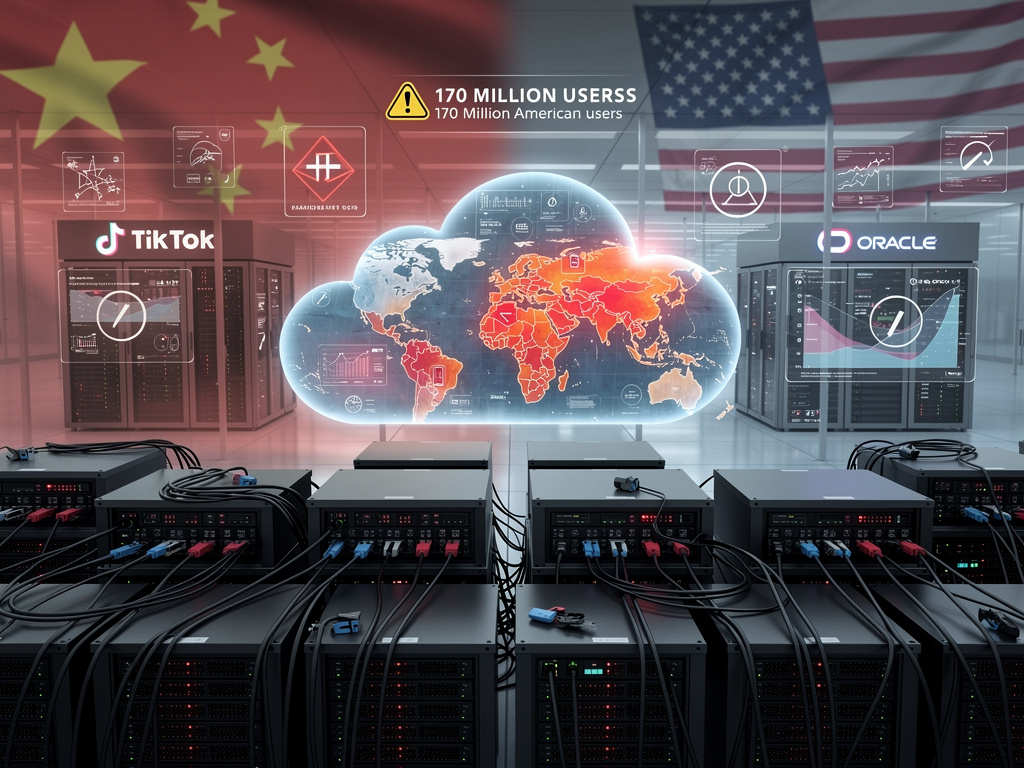
For the roughly 170 million Americans who open TikTok daily, the brief outage that struck the platform in late March 2026 was a minor inconvenience — a few hours of frozen feeds and failed uploads before the familiar scroll resumed. But for the engineers, executives, and policymakers entangled in TikTok’s fraught transition to American-controlled infrastructure, the disruption was something far more consequential: the first visible crack in one of the most complex and politically charged technology migrations ever attempted.
The outage, which occurred during TikTok’s ongoing migration of its U.S. operations to Oracle’s cloud infrastructure, temporarily knocked the app offline for millions of users. According to The Verge, the disruption was directly linked to the technical process of shifting TikTok’s data and services away from servers tied to its Chinese parent company, ByteDance, and onto Oracle’s domestic systems — a move mandated by a law signed by former President Biden in April 2024 and enforced under the current Trump administration.
A Migration Unlike Any Other in Tech History
The scale of what Oracle and TikTok are attempting cannot be overstated. TikTok is not simply moving a database from one server rack to another. The platform must replicate — and in many cases, rebuild from scratch — the algorithmic recommendation engine, content moderation systems, advertising infrastructure, and creator tools that make the app function. All of this must happen while the app continues to serve content to its enormous American user base without meaningful interruption, a feat one former Oracle engineer compared to “rebuilding a 747 in flight.”
Oracle won the contract to host TikTok’s U.S. data as part of what was originally called “Project Texas,” an initiative that dates back to 2022 when TikTok first began routing American user data through Oracle’s servers. But the scope of the project expanded dramatically after Congress passed the Protecting Americans from Foreign Adversary Controlled Applications Act in 2024, which gave ByteDance a hard deadline to divest TikTok’s U.S. operations or face a nationwide ban. The law, as The Verge reported, has pushed the migration from a data-hosting arrangement into a full operational separation — a far more technically demanding undertaking.
What Went Wrong During the March Outage
Details about the specific cause of the March 2026 outage remain limited. Neither Oracle nor TikTok has issued a comprehensive public post-mortem, though both companies acknowledged the disruption and attributed it to the migration process. According to reporting from The Verge, the outage affected core app functionality including video playback, content uploads, and the “For You” feed — the algorithmically curated stream that is the backbone of TikTok’s user experience.
Industry analysts say that the “For You” feed is precisely where migration risks are highest. TikTok’s recommendation algorithm, widely regarded as the most sophisticated of its kind in social media, relies on vast quantities of real-time behavioral data processed through machine learning models that were originally developed and trained in China. Replicating the performance of these models on Oracle’s infrastructure — while ensuring that no data flows back to ByteDance servers — is a technical challenge with no real precedent. The outage suggests that at least some portion of this transition is not going smoothly.
The Political Pressure Cooker Behind the Technical Work
The migration is unfolding against a backdrop of intense political pressure from multiple directions. The Trump administration, which initially sought to ban TikTok during Trump’s first term before reversing course, has taken a more transactional approach this time around. President Trump has publicly expressed interest in a deal structure that would give American investors a majority stake in TikTok’s U.S. operations, and he has granted multiple extensions to the divestiture deadline to allow negotiations to continue.
But patience in Washington is not unlimited. Lawmakers from both parties have expressed frustration with the pace of the transition. Senator Mark Warner of Virginia, who chairs the Senate Intelligence Committee, has repeatedly warned that every day TikTok operates without full separation from ByteDance represents a national security risk. On the other side, some Republican members have raised concerns that a heavy-handed approach could alienate the millions of young voters and small business owners who depend on the platform. The March outage added fuel to both arguments — proof, depending on one’s perspective, that the migration is either being rushed recklessly or not proceeding fast enough.
Oracle’s Enormous Bet and Its Reputational Exposure
For Oracle, the TikTok contract represents both a massive business opportunity and a significant reputational gamble. The Austin-based enterprise software giant, led by co-founder Larry Ellison, has staked considerable resources on becoming the trusted infrastructure provider for TikTok’s American operations. Ellison, who has a personal relationship with Trump, has been a visible advocate for the deal structure that keeps TikTok operational in the U.S. under Oracle’s technical oversight.
Oracle’s cloud business, while growing, still trails far behind Amazon Web Services, Microsoft Azure, and Google Cloud in market share. Landing TikTok as a flagship client was supposed to be a statement of capability — proof that Oracle could handle consumer-scale workloads at the highest level. The March outage complicates that narrative. While a single disruption during a migration of this complexity is hardly unusual, the intense public scrutiny surrounding TikTok means that Oracle’s technical stumbles will receive attention that a comparable incident at AWS or Azure might not. Investors have taken notice; Oracle shares dipped modestly in the trading sessions following reports of the outage, though the stock has since recovered.
The Creator Economy Hangs in the Balance
Beyond the geopolitics and cloud computing contracts, the migration has real consequences for the millions of creators and businesses that have built livelihoods on TikTok. The platform has become a primary income source for a generation of content creators, and it drives significant commerce through its TikTok Shop feature and its influence on consumer purchasing decisions. Even a brief outage can cost creators thousands of dollars in lost views, missed brand deals, and disrupted livestream commerce sessions.
Creator advocacy groups have called on both TikTok and Oracle to provide more transparency about the migration timeline and to establish compensation mechanisms for creators who lose revenue due to migration-related disruptions. So far, TikTok has offered only vague assurances that it is working to minimize service interruptions. The company’s U.S. communications team issued a statement following the March outage calling it “a temporary issue related to our ongoing infrastructure improvements” and promising that “the vast majority of users experienced no lasting impact.”
What Happens If the Migration Fails — or Succeeds
The stakes of this migration extend well beyond TikTok itself. If Oracle and TikTok can successfully complete the separation — fully isolating American user data, replicating the recommendation algorithm’s performance on domestic infrastructure, and satisfying regulators that no meaningful connection to ByteDance remains — it would establish a template for how democracies can address national security concerns about foreign-owned technology platforms without resorting to outright bans. It would also validate the idea that a forced divestiture of a major technology platform is technically and commercially feasible.
If the migration fails, or if repeated outages and performance degradation drive users to competitors like Instagram Reels and YouTube Shorts, the consequences could be severe. ByteDance could argue that the U.S. government effectively destroyed a functioning business through unreasonable technical demands. American creators and small businesses would lose a vital platform. And the precedent set would be a cautionary one — suggesting that forced technology decouplings between rival nations may be more disruptive than policymakers appreciate.
A Test Case With Global Implications
Other countries are watching closely. The European Union, India (which banned TikTok in 2020), and several Southeast Asian nations are all grappling with similar questions about how to regulate foreign-owned platforms that hold sensitive data on their citizens. The American approach — forced divestiture with a domestic cloud provider serving as a technical guarantor — is one model. Whether it works depends in large part on whether Oracle can execute the migration without further significant disruptions.
For now, TikTok continues to function in the United States, and most users remain blissfully unaware of the extraordinary technical and political machinery operating behind their feeds. But the March 2026 outage served as a reminder that the app’s future in America is far from settled. The next few months of the migration will determine whether TikTok’s American chapter is a story of successful adaptation or a cautionary tale about the limits of trying to separate technology from the geopolitical forces that created it.


 WebProNews is an iEntry Publication