
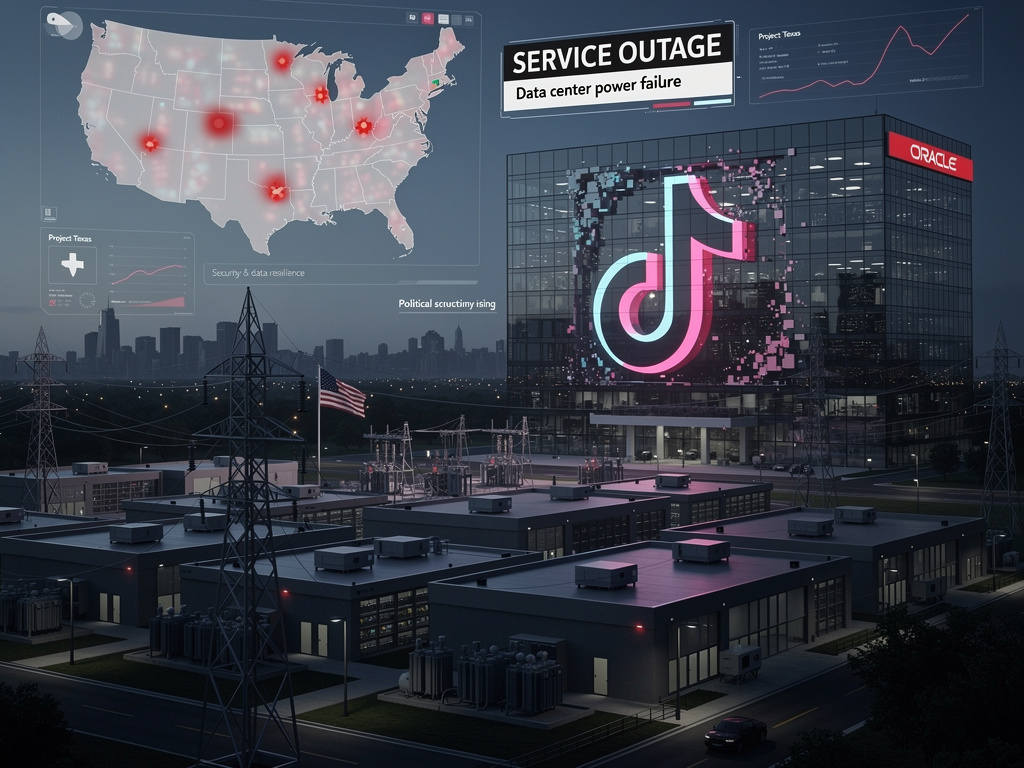
NEW YORK – For millions of American users, TikTok simply vanished. On a quiet Monday evening, the endless scroll of videos on the massively popular social media app sputtered to a halt. Feeds refused to refresh, new videos wouldn’t upload, and the platform’s powerful recommendation engine went dark. The ensuing digital silence sparked a familiar frenzy on rival platforms, with the hashtag #TikTokDown quickly trending as users and creators speculated on everything from a cyberattack to a government-ordered shutdown.
The official explanation, when it came, was decidedly more mundane, yet potentially more troubling. In a statement provided to TechCrunch, a TikTok spokesperson attributed the widespread service disruption to “a power outage at a U.S. data center.” While the company worked to restore service, the brief statement inadvertently illuminated a far greater concern: the potential fragility of Project Texas, the intricate and costly arrangement designed to insulate TikTok’s U.S. operations and quell national security fears in Washington.
The Fortress of Project Texas Shows Its Cracks
Project Texas is TikTok’s billion-dollar answer to American regulators. The ambitious initiative involves walling off U.S. user data within the country, hosting it on servers managed by American tech giant Oracle Corp., and allowing Oracle to audit the platform’s algorithms and moderation policies. The goal, as Reuters has reported, is to create a firewall that prevents any sensitive American data from being accessed by its Chinese parent company, ByteDance. This outage, however, raises pointed questions about the operational resilience of this digital fortress.
For a service of TikTok’s scale, a single power outage at one facility should not trigger a catastrophic, nationwide failure. Modern cloud architecture, particularly for a hyperscale client, is built on layers of redundancy. Data centers operated by major players like Oracle are typically designed to withstand municipal power grid failures, equipped with vast arrays of uninterruptible power supplies (UPS) and massive on-site diesel generators that can power the facility for days. The incident suggests a potential single point of failure in either TikTok’s deployment within Oracle’s cloud or a more severe, cascading failure within the data center itself that overwhelmed its backup systems.
A Technical Failure with Geopolitical Consequences
Industry experts contend that a simple grid failure is an insufficient explanation. “Saying a ‘power outage’ caused this is like saying a ‘flat tire’ caused a 50-car pileup. It’s the beginning of the story, not the end,” said one cloud infrastructure consultant, who spoke on condition of anonymity. The failure could point to a breakdown in power distribution units inside the facility, a cooling system collapse that triggered an automatic shutdown to prevent servers from overheating—similar to a 2023 incident at a Google Cloud facility in France, as detailed by Data Center Dynamics—or a flaw in how TikTok’s application is architected across different availability zones.
This technical vulnerability immediately becomes a political one. The entire premise of Project Texas is to build trust with U.S. lawmakers who remain deeply skeptical of the platform’s ties to China. Critics in Congress, who have long called for an outright ban, will likely seize upon this operational stumble as proof that the complex arrangement with Oracle is not the foolproof solution TikTok claims it to be. If the company cannot guarantee basic uptime and operational stability, it fuels arguments that it also cannot guarantee the security and integrity of the data it has sworn to protect.
The High Cost of Digital Silence
The financial ramifications of the downtime are significant. For a platform that is a key marketing channel for countless brands and the primary source of income for a generation of creators, hours of inactivity translate into millions in lost advertising revenue and broken trust with commercial partners. The cost of IT downtime has been well-documented, with a 2021 study from the Information Technology Intelligence Consulting group, cited by TechChannel, finding that for 91% of enterprises, a single hour of server downtime costs more than $300,000.
For a platform of TikTok’s scale, that figure is likely orders of magnitude higher. Beyond the direct monetary loss, the outage damages user confidence. Social media is a fiercely competitive market, and while TikTok’s user base is famously loyal, prolonged instability can drive users and, more importantly, high-value creators to more reliable platforms like YouTube Shorts or Instagram Reels. This incident serves as a stark reminder that in the digital economy, reliability is a core feature, not just a technical specification.
Oracle’s Reputation on the Line
The blackout also puts an uncomfortable spotlight on Oracle. The database titan has been aggressively trying to build its cloud infrastructure business, known as OCI, to compete with market leaders Amazon Web Services, Microsoft Azure, and Google Cloud. Landing the TikTok account was seen as a monumental win, a validation of OCI’s capabilities on a global scale. As CNBC noted when the deal was solidified, it instantly made Oracle a more significant player in the cloud market.
Now, however, having its most high-profile client suffer a nationwide outage attributed to a failure in its infrastructure is a significant reputational blow. While the full details of the failure remain undisclosed, the event provides ammunition to rivals who can question the resilience and maturity of Oracle’s cloud offerings. The company, which has remained silent since TikTok’s statement, will face immense pressure from its enterprise customers to provide a transparent post-mortem on what went wrong and what steps are being taken to prevent a recurrence.
A Stress Test for a Global Giant
This outage is more than a fleeting technical glitch. It represents a critical stress test of TikTok’s entire strategy to survive and thrive in its most valuable market. The incident has exposed a potential weakness in its operational backbone at the worst possible time, as the company continues to navigate a fraught political environment. The company’s response in the coming days will be crucial.
A full, transparent accounting of the failure is necessary to begin rebuilding trust not just with users and advertisers, but with the regulators in Washington who hold the company’s future in their hands. The power may be back on, but for TikTok, the challenge of proving that its American fortress is truly secure and resilient has only just begun. The digital silence of Monday night may echo for months to come in boardrooms and the halls of Congress.


 WebProNews is an iEntry Publication