
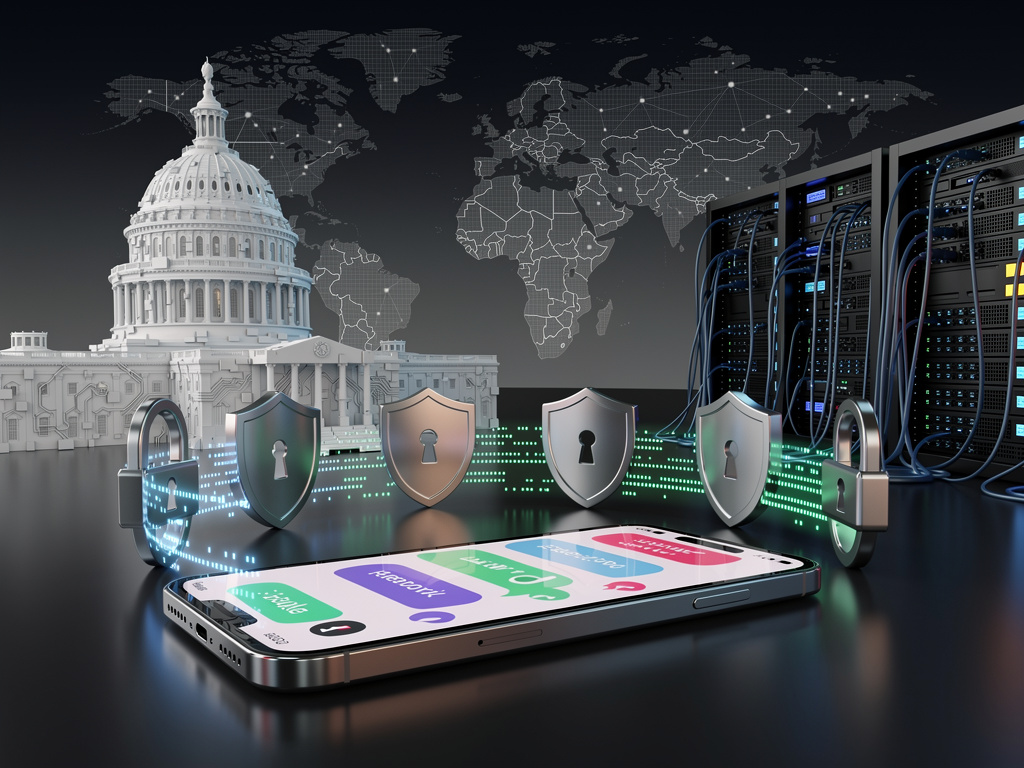
TikTok has begun rolling out end-to-end encryption for its direct messaging feature, a move that brings the short-video giant closer to the privacy standards set by competitors like WhatsApp and Signal. But for a platform that has spent the last two years fending off national security concerns, potential bans, and forced divestitures, the timing of this privacy upgrade is generating as much skepticism as praise.
According to Mashable, TikTok has started enabling end-to-end encryption (E2EE) for direct messages, meaning that only the sender and recipient of a message can read its contents. Not even TikTok itself — or its Beijing-based parent company ByteDance — would be able to access the encrypted communications. The feature is reportedly being rolled out gradually, with some users already seeing the encryption option appear in their messaging settings.
What End-to-End Encryption Actually Means for TikTok Users
End-to-end encryption is a security protocol that scrambles messages so that only the devices involved in a conversation hold the keys to decode them. When properly implemented, E2EE prevents intermediaries — including the platform operator, internet service providers, and government agencies — from reading message content. The technology has become an industry standard for messaging apps. WhatsApp enabled it by default for all messages in 2016. Apple’s iMessage has used it for years. Signal, widely regarded as the gold standard for secure communication, was built entirely around the concept.
TikTok’s direct messaging feature, by contrast, has historically been one of the less developed aspects of the platform. For years, TikTok DMs were relatively basic compared to the messaging infrastructure of Meta’s apps or even Snapchat. The addition of E2EE represents a significant technical investment and signals that TikTok is serious about positioning its messaging capabilities as a competitive feature rather than an afterthought.
A Strategic Shield Against Political Pressure
The broader context here is impossible to ignore. TikTok has been under relentless scrutiny from U.S. lawmakers, European regulators, and intelligence officials who have raised concerns about the potential for the Chinese government to access user data through ByteDance. In April 2024, President Biden signed legislation that would force ByteDance to divest TikTok or face a ban in the United States. The law gave ByteDance roughly nine months to find a buyer, and the legal battle over the measure has been winding through the courts.
Against that backdrop, the introduction of end-to-end encrypted messaging looks like more than just a product update. It functions as a technical argument: if TikTok cannot itself read the messages sent on its platform, then neither can ByteDance, and by extension, neither can any foreign government that might compel ByteDance to hand over data. Privacy advocates have long argued that strong encryption is one of the most effective tools for protecting user communications, regardless of who owns the platform. TikTok appears to be adopting that logic as both a user feature and a political defense.
Skeptics Question Whether Encryption Alone Addresses Core Concerns
Not everyone is convinced that encrypted DMs resolve the fundamental issues at the heart of the TikTok debate. The national security concerns raised by U.S. officials have never been limited to direct messages. The far larger trove of data that TikTok collects includes browsing behavior, location information, device identifiers, biometric data extracted from videos, and the algorithmic profile that determines what each user sees on their For You page. None of that data is affected by message encryption.
Senator Mark Warner of Virginia, who chairs the Senate Intelligence Committee, has repeatedly emphasized that the concern is about the totality of data collection, not any single feature. Encrypting DMs, in this view, addresses a narrow slice of the privacy picture while leaving the most valuable and sensitive categories of data untouched. Critics have also noted that the effectiveness of any encryption system depends entirely on its implementation. Without independent audits of TikTok’s encryption protocol — the specific algorithms used, how keys are generated and stored, and whether there are any backdoors — it is difficult to verify the company’s claims.
The Technical Details Still Emerging
As reported by Mashable, the specifics of TikTok’s encryption implementation remain somewhat opaque. The company has not yet published a detailed technical whitepaper outlining its encryption protocol, which is the standard practice among companies that want to earn the trust of the security community. WhatsApp, for example, published extensive documentation about its Signal Protocol implementation. Signal itself is open source, allowing anyone to inspect its code.
TikTok’s decision to keep the technical details under wraps — at least for now — has drawn criticism from cryptography experts who argue that encryption claims are meaningless without transparency. The security community operates on a principle often attributed to Auguste Kerckhoffs: a cryptographic system should be secure even if everything about the system, except the key, is public knowledge. Companies that refuse to open their encryption to scrutiny often face suspicion that the system may contain weaknesses, whether intentional or accidental.
How TikTok’s Move Compares to Industry Peers
TikTok’s adoption of E2EE for DMs puts it in line with a broader industry trend, though it arrives later than most of its competitors. Meta completed the rollout of default end-to-end encryption for Messenger in December 2023, a project that had been in development for years. Google Messages began rolling out E2EE for group chats in 2024. Even X, formerly Twitter, explored encrypted DMs under Elon Musk’s ownership, though the implementation has been limited to verified subscribers and has received mixed reviews from security researchers.
The competitive pressure to offer encrypted messaging has been building for years. Users, particularly younger demographics that make up TikTok’s core audience, have become increasingly aware of digital privacy issues. High-profile data breaches, government surveillance revelations, and a growing cultural conversation around data rights have made encryption a feature that users actively seek out. For TikTok, failing to offer encrypted messaging would have been a conspicuous gap in its feature set — one that competitors could exploit in marketing and that critics could point to as evidence of inadequate privacy protections.
Regulatory Implications on Both Sides of the Atlantic
The introduction of encrypted DMs also carries regulatory implications that extend well beyond the U.S.-China tensions. In Europe, TikTok is subject to the Digital Services Act and the General Data Protection Regulation, both of which impose strict requirements on how platforms handle user data. The European Commission opened formal proceedings against TikTok in 2024 over concerns about child safety, addictive design features, and data processing practices. Encrypted messaging could help TikTok demonstrate compliance with certain GDPR principles around data minimization — the idea that companies should collect and retain only the data strictly necessary for a given purpose.
However, encryption also puts TikTok on a potential collision course with law enforcement agencies that have been lobbying against strong encryption for years. In the United Kingdom, the Online Safety Act gives the communications regulator Ofcom the power to require platforms to use “accredited technology” to scan for child sexual abuse material, even in encrypted messages. Apple famously abandoned a similar client-side scanning proposal in 2022 after backlash from privacy advocates. If TikTok’s encryption is strong enough to prevent the company from reading messages, it may face pressure from governments demanding access for law enforcement purposes — the same governments that are simultaneously demanding TikTok do more to protect user data from foreign access.
The Paradox at the Heart of TikTok’s Privacy Push
This tension highlights a fundamental paradox in the TikTok encryption story. The company is deploying a technology designed to prevent anyone — including itself — from reading user messages, while simultaneously operating under a legal framework in the United States that is premised on the assumption that ByteDance cannot be trusted with American user data. If the encryption works as advertised, it should render the ownership question moot for DM content specifically. But the ownership question was never really about DMs. It was about the algorithm, the data pipeline, and the potential for a foreign government to influence what 170 million Americans see on their screens every day.
TikTok’s encryption move is, in many ways, an answer to a question that regulators are not asking. The company is demonstrating technical competence in privacy protection at a moment when the political debate has moved far beyond technical solutions. The forced divestiture legislation does not include a carve-out for platforms with strong encryption. The national security establishment’s concerns are not assuaged by the knowledge that DMs are unreadable if the broader data collection apparatus remains intact.
What Comes Next for TikTok’s Messaging Ambitions
Still, the encryption rollout signals something important about TikTok’s long-term ambitions. ByteDance has long sought to replicate the “super app” model popularized by WeChat in China, where a single platform handles messaging, payments, shopping, and social media. TikTok’s messaging feature has historically been too rudimentary to support that vision. The addition of encryption suggests that TikTok is investing seriously in building out its messaging infrastructure, potentially as a foundation for more ambitious features down the road.
For now, TikTok users who see the encryption option in their settings can enable it knowing that their DMs will have a level of protection comparable to what WhatsApp and Signal offer — assuming TikTok’s implementation holds up to eventual scrutiny. But the larger questions about data sovereignty, algorithmic influence, and the geopolitics of technology platforms remain exactly where they were before the encryption announcement. TikTok has added a lock to one door in a building where regulators are concerned about the entire architecture.


 WebProNews is an iEntry Publication