
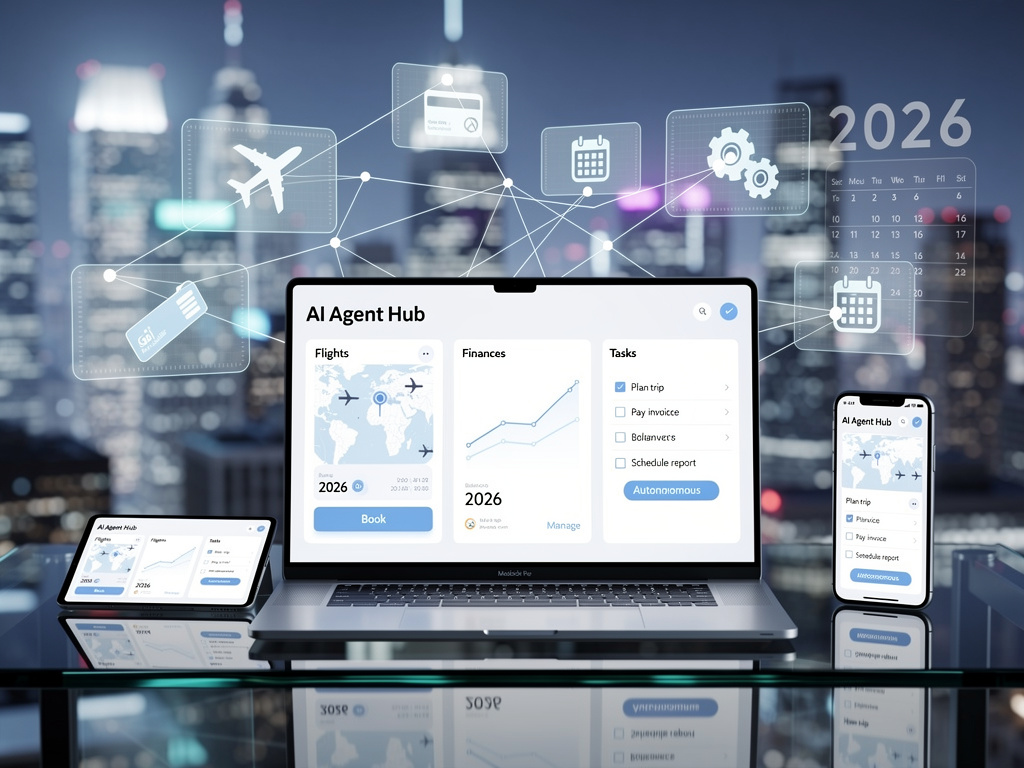
For years, artificial intelligence has been something you talk to — a chatbot that answers questions, drafts emails, or generates images on command. But a fundamental shift is underway. By 2026, the technology industry is betting heavily that AI will become something that acts on your behalf: booking flights, managing finances, negotiating with customer service, and executing multi-step tasks across the internet with minimal human oversight. These are AI agents, and they represent the next major frontier in how consumers and businesses interact with software.
The concept is not entirely new. Software automation has existed in various forms for decades. But what distinguishes the current generation of AI agents is their ability to reason through complex, open-ended tasks, adapt to unexpected obstacles, and interact with websites and applications the way a human would — clicking buttons, filling out forms, and making decisions along the way. According to Mashable, the major technology companies — Google, OpenAI, Microsoft, Apple, and Meta — are all racing to bring agentic AI products to market, with 2025 and 2026 shaping up as the pivotal deployment window.
From Chatbots to Autonomous Workers: What Makes AI Agents Different
The distinction between a chatbot and an AI agent comes down to autonomy and action. A chatbot responds to prompts. An agent, by contrast, can be given a goal — say, “find me the cheapest round-trip flight to Tokyo in March and book it” — and then independently perform the research, compare options, enter payment information, and confirm the reservation. The agent doesn’t just suggest; it executes. This is a qualitative leap from the large language models that powered the first wave of consumer AI products like ChatGPT and Google’s Gemini.
As Mashable reported, OpenAI has been particularly aggressive in this space. The company’s “Operator” tool, introduced in early 2025, is designed to perform web-based tasks autonomously. Google, meanwhile, has integrated agentic features into its Gemini assistant, with capabilities that extend into Gmail, Google Calendar, and other Workspace products. Apple’s Siri is also being rebuilt with agentic capabilities, though the company’s rollout has been more cautious and incremental. Microsoft has woven agent functionality into its Copilot product line, targeting enterprise customers who want AI to handle routine business processes like expense reporting, data entry, and scheduling.
The Enterprise Opportunity: Where the Real Money Is
While consumer-facing agents grab headlines, the enterprise market is where the financial stakes are highest. Companies like Salesforce, ServiceNow, and SAP have all announced or expanded AI agent offerings aimed at automating customer service, IT support, sales operations, and supply chain management. Salesforce’s Agentforce platform, for instance, allows businesses to deploy AI agents that can handle customer inquiries, process returns, and escalate complex issues to human representatives — all without custom coding.
The financial incentive is straightforward: if an AI agent can handle tasks that previously required a human employee, the cost savings are enormous. McKinsey has estimated that generative AI and agentic systems could automate activities that absorb 60 to 70 percent of employees’ time today. That doesn’t necessarily mean mass layoffs — proponents argue it means redeploying human workers to higher-value tasks — but it does mean that companies that fail to adopt these tools risk falling behind competitors that do. The pressure to integrate AI agents into business workflows is intensifying across virtually every sector, from banking and insurance to healthcare and logistics.
The Trust Problem: Can You Really Let AI Spend Your Money?
For all the enthusiasm, there are significant barriers to widespread adoption, and the most fundamental is trust. Giving an AI agent permission to book a flight is one thing. Giving it access to your bank account, your medical records, or your corporate procurement system is quite another. The risk of errors — an agent booking the wrong flight, sending money to the wrong account, or misinterpreting a medical instruction — is not hypothetical. Early versions of these tools have already demonstrated a tendency to “hallucinate” or make confident mistakes.
Mashable noted that most current AI agent systems include “human-in-the-loop” safeguards, requiring user confirmation before completing high-stakes actions like financial transactions. But the entire value proposition of an agent is that it reduces the need for human involvement. If you have to approve every step, the efficiency gains diminish rapidly. Striking the right balance between autonomy and oversight is one of the central design challenges facing every company in this space.
Security Risks and the Attack Surface Problem
Beyond simple errors, AI agents introduce new and potentially severe security vulnerabilities. An agent that can browse the web, interact with third-party services, and execute transactions is, by definition, an expanded attack surface. Researchers have already demonstrated “prompt injection” attacks, in which malicious instructions hidden in web pages or emails can hijack an AI agent’s behavior, causing it to leak sensitive data or perform unauthorized actions.
The cybersecurity implications are sobering. If an AI agent has access to a company’s internal systems and can be manipulated through a carefully crafted email, the potential for data breaches and financial fraud is substantial. Security firms including CrowdStrike and Palo Alto Networks have begun publishing research on agentic AI threats, and the topic is expected to dominate cybersecurity conferences throughout 2025 and 2026. Building agents that are both capable and secure will require new approaches to authentication, sandboxing, and real-time monitoring that the industry is still developing.
The Platform War: Who Controls the Agent Layer?
There is also a massive competitive dimension to the rise of AI agents. Whoever controls the primary agent interface — the tool through which consumers and businesses interact with the digital world — stands to capture an extraordinary amount of economic value. This is why Google, Apple, Microsoft, and OpenAI are all investing billions. The agent layer could become the new operating system, the new browser, or the new search engine: the default gateway through which all digital activity flows.
Google has a natural advantage because of its dominance in search, email, and mobile operating systems. If Gemini becomes the default agent on Android devices, it would have immediate access to billions of users. Apple’s advantage lies in its tight hardware-software integration and its reputation for privacy, which could make users more comfortable granting an AI agent deep access to their personal data. OpenAI, despite lacking a hardware platform, has built the strongest brand in consumer AI and is aggressively partnering with device manufacturers and app developers. Microsoft’s strength is in the enterprise, where its Office 365 and Azure platforms give Copilot a built-in distribution channel.
What Happens to the Web When Agents Do the Browsing?
One of the less-discussed but potentially most disruptive consequences of AI agents is their impact on the open web. If agents increasingly perform tasks on behalf of users — searching for products, reading reviews, comparing prices — then human traffic to websites could decline significantly. This has profound implications for the advertising-supported internet. A website that never receives a human visitor generates no ad revenue, regardless of how often an AI agent scrapes its content.
Publishers, retailers, and service providers are already grappling with this issue as AI-generated search summaries reduce click-through rates from Google. The rise of agents could accelerate this trend dramatically. Some companies may respond by building agent-friendly APIs and partnerships, essentially paying for placement in an AI agent’s recommendation set. Others may try to block agent access entirely. The economic model of the internet could look very different in a world where machines, not humans, are the primary consumers of online content.
The Road Ahead: Incremental Progress, Not Overnight Transformation
Despite the hype, the transition to an agent-driven world will likely be gradual rather than sudden. Current AI agents are impressive in controlled demonstrations but often struggle with the messy complexity of real-world tasks. Websites change their layouts. CAPTCHAs block automated access. Multi-step processes involve ambiguity that even the best language models cannot always resolve. The technology will improve — and improve rapidly — but the gap between a polished demo and a reliable, production-grade agent remains significant.
Industry analysts expect 2026 to be the year when AI agents move from novelty to genuine utility for a meaningful number of users and businesses. But “meaningful” does not mean “universal.” Adoption will be uneven, with tech-savvy early adopters and large enterprises leading the way, while smaller businesses and less digitally engaged consumers lag behind. Regulatory frameworks are also still catching up; questions about liability when an AI agent makes a costly mistake, data privacy when agents access personal information, and antitrust when platform companies favor their own agents over competitors’ are all unresolved.
What is clear is that the ambition is enormous. The companies building AI agents are not trying to create better chatbots. They are trying to build digital workers — software entities that can perform an expanding range of tasks with increasing independence. Whether that vision is realized in 2026, 2028, or later, the direction of travel is unmistakable. The machines are no longer just answering questions. They are starting to run errands.


 WebProNews is an iEntry Publication