
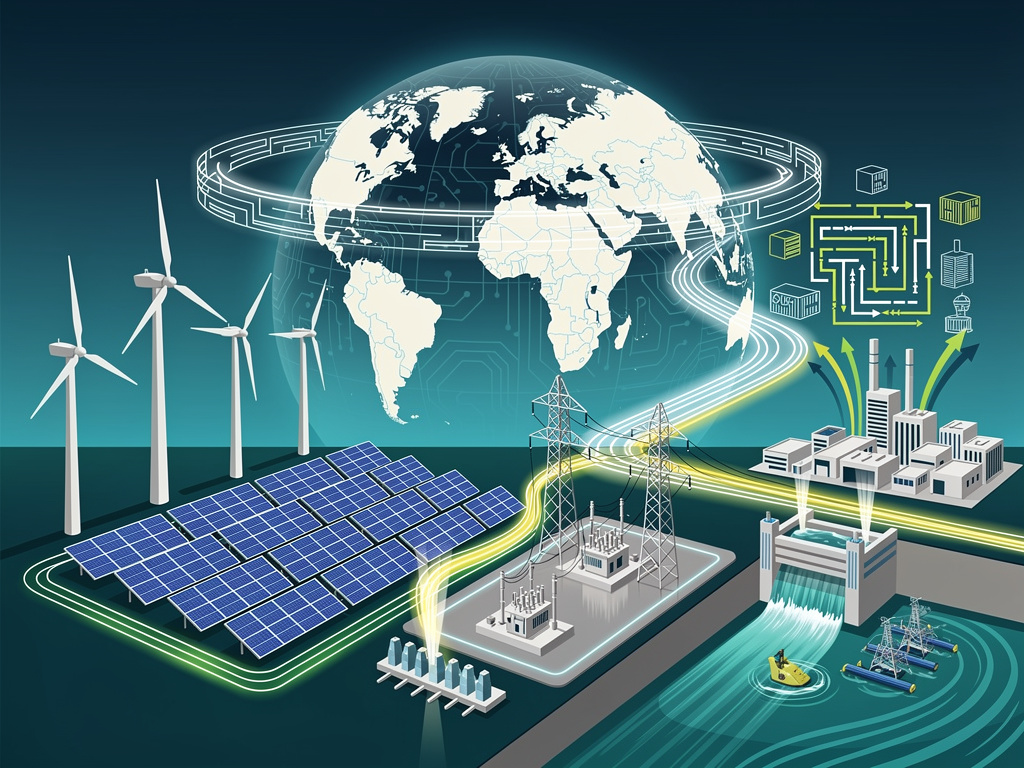
For the first time in human history, renewable energy sources generated roughly 40% of the world’s electricity in 2024. That single number tells a story decades in the making — one of declining costs, shifting policy, and an industrial transformation that is now, by most measures, irreversible.
The milestone was reported by the International Energy Agency in its latest annual assessment, and the data has landed with force across energy markets and policy circles. According to The Register, which covered the IEA’s findings, renewables generated nearly half the planet’s power last year, with solar and wind carrying the bulk of new capacity additions. The IEA’s “Renewables 2024” report confirmed that solar photovoltaic alone accounted for the largest single share of new electricity generation capacity added globally — more than all other sources combined.
That’s not a forecast. That’s what already happened.
The numbers are stark. Global renewable electricity capacity surged past 4,200 gigawatts in 2024, driven overwhelmingly by China, which installed more solar panels in a single year than the United States has in its entire history. But this isn’t just a China story. India, Brazil, the European Union, and parts of Africa all posted record or near-record renewable installations. The IEA noted that every region of the world added more renewable capacity in 2024 than in 2023, marking the first time that’s happened across the board.
Solar’s dominance is now almost difficult to overstate. The technology has followed a cost curve that has stunned even its most ardent supporters. A decade ago, utility-scale solar cost roughly $350 per megawatt-hour in many markets. Today it regularly comes in under $30. In some auction results in the Middle East and South America, prices have dropped below $15 per MWh — cheaper than running an already-built natural gas plant in many jurisdictions. Wind energy has followed a similar, if less dramatic, trajectory, with offshore wind costs falling by roughly 70% over the past decade.
And yet the picture isn’t simply one of triumphalism. The same IEA data that celebrates renewable growth also underlines a hard reality: fossil fuels still generated the majority of the world’s electricity. Coal, natural gas, and oil collectively accounted for about 60% of global power production in 2024. Coal alone remained the single largest source of electricity worldwide, a fact that sits uncomfortably alongside the renewable records. The transition is real, but it is incomplete.
Grid integration remains the central engineering challenge. As variable renewable sources like solar and wind grow to dominate generation mixes in certain hours of the day, grid operators face mounting complexity. California’s now-famous “duck curve” — where net demand plunges midday as solar floods the grid, then spikes in the evening as the sun sets — has become a global phenomenon. Germany, Australia, Spain, and Chile have all experienced moments of negative wholesale electricity prices, where generators effectively pay the grid to take their power. These aren’t signs of failure, exactly. But they are symptoms of systems that weren’t designed for what’s now being asked of them.
Battery storage is scaling fast to address these imbalances. Global battery storage deployments more than doubled in 2024 compared to 2023, with China again leading installations. The cost of lithium-ion battery packs has fallen below $100 per kilowatt-hour for the first time at the cell level, a threshold long considered critical for making storage economically viable at grid scale. Tesla, BYD, CATL, and a host of smaller companies are racing to deploy storage at volumes that would have seemed fantastical five years ago.
Still, storage alone won’t solve everything. Long-duration storage — the ability to store energy not for four hours but for days or weeks — remains expensive and technologically immature. Pumped hydro, compressed air, iron-air batteries, and hydrogen-based storage are all being explored, but none has achieved the kind of cost declines that lithium-ion has enjoyed. This matters enormously for grids trying to eliminate the last 20-30% of fossil generation, where the hardest hours to decarbonize are long winter evenings with no wind.
The policy environment has shifted in ways that would have been unrecognizable a decade ago. The U.S. Inflation Reduction Act, passed in 2022, has channeled hundreds of billions of dollars in tax credits toward clean energy manufacturing and deployment. The European Union’s Green Deal Industrial Plan and REPowerEU initiative have similarly accelerated investment. China’s state-directed industrial policy has turned the country into the world’s factory for solar panels, batteries, and electric vehicles — a dominance that is itself becoming a source of geopolitical tension.
That tension is real and growing. The U.S. and EU have both imposed or proposed tariffs on Chinese clean energy products, arguing that state subsidies create unfair competition. China produces roughly 80% of the world’s solar panels and an even higher share of the polysilicon and wafers that go into them. This concentration of supply has alarmed policymakers in Washington and Brussels, who see parallels to Europe’s dependence on Russian natural gas — a vulnerability painfully exposed by Russia’s invasion of Ukraine. The result is a strange paradox: the fastest way to deploy renewables globally is to buy cheap Chinese equipment, but the geopolitical imperative is to diversify supply chains, which raises costs and slows deployment.
The investment numbers reflect this acceleration despite the tensions. According to the IEA, global investment in clean energy reached approximately $2 trillion in 2024, exceeding investment in fossil fuels for the first time by a significant margin. Solar alone attracted more investment than upstream oil and gas exploration. For institutional investors, pension funds, and sovereign wealth funds, the signal is increasingly clear: the risk-adjusted returns on renewable energy infrastructure are competitive with, and in many cases superior to, traditional energy investments.
Not everyone is convinced the pace can hold. Critics point to permitting bottlenecks, transmission grid constraints, and raw material supply chains as potential choke points. Building a new high-voltage transmission line in the United States takes an average of 10 to 12 years from proposal to energization. In Germany, the delay between approving an onshore wind farm and connecting it to the grid can stretch to seven years. These aren’t trivial obstacles. They are structural, and they require political will to resolve — the kind of will that tends to evaporate when electricity prices are low and the urgency feels abstract.
Mining is another pressure point. The energy transition requires vast quantities of copper, lithium, cobalt, nickel, and rare earth elements. The IEA has warned repeatedly that current mining and refining capacity is insufficient to meet projected demand under most net-zero scenarios. Lithium prices, which spiked dramatically in 2022, have since crashed due to oversupply — but the underlying demand trajectory points upward over the next two decades. Copper, essential for wiring in everything from solar farms to EVs, faces a projected supply deficit that could become acute by the late 2020s.
So where does this leave the global power system? At a tipping point, but not the kind that resolves neatly. The direction is unmistakable: renewables are growing faster than any energy source in history, costs continue to fall, and policy support is broad if uneven. But the system still depends heavily on fossil fuels for reliability, and the infrastructure needed to fully integrate variable renewables — transmission, storage, demand flexibility — lags behind the generation build-out.
Nuclear power, often sidelined in the renewables conversation, is experiencing a quiet resurgence. Several countries, including the U.K., France, and the U.S., have announced new reactor programs or lifetime extensions for existing plants. Small modular reactors, long promised but never delivered at commercial scale, are inching closer to deployment, with NuScale and Rolls-Royce among the companies furthest along. The argument for nuclear as a complement to renewables — providing firm, dispatchable, zero-carbon power — has gained traction even among some former skeptics.
The implications for fossil fuel producers are profound, if slow-moving. Oil majors like Shell, BP, and TotalEnergies have all made varying commitments to diversify into renewables, though the depth of those commitments fluctuates with quarterly earnings and shareholder pressure. Coal’s decline in the power sector is now structural in Europe and North America, though it continues to grow in parts of Asia. Natural gas occupies an awkward middle ground: cleaner than coal, but still a significant source of carbon emissions, and increasingly challenged on cost by solar-plus-storage in many markets.
The IEA’s latest data, as reported by The Register, puts a fine point on a transformation that has moved from the margins to the center of global energy. Forty percent. A number that was considered aspirational a decade ago is now historical fact. The question is no longer whether renewables will dominate the world’s electricity supply. It’s how fast, how messy, and who wins.
For energy executives, investors, and policymakers, the strategic calculus has fundamentally changed. The economics favor renewables in most new-build scenarios. The policy environment, despite its contradictions, broadly supports them. And the technology continues to improve. But execution — building the grids, securing the materials, reforming the permitting systems, managing the geopolitics — is where the real contest lies. The era of debating whether the energy transition will happen is over. The era of figuring out how to manage it has barely begun.


 WebProNews is an iEntry Publication