
Katherine Sizov doesn’t look like someone who spends her days obsessing over the rot rate of strawberries. But that’s exactly what she does.
The founder and CEO of Strella Biotechnology has built a company around a deceptively simple premise: the American food supply chain wastes an unconscionable amount of produce, and sensors coupled with predictive software can stop it. Not all of it. But enough to matter—enough to reshape how grocers, distributors, and packhouses think about the perishable goods moving through their operations every hour of every day.
GeekWire profiled Sizov this week as a “guardian angel of groceries,” and the moniker, while generous, isn’t entirely unearned. The Philadelphia-based startup she founded while still a student at the University of Pennsylvania has grown into a legitimate force in postharvest technology—a field most consumers have never heard of and most investors ignored for decades.
The problem Strella attacks is staggering in scale. Roughly 30 to 40 percent of the food produced in the United States never gets eaten. That’s according to the USDA’s own estimates, and the figures have barely budged in years. For fresh produce, the numbers are even worse. Fruits and vegetables are biologically active after harvest—they breathe, they ripen, they decay. The window between “perfect” and “compost” can be shockingly narrow. A few days. Sometimes hours.
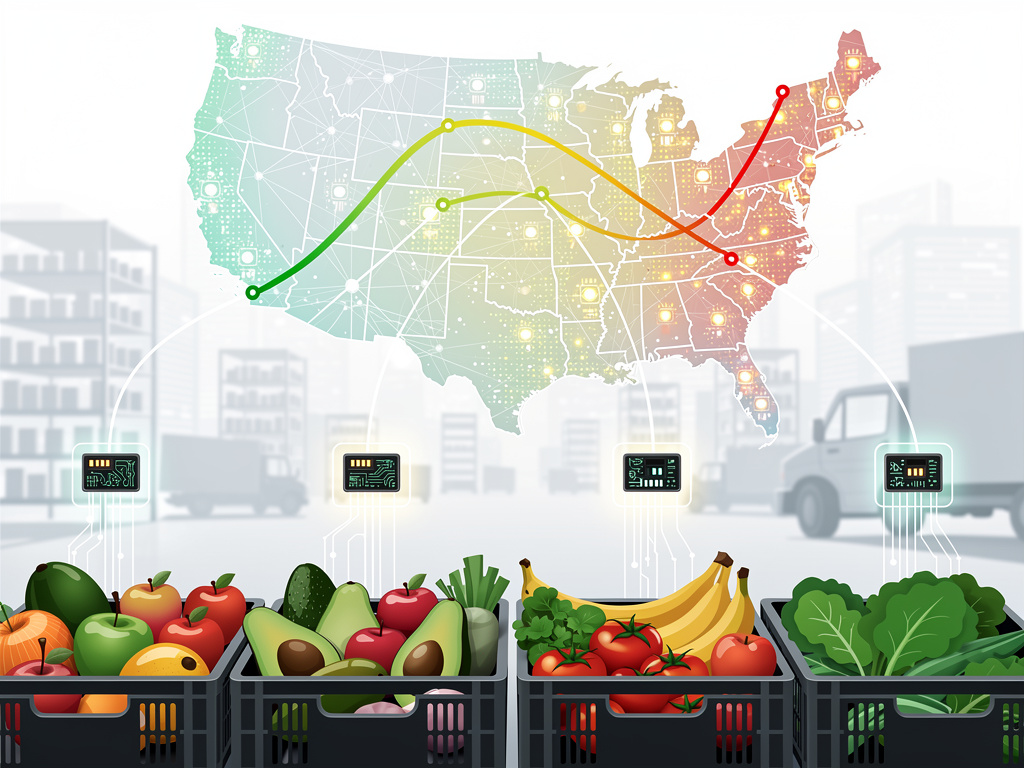
Sizov’s insight, hatched during her undergraduate work in bioengineering, was that ethylene gas—the naturally occurring compound fruits emit as they ripen—could serve as a real-time indicator of produce quality inside cold storage facilities. Strella developed small biosensors that sit in storage rooms and shipping containers, continuously measuring ethylene concentrations. That data feeds into a machine learning platform that predicts when a given lot of apples or avocados or berries will hit peak ripeness, and when it will start to turn.
Simple in concept. Brutally hard in execution.
Cold storage environments are hostile to electronics. Humidity is high. Temperatures fluctuate. The sensors need to be cheap enough to deploy at scale but accurate enough to generate trustworthy predictions. And the predictions themselves need to translate into actionable decisions for supply chain managers who’ve spent careers relying on visual inspection and gut instinct.
Strella has apparently cracked enough of these challenges to win real customers. The company works with major produce distributors and retailers across North America, though Sizov has historically been guarded about naming all of them publicly. What she has disclosed, as reported by GeekWire, is that Strella’s technology is now monitoring billions of dollars’ worth of produce annually—a figure that, if accurate, would place the company among the most widely deployed postharvest quality platforms in the country.
The timing matters. Food waste has climbed the priority list for both policymakers and corporate sustainability officers. The Environmental Protection Agency and USDA jointly set a national goal in 2015 to cut food waste in half by 2030. We’re now well past the halfway mark on that timeline, and progress has been incremental at best. Technologies like Strella’s represent one of the few categories of intervention that can deliver measurable reductions without requiring consumers to change their behavior—always the hardest variable in any waste equation.
Investors have noticed. Strella has raised over $30 million in venture funding to date, with backers that include S2G Ventures, Tencent, and the investment arm of grocery giant Ahold Delhaize. That last name is particularly telling. When one of the world’s largest food retailers puts money behind a startup, it signals more than financial interest—it signals operational intent.
But Sizov’s ambitions extend beyond sensors in cold rooms. In her GeekWire interview, she described a vision for Strella as an intelligence layer across the entire fresh produce supply chain, from packhouse to store shelf. The company is building what amounts to a digital twin of produce quality—a continuously updated model that tells operators not just what’s happening now, but what will happen next. Which pallets should ship first. Which lots are deteriorating faster than expected. Which shipments should be rerouted to closer markets before they lose value.
This is where the technology gets genuinely interesting for industry insiders. The fresh produce business operates on razor-thin margins. A single percentage point improvement in shrink—the industry term for product lost to spoilage, damage, or theft—can translate into millions of dollars in recovered revenue for a large distributor. And shrink in the produce department is the highest of any category in a typical grocery store, often running between 4 and 10 percent of sales depending on the product and the retailer.
Strella isn’t alone in this space. Competitors and adjacent players include companies like Apeel Sciences, which developed an edible coating that slows produce ripening; OneThird, a Dutch startup using handheld scanners and AI to predict shelf life; and ImpactVision (now part of Apeel), which applied hyperspectral imaging to food quality assessment. Large technology firms including Google and Microsoft have also explored agricultural supply chain optimization, though their efforts have been broader and less focused on the specific postharvest quality problem.
What distinguishes Strella, according to people familiar with the company’s operations, is the specificity of its data. Ethylene measurement provides a direct biological signal—not a proxy based on temperature logs or visual appearance, but a chemical indicator of what’s actually happening inside the fruit at a cellular level. Temperature monitoring, long the default tool for cold chain management, tells you whether storage conditions were maintained. It doesn’t tell you whether the produce arrived in good condition to begin with, or how it’s responding to those conditions in real time.
Sizov has spoken publicly about the cultural resistance she’s encountered. The produce industry is old. Relationships are entrenched. Many decisions are still made by phone, and quality assessments still rely on a person cutting open a sample piece of fruit. Convincing operators to trust an algorithm over their own experienced judgment requires more than a good demo—it requires sustained proof delivered over multiple seasons and crop varieties.
And then there’s the gender dimension, which Sizov has addressed with characteristic directness. She launched Strella in her early twenties, a woman in a field dominated by older men. The produce industry’s old guard didn’t always roll out the red carpet. But as GeekWire noted, she’s built credibility the only way that ultimately works in any industry: by delivering results that show up on the balance sheet.
The broader context here is a food system under increasing strain. Climate volatility is making crop yields less predictable. Labor shortages have plagued agriculture and food distribution since the pandemic. Consumer expectations around freshness and sustainability continue to rise. And the economics of grocery retail—already among the most competitive and low-margin sectors in American business—leave almost no room for inefficiency.
So when a company claims it can reduce produce waste by even a modest percentage, the math gets attention fast. If Strella’s platform prevents just 2 percent of the produce it monitors from going to waste, and it’s monitoring billions of dollars in product, the implied savings run into the tens of millions annually. Scale that across the entire U.S. produce supply chain—worth roughly $70 billion at the wholesale level—and the addressable opportunity becomes enormous.
Whether Strella can capture a meaningful share of that opportunity depends on several factors. Can the sensor hardware hold up across diverse environments and geographies? Can the predictive models maintain accuracy as they’re applied to new crop varieties and new supply chain configurations? Can the company build the kind of enterprise sales organization needed to penetrate large, conservative food businesses? And can it do all of this while managing burn rate and maintaining the trust of investors who will eventually want to see a path to profitability?
These are execution questions, not vision questions. The vision is clear. And the market need is undeniable.
Sizov herself seems acutely aware of the gap between ambition and delivery. In public appearances, she tends to focus on specific, measurable outcomes rather than grand rhetoric about transforming the food system. She talks about shrink reduction percentages. About days of additional shelf life. About the dollar value of produce saved from the dumpster. It’s a disciplined approach—one that reads as mature beyond her years in a startup culture that often rewards grandiosity over substance.
The food waste problem isn’t going to be solved by any single company or technology. It’s a systemic issue with roots in agricultural policy, retail incentive structures, consumer behavior, and infrastructure underinvestment. But the postharvest segment—the stretch between farm gate and store shelf—is arguably where technology can have the most immediate and measurable impact, because it’s where the most controllable waste occurs.
Strella Biotechnology is making a credible bet that data, deployed at the right point in the supply chain, can turn spoilage from an accepted cost of doing business into a solvable problem. Katherine Sizov is making a personal bet that she’s the one to build the company that proves it.
Both bets are still in play. But the produce industry, for the first time in a long time, is watching.


 WebProNews is an iEntry Publication