
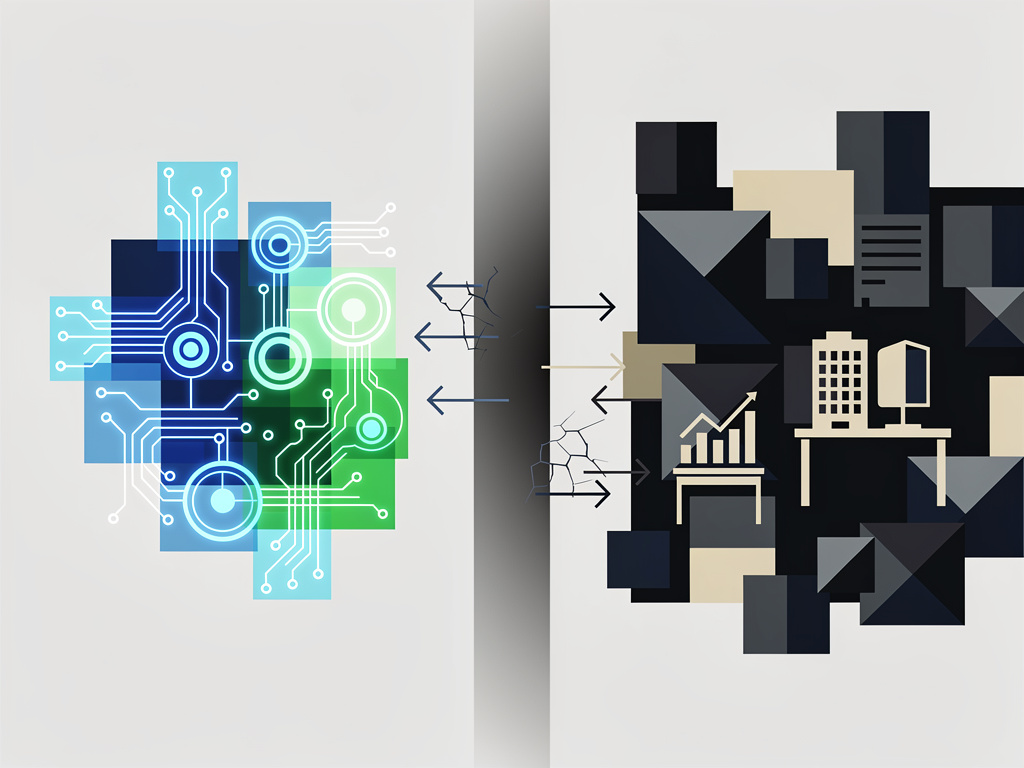
The machines are ready. The people are not.
A sweeping new study from Microsoft and Carnegie Mellon University has found that the single greatest obstacle to AI adoption in the workplace isn’t the technology itself — it’s the humans who are supposed to use it. White-collar workers across industries are pushing back against artificial intelligence tools with a combination of passive resistance, open skepticism, and quiet non-compliance that is costing companies billions in unrealized productivity gains.
The research, which surveyed thousands of knowledge workers and their managers, paints a picture that should alarm every C-suite executive who has bet heavily on AI transformation. According to TechRadar’s reporting on the findings, the study’s authors concluded bluntly: “The problem is not AI’s capability. What won’t improve on its own is the human side.”
That sentence deserves to sit on the desk of every chief technology officer in America.
The resistance takes many forms. Some workers simply ignore AI tools that have been deployed at considerable expense. Others use them superficially — running a query here, generating a draft there — without integrating them into core workflows. A significant cohort actively distrusts AI outputs, spending as much time checking and re-doing AI-generated work as they would have spent doing it from scratch. And then there are those who view the entire enterprise as a threat to their livelihoods and professional identities, treating every AI initiative as something to be endured rather than embraced.
None of this is irrational.
Workers have watched rounds of layoffs attributed, at least in part, to automation gains. They’ve seen colleagues displaced. They’ve heard executives talk about “doing more with less” — a phrase that, to the person whose job is the “less,” carries a distinctly menacing undertone. The fear isn’t abstract. It’s rooted in observable reality, and the Microsoft-Carnegie Mellon research suggests that companies have done a remarkably poor job of addressing it.
The study found that organizations investing heavily in AI infrastructure — purchasing licenses, building custom models, integrating copilots into productivity software — have largely neglected the change management required to make those investments pay off. Training programs, where they exist, tend to focus on how to use the tools rather than why to use them, or how workers’ roles will evolve rather than evaporate. The result is a workforce that has access to powerful AI capabilities but lacks the motivation, trust, or organizational support to deploy them effectively.
This isn’t a niche problem. Microsoft’s own data suggests that while AI tool adoption rates look impressive on dashboards — licenses activated, queries submitted, features enabled — actual deep integration into daily work remains startlingly low. The gap between deployment and genuine use is where billions of dollars in enterprise AI spending go to die.
And the problem is getting worse, not better.
As AI tools have grown more capable over the past eighteen months, expectations from leadership have escalated accordingly. Executives who read about GPT-4’s performance on bar exams and medical licensing tests naturally expect their employees to extract similar value from workplace AI deployments. But capability in a controlled benchmark and utility in a messy, politically complex, institutionally constrained office environment are very different things. The workers know this. Many of their bosses, apparently, do not.
Recent reporting reinforces the scale of the disconnect. A May 2025 survey by Gallup found that only 33% of U.S. employees say they use AI tools at work regularly, despite the fact that a majority of large employers have now made such tools available. Among those who do use AI, satisfaction is mixed — workers report that the tools are helpful for certain narrow tasks but often fall short in the complex, judgment-intensive work that defines most white-collar roles. The gap between what AI demos promise and what AI tools deliver in practice remains a persistent source of frustration.
The Microsoft-Carnegie Mellon study identifies several specific failure modes. First, there’s the trust deficit. Workers who have encountered AI hallucinations — confident-sounding but factually wrong outputs — become permanently wary. One bad experience can poison months of adoption efforts. Second, there’s role ambiguity. When companies introduce AI without clarifying how job descriptions, performance metrics, and career paths will change, workers default to self-preservation. They hoard expertise, avoid delegation to machines, and treat AI as a competitor rather than a collaborator. Third, there’s the training gap. Most organizations offer AI training that amounts to a product demo. Here’s the button. Click it. Good luck.
That’s not training. That’s abandonment.
Real change management — the kind that actually shifts behavior at scale — requires sustained investment in coaching, workflow redesign, incentive realignment, and honest communication about what AI will and won’t change about people’s jobs. It requires managers who understand the tools well enough to model effective use. It requires feedback loops that let workers report problems without fear of being labeled Luddites. And it requires executives who are willing to admit that the technology, however impressive, is only as valuable as the humans who wield it.
Few companies are doing any of this well. Fewer still are doing all of it.
The financial stakes are enormous. McKinsey has estimated that generative AI could add up to $4.4 trillion in annual value to the global economy — but only if organizations successfully integrate it into workflows. That “if” is doing extraordinary heavy lifting. The Microsoft-Carnegie Mellon research suggests that the human bottleneck could reduce realized value by half or more in many organizations, turning what should be a productivity windfall into an expensive experiment in corporate frustration.
There’s a historical parallel worth considering. In the 1980s and 1990s, companies invested heavily in personal computers and enterprise software, expecting immediate productivity gains. What they got instead was what economist Robert Solow famously described: “You can see the computer age everywhere but in the productivity statistics.” The so-called productivity paradox persisted for nearly a decade before organizations finally figured out how to restructure work around the new tools. The gains came eventually — but only after massive investments in training, process redesign, and cultural change that dwarfed the original technology spending.
We’re watching the same movie again. Different technology. Same human dynamics.
But there’s a wrinkle this time that makes the challenge harder. AI doesn’t just automate routine tasks the way spreadsheets automated arithmetic. It encroaches on cognitive work — writing, analysis, judgment, creativity — that white-collar workers consider the core of their professional identity. Asking a factory worker to oversee a robot that welds faster than a human is one thing. Asking a lawyer to trust an AI that drafts contracts, or a marketing director to accept AI-generated strategy memos, is something qualitatively different. It touches on questions of expertise, status, and self-worth that run far deeper than workflow efficiency.
The resistance, in other words, isn’t just practical. It’s existential.
And companies that treat it as a mere training problem — solvable with a few webinars and a Slack channel — are kidding themselves. The Microsoft-Carnegie Mellon researchers are explicit on this point: technological capability will continue to improve on its own, driven by competition among AI labs and the relentless pace of model development. What won’t improve on its own is organizational readiness. That requires deliberate, sustained, expensive human effort — the kind that doesn’t show up in flashy product announcements or quarterly earnings calls.
Some companies are starting to get it right. JPMorgan Chase, for instance, has invested not just in AI tools but in dedicated AI training programs for tens of thousands of employees, paired with clear communication about how roles will evolve. Walmart has taken a similar approach in its corporate offices, embedding AI coaches within teams to provide ongoing support rather than one-time instruction. These efforts are expensive and slow. They don’t make for exciting headlines. But they’re the only approach that the evidence suggests actually works.
The alternative — deploying powerful AI tools and hoping workers will figure it out — is a strategy that the data now clearly shows is failing. Companies are spending millions on AI licenses that go largely unused, on copilots that workers treat as novelties rather than necessities, on infrastructure that generates impressive technical metrics but negligible business value.
So what should executives do?
The research points to several concrete steps. Start by acknowledging the fear. Workers who are told their jobs are safe but see layoffs happening around them won’t believe reassurances — they’ll believe actions. Companies that genuinely intend to redeploy rather than replace workers need to demonstrate that commitment with specific, visible examples. Next, redesign jobs before deploying tools. If you hand someone an AI assistant without changing their job description, performance metrics, or daily workflow, you’ve given them a solution to a problem they don’t have. The tool will sit unused. Third, invest in managers. Middle managers are the transmission mechanism for organizational change, and most of them are as confused about AI as their direct reports. Training managers first — giving them time to experiment, fail, and develop genuine competence — creates the modeling effect that drives adoption far more effectively than any top-down mandate.
Finally, accept that this will take years, not quarters. The productivity paradox of the 1990s didn’t resolve in a single budget cycle. Neither will this one. Companies that treat AI adoption as a multi-year organizational transformation — rather than a technology deployment with a go-live date — will capture disproportionate value. Everyone else will keep buying licenses and wondering why nothing changes.
The irony of the current moment is striking. AI has never been more capable. Models are faster, cheaper, more accurate, and more versatile than anyone predicted even two years ago. The technology is, by any reasonable measure, ready. But technology readiness and organizational readiness are different things entirely, and the gap between them is where the real story of AI in the workplace is playing out — not in research labs or product launches, but in the quiet, stubborn, deeply human refusal of millions of workers to change how they do their jobs just because a machine says they should.
The machines will wait. They’re patient like that. The question is whether companies can afford to.


 WebProNews is an iEntry Publication