
Jean-Baptiste Kempf built the software that let billions watch video without a hitch. Now he wants the same for machines that move in the physical world.
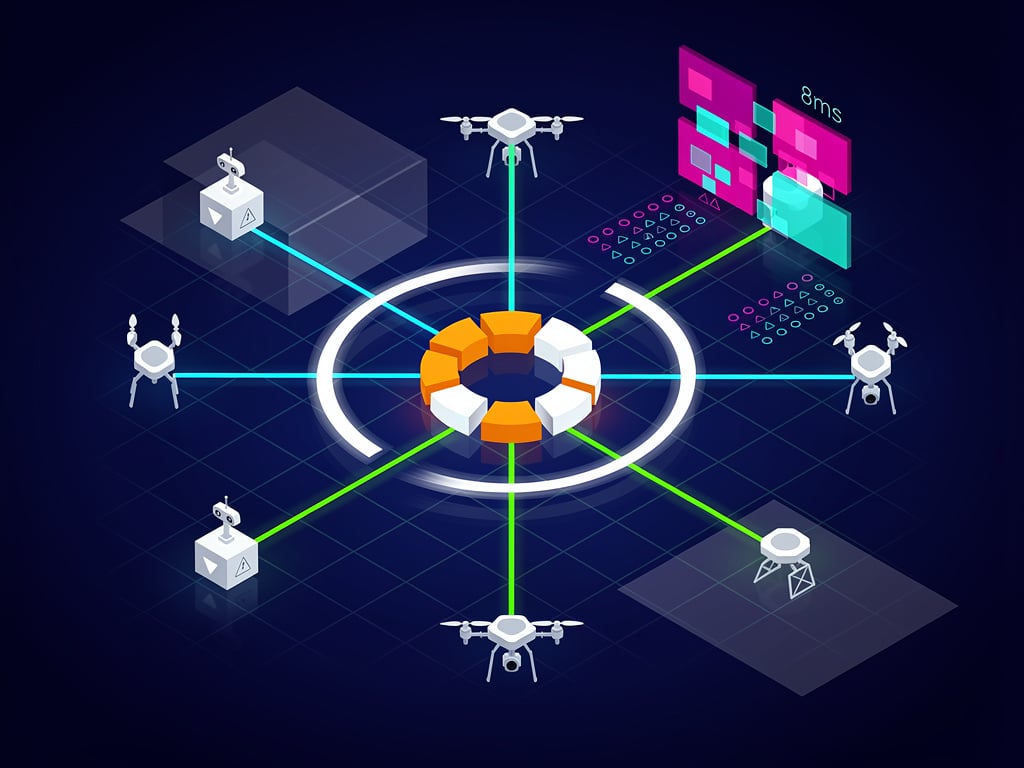
His latest creation, Kyber, targets the control layer for remote robots, drones and devices. It promises synchronization of video feeds, sensor streams, audio and operator inputs at latencies low enough that distant hardware feels immediate. The bet rests on a simple idea. As fleets grow from thousands to millions, custom one-off systems won’t cut it.
Kempf, the longtime lead developer of VLC Media Player, knows scale. That free orange-cone player has racked up more than 6 billion downloads. He sees a parallel future for embodied systems. “Hundreds of millions of robots and drones” could roam soon, he told TechCrunch. The infrastructure underneath must handle that volume without breaking.
Kyber’s Technical Foundation
The Paris startup delivers an SDK at its core. It handles real-time streaming over QUIC, achieving glass-to-glass latencies down to 8 milliseconds. That’s the round trip from camera capture on the remote device back to the operator’s screen and command return. Video streaming expertise from Kempf’s past roles drives much of it. He served as CTO at cloud gaming firm Shadow. IoT-level optimization matters too. The system tunes to whatever compute sits on the edge device.
But. The hardest part isn’t the codec. It’s the network. Kempf has said exactly that in recent talks. Every millisecond counts when actions happen in the real world. “If you control things in the real world, every millisecond matters,” he explained to TechCrunch.
Competitors exist. Large operators have sunk years and tens of millions into proprietary remote-driving stacks or internal tools. Those solutions stay locked away. Kyber takes the opposite path. Its core stays open source. Enterprises buy the productized version plus support from forward-deployed engineers. The model echoes Palantir’s approach more than a pure SaaS play.
The company raised $5 million in seed funding. Lightspeed Venture Partners led the round. The firm, known for bets on Anthropic and Mistral AI, made its view plain. “Physical AI is only as good as the underlying systems running it,” Lightspeed wrote in a LinkedIn announcement. That observation captures the shift. Fancy models mean little if the robot hesitates or the video lags.
Current deployments span defense, telecommunications, robotics and AI companies. Kyber prioritizes three areas. Robotics. Drones of all types. And remote IT access. The last one surprises some. Yet demand runs strong there. Kempf positions his tool as more than a Citrix replacement. It delivers low-latency remote desktop that feels local even across continents.
Scale changes everything. Today’s biggest remote vehicle fleets top out around 2,000 to 3,000 units. Managing millions demands different observability, update mechanisms and reliability. AI agents will soon direct many of those fleets. When software watches the systems instead of humans, knowing exactly what fails becomes non-negotiable. No need to touch every device for patches either. That alone saves time and risk.
Kyber operates with 25 full-time staffers. Headquarters sit in Paris. Offices in San Francisco and Singapore support a client base expected to spread globally. The team includes a sizable contingent of those forward-deployed engineers who embed with customers for custom setups. This hands-on element differentiates it in complex industrial or defense environments.
Recent coverage reinforces the momentum. A February 2025 interview at Streaming Learning Center highlighted Kyber’s roots in FFmpeg and VLC. It serves cloud gaming, telemedicine, robotics and remote vehicles. “We’re working with companies using Kyber to control robots and drones. Even autonomous systems need human intervention sometimes, and that requires fast, precise controls,” Kempf said there. The piece, available at Streaming Learning Center, adds technical color on ultra-low latency video control.
His personal site and LinkedIn posts echo the focus. Ultra-low-latency video over QUIC. Control streaming that makes WebRTC seem slow. Applications range from AI agents to remote surgery concepts. One recent talk in Taiwan walked through the architecture. Latencies so low the machines feel present.
The broader robotics sector shows parallel excitement. NVIDIA detailed new Isaac GR00T models and simulation tools in April for physical AI training. NVIDIA’s blog outlined vision-language-action systems that let robots follow natural language and tackle multistep tasks. Those models still need reliable real-world interfaces. Low-latency transport fills that gap.
Bessemer Venture Partners surveyed the field in April too. Their predictions noted that the ChatGPT moment for robotics approaches but hasn’t arrived. Infrastructure layers like Kyber could accelerate it. Bessemer Predicts: Robotics and physical AI stressed commercialization hurdles around reliability and scale. Exactly the problems Kempf targets.
Market forecasts point higher. Industrial ROS and middleware software could reach hundreds of millions in coming years as real-time performance demands grow. One March report projected the segment hitting $0.8 billion in 2026 with strong growth from hardened, deterministic kernels. Those numbers align with Kempf’s vision of ubiquitous machines.
Yet challenges remain. Network variability still bites. Packet loss, jitter and distance test any low-latency claim. Kempf’s background in multimedia gives him an edge. Decades tuning codecs, buffers and transport protocols for VLC taught hard lessons about real devices and flaky connections. The same principles apply when the payload controls a moving arm instead of pixels on a screen.
So the transition feels natural. From video players on every desktop and phone to control planes for physical agents. Open source at the foundation. Enterprise polish on top. Hands-on services where needed. The formula worked before.
Kempf doesn’t promise magic. He offers infrastructure that removes one major friction point in remote operation. If hundreds of millions of robots do arrive, someone must keep them responsive. His track record suggests he understands what that demands. Precision. Reliability. And software that just works at scale.
Whether Kyber becomes the default layer remains to be seen. The market will decide. But the problem it attacks grows more urgent by the month. Physical AI needs solid footing. Milliseconds matter. Kempf has spent his career making sure they don’t get wasted.


 WebProNews is an iEntry Publication