
In the relentless pursuit of higher transaction values, retailers face an increasingly delicate balancing act: maximizing revenue through upselling while preserving the customer relationships that sustain long-term profitability. New research reveals that this practice, now ubiquitous across digital and physical retail channels, carries hidden risks that could fundamentally reshape how businesses approach sales strategies in an era where consumer trust has become a precious commodity.
According to Customer Experience Dive, the dual nature of upselling creates a tension that many retailers underestimate. While the immediate financial benefits appear compelling—studies show that upselling to existing customers can be five times more cost-effective than acquiring new ones—the psychological aftermath of aggressive sales tactics may erode the very foundation upon which repeat business depends. This phenomenon has intensified as e-commerce platforms deploy increasingly sophisticated algorithms designed to present additional purchase options at every conceivable touchpoint in the customer journey.
The mechanics of modern upselling have evolved far beyond the simple “would you like fries with that?” approach. Today’s retailers employ machine learning systems that analyze browsing patterns, purchase history, and demographic data to present personalized upgrade suggestions with surgical precision. These systems can identify the optimal moment to present an offer, the ideal price point that maximizes both acceptance rates and margin, and even the specific language that resonates most effectively with individual consumers.
The Psychology Behind Purchase Regret
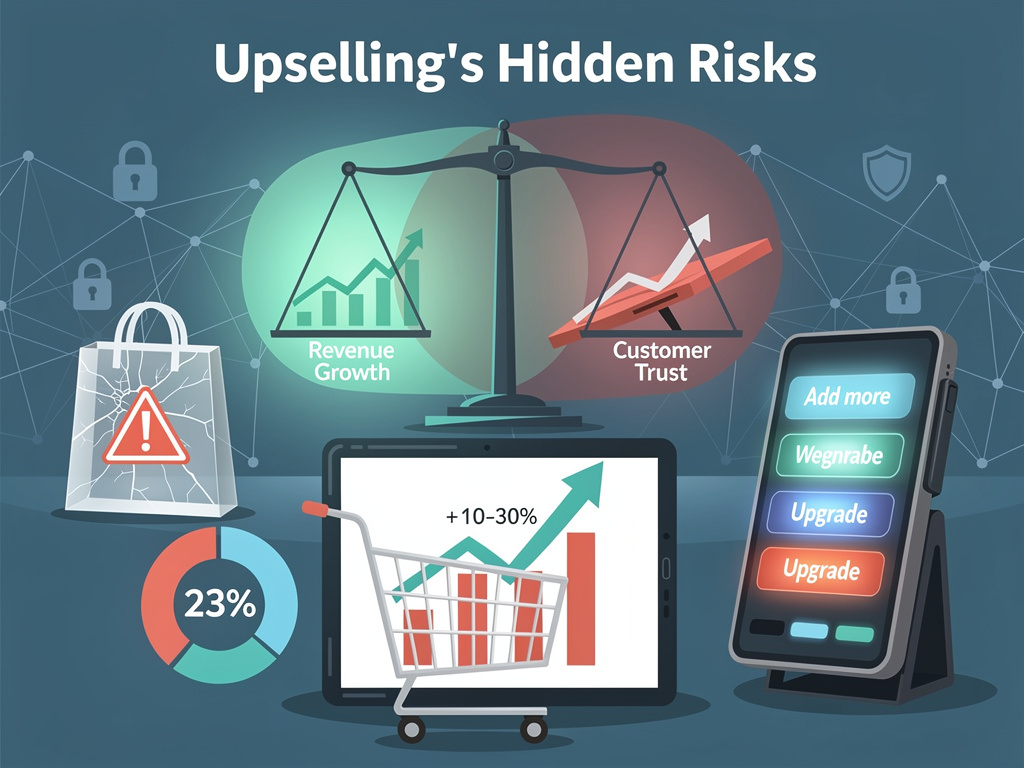
Consumer psychologists have identified a critical threshold where persuasion transforms into manipulation, triggering what researchers call “post-purchase dissonance.” This psychological state occurs when buyers question whether they genuinely needed the additional items they purchased or simply succumbed to sales pressure. The research highlighted by Customer Experience Dive indicates that approximately 23% of consumers who accepted upsell offers later experienced regret, with that figure climbing to 34% among younger demographics who are simultaneously more digitally savvy and more susceptible to FOMO-driven purchasing decisions.
The emotional trajectory of an upsold customer often follows a predictable pattern. Initial excitement about the enhanced product or service gives way to rational evaluation, during which buyers recalculate the value proposition against their original needs and budget constraints. When this recalibration reveals a mismatch, the resulting regret extends beyond the specific transaction to contaminate the customer’s perception of the brand itself. Industry data suggests that customers who experience upsell regret are 40% less likely to make repeat purchases within the subsequent six months, representing a significant hidden cost that traditional sales metrics fail to capture.
The Revenue Imperative Versus Long-Term Value
Financial pressures facing retailers have intensified the focus on average order value as a key performance indicator. Quarterly earnings calls frequently highlight improvements in this metric as evidence of successful merchandising strategies, creating organizational incentives that prioritize immediate revenue over customer lifetime value. Sales teams receive commissions and bonuses tied to upselling success rates, while customer service representatives face performance evaluations that reward their ability to convert support interactions into additional sales opportunities.
This structural emphasis on upselling has produced measurable results. Companies that implement systematic upselling programs typically report 10-30% increases in average transaction values, translating to millions in additional annual revenue for large retailers. However, these gains must be weighed against the less visible costs of customer churn, negative word-of-mouth, and brand reputation damage that accumulate when upselling crosses the line from helpful suggestion to aggressive manipulation.
The Trust Deficit in Modern Retail
Consumer trust in retailers has declined steadily over the past decade, with recent surveys indicating that only 34% of shoppers believe that sales recommendations are primarily designed to benefit the customer rather than the company. This skepticism has profound implications for upselling effectiveness, as consumers increasingly approach product recommendations with defensive cynicism rather than open-minded consideration. The erosion of trust creates a vicious cycle: as consumers become more resistant to upselling attempts, retailers respond with more aggressive tactics, which further damages trust and reinforces consumer skepticism.
The transparency revolution enabled by social media and review platforms has amplified the consequences of perceived upselling manipulation. Customers who feel they were pressured into unnecessary purchases now have powerful channels to share their experiences, with negative reviews and social media posts reaching audiences that dwarf traditional word-of-mouth networks. A single viral complaint about aggressive upselling tactics can undo months of marketing investment and damage brand perception among thousands of potential customers who have never directly interacted with the company.
Industry Variations in Upselling Impact
The effectiveness and appropriateness of upselling vary dramatically across different retail sectors. In the automotive industry, upselling extended warranties and premium features has become so normalized that consumers expect and often appreciate guidance through complex option packages. Conversely, in the airline industry, aggressive upselling of baggage fees, seat selection, and priority boarding has contributed to historically low customer satisfaction scores and has transformed air travel into a adversarial transaction for many passengers.
The hospitality sector illustrates both the potential and the pitfalls of upselling. Hotels that successfully upgrade guests to premium rooms or sell spa packages often create genuine value that enhances the customer experience and generates positive reviews. However, properties that employ high-pressure tactics at check-in or bury mandatory resort fees in the fine print face backlash that extends far beyond the individual transaction. The distinction lies in whether the upsell genuinely addresses customer needs or simply exploits the customer’s presence and commitment to the original purchase.
Data-Driven Personalization: Solution or Amplification?
Retailers have embraced artificial intelligence and predictive analytics as tools to make upselling more relevant and less intrusive. The theory holds that precisely targeted recommendations based on comprehensive customer data will feel more like personalized service than sales pressure. Amazon’s recommendation engine, which accounts for approximately 35% of the company’s revenue, represents the aspirational model for this approach—suggesting additional products that customers genuinely want based on sophisticated analysis of purchasing patterns across millions of transactions.
However, the increasing sophistication of these systems raises new concerns about manipulation and privacy. When algorithms can predict customer vulnerabilities—identifying when someone is likely to be tired, stressed, or otherwise susceptible to impulse purchases—the line between helpful personalization and exploitative manipulation becomes dangerously thin. Consumer advocacy groups have raised alarms about “dark patterns” in e-commerce interfaces that use psychological tricks to push customers toward more expensive options or additional purchases they didn’t intend to make.
The Regulatory Response and Ethical Guidelines
Governments and industry organizations have begun developing frameworks to address upselling practices that cross ethical boundaries. The European Union’s consumer protection regulations now require greater transparency about the total cost of purchases, including any add-ons, before the final commitment point. These rules aim to prevent the common practice of gradually increasing the price through successive upsells, leaving customers shocked by the final total. In the United States, the Federal Trade Commission has increased scrutiny of deceptive pricing practices and has taken enforcement action against companies that use manipulative upselling techniques.
Industry self-regulation efforts have produced mixed results. Trade associations have published best practice guidelines emphasizing the importance of customer-centric selling, but enforcement mechanisms remain weak and adoption uneven. Companies that voluntarily adopt more conservative upselling policies often face competitive pressure from rivals willing to push ethical boundaries in pursuit of higher short-term revenue. This dynamic creates a race-to-the-bottom scenario where the most aggressive tactics become industry norms, even when they ultimately damage the sector’s reputation and customer relationships.
Reimagining the Sales Conversation
Forward-thinking retailers are exploring alternative approaches that preserve revenue opportunities while rebuilding customer trust. The concept of “value-based selling” emphasizes understanding customer needs before presenting solutions, ensuring that any additional products or services genuinely address identified problems rather than simply increasing transaction value. This approach requires more sophisticated training for sales staff and often involves longer sales cycles, but early adopters report higher customer satisfaction scores and stronger repeat purchase rates.
Some companies have experimented with radical transparency, explicitly acknowledging the financial incentives behind upselling while committing to recommend only products that meet objective criteria for customer benefit. This approach, pioneered by certain financial services firms and now spreading to retail, involves educating customers about how sales recommendations are generated and providing tools to evaluate whether suggested upgrades align with their actual needs and budgets. While counterintuitive, this transparency appears to increase conversion rates by addressing the trust deficit that makes customers reflexively reject all upselling attempts.
Measuring Success Beyond Transaction Value
The fundamental challenge facing retailers is that traditional metrics fail to capture the full impact of upselling practices. Average order value and attachment rates provide clear, immediate feedback that drives organizational behavior, while customer lifetime value, brand perception, and trust levels require more sophisticated measurement and longer time horizons to assess accurately. Companies that continue to optimize for short-term transaction metrics while ignoring these deeper indicators risk winning the battle while losing the war.
Progressive organizations are developing more holistic performance frameworks that balance revenue generation with customer experience indicators. These systems track not just whether an upsell occurred, but whether the customer subsequently used the additional product or service, whether they expressed satisfaction in post-purchase surveys, and whether they returned for future purchases. By making sales teams accountable for these downstream outcomes, companies can align incentives with long-term value creation rather than short-term revenue extraction. The transition to these more sophisticated metrics requires significant investment in data infrastructure and cultural change, but early evidence suggests the effort produces both stronger customer relationships and more sustainable revenue growth.


 WebProNews is an iEntry Publication