
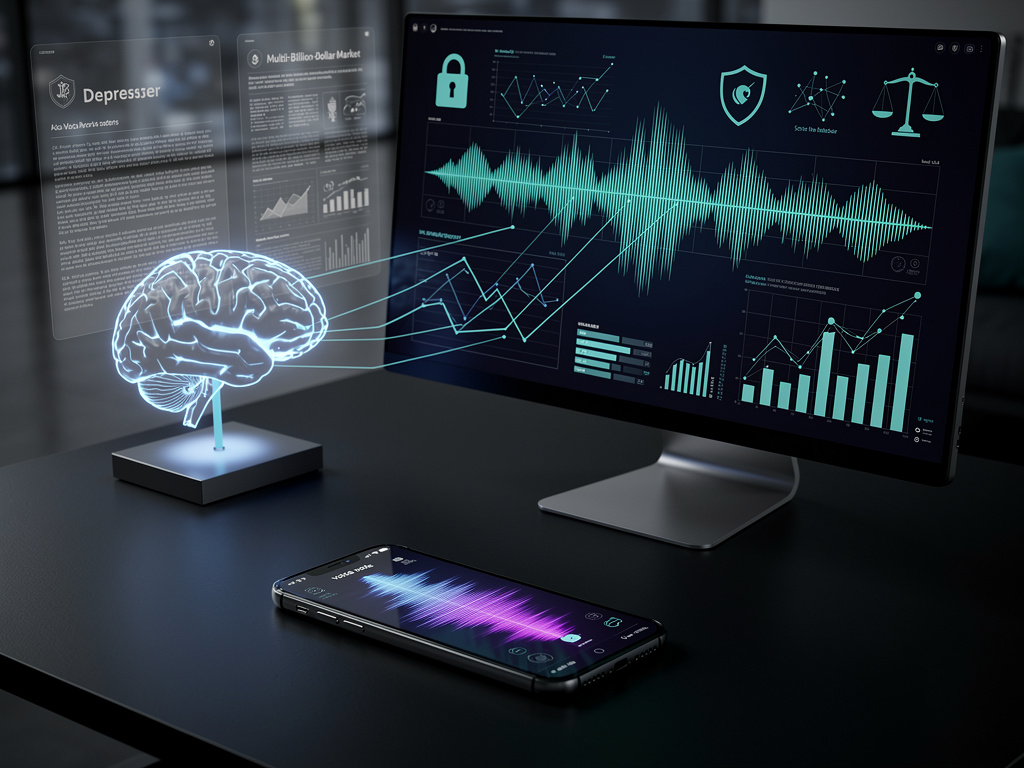
The digital chatter of modern life—the millions of voice notes exchanged daily on platforms like WhatsApp—is filled with more than just casual conversation. A new wave of artificial intelligence is beginning to parse these vocal recordings not for what is said, but how it is said, searching for subtle acoustic patterns that may signal the early onset of mental health conditions like depression.
At the forefront of this movement is Klick Labs, the innovation arm of the health-focused marketing firm Klick Health. In a recent study, the company developed an AI model that could distinguish between individuals with and without depression with a startling 89% accuracy, simply by analyzing short clips of their speech. As detailed in a report by Digital Trends, the technology promises a future of passive, non-invasive mental health screening, turning the smartphone into a potential first line of defense.
From Abstract Signal to Concrete Diagnosis: The Science Behind Vocal Biomarkers
The Klick Labs research, published in Mayo Clinic Proceedings: Digital Health, analyzed the voices of 131 participants with diagnosed depression and anxiety alongside a control group. The AI wasn’t listening for keywords like “sad” or “lonely.” Instead, it scrutinized a suite of 29 distinct vocal features—acoustic tells that are imperceptible to the human ear. These included “jitter,” the minute variations in vocal pitch; “shimmer,” the subtle changes in amplitude; and the overall melodic contour of speech.
This approach is grounded in the well-established physiological effects of depression. The condition often causes psychomotor retardation, a slowing down of physical and emotional responses, which manifests in the voice as a flatter affect, reduced pitch range, and more frequent pauses. The AI model learns to identify this unique vocal signature, creating a powerful tool for objective screening that could one day augment or even precede traditional methods like patient questionnaires.
A Crowded Field Chasing the Voice of a Multi-Billion Dollar Market
While Klick’s results are impressive, they are not operating in a vacuum. The concept of vocal biomarkers is rapidly becoming one of the most promising frontiers in digital health. The technology is being developed to detect a range of conditions, from respiratory illnesses to cognitive decline. In a significant regulatory milestone, the FDA recently cleared a voice-analysis app to screen for cognitive impairment, a step that, according to STAT News, signals growing confidence in the diagnostic potential of speech.
This burgeoning field is fueled by immense commercial potential. The global digital health market was valued in the hundreds of billions of dollars and is projected to continue its aggressive expansion, as noted by industry analysts at Grand View Research. Companies like Ellipsis Health are already deploying voice analysis tools in clinical settings to help providers monitor patient mental health between visits. The ultimate goal for many in this space is to license their technology to telehealth platforms, healthcare systems, and even consumer tech giants, creating a vast, interconnected system of passive health monitoring.
The Unseen Listener: Navigating a Minefield of Privacy and Consent
The prospect of a smartphone that constantly listens for signs of illness raises profound ethical and privacy questions that the industry is only beginning to confront. For this technology to be effective at scale, it would require continuous access to one of the most personal forms of data: the human voice. This creates a trove of sensitive information that could be vulnerable to breaches or misuse, moving far beyond the scope of traditional health data protected by regulations like HIPAA.
The issue of consent is particularly thorny. While a user might agree to an app’s terms of service, the concept of “passive screening” implies a level of persistent monitoring that many may not fully comprehend. As experts at the Brookings Institution have noted, the use of AI in healthcare demands a new framework for transparency and patient control. Without robust safeguards, there are significant risks that this data could be used by third parties, such as insurers to adjust premiums or employers to make hiring decisions, creating a new form of digital discrimination.
The Peril of the Algorithmic Oracle: Bias and the Burden of a False Positive
Beyond privacy, the accuracy and equity of the algorithms themselves present a major challenge. AI models are trained on data, and if that data is not representative of the broader population, the resulting tool can perpetuate and even amplify existing biases. A model trained primarily on the speech patterns of North American English speakers may perform poorly for individuals with different accents, dialects, or native languages, potentially leaving entire communities underserved or misdiagnosed.
Furthermore, the human cost of an error cannot be understated. An 89% accuracy rate, while high, still means one in ten people could be wrongly classified. A false positive could induce significant anxiety and lead to unnecessary medical intervention, while a false negative could provide false reassurance to someone in genuine need of help. As one expert explained in a Forbes analysis of the technology, these tools must be seen as a way to augment, not replace, the nuanced judgment of a trained clinician.
Bridging the Gap Between Innovation and Clinical Reality
For vocal biomarkers to transition from a promising research finding to a standard clinical tool, they must navigate a complex regulatory and adoption pathway. Developers will need to prove to bodies like the FDA that their tools are not only accurate but also safe and effective for their intended use as screeners. This involves rigorous, large-scale clinical trials that demonstrate real-world utility and a clear benefit to patient outcomes.
Equally important is securing the trust and buy-in of the medical community. Physicians are rightfully cautious about adopting new technologies, particularly those driven by opaque “black box” algorithms. The industry will need to clearly articulate how these tools fit into existing clinical workflows—not as automated diagnosticians, but as sophisticated instruments that can flag at-risk patients who may require further evaluation, ultimately enabling earlier and more effective intervention.


 WebProNews is an iEntry Publication