
BRUSSELS—In an era dominated by the breathless ascent of artificial intelligence and the seamless integration of smart devices, the voice of Richard Stallman can sound like a dispatch from a different time. The iconoclastic founder of the free software movement, whose GNU Project laid the groundwork for the Linux operating system, remains an unyielding critic of the technological paradigms he sees as fundamentally eroding human freedom. His recent address here, detailed in a first-hand account by technologist Aral Balkan, served as a stark reminder that the foundational debates over user control and digital liberty are more urgent than ever.
Stallman, often referred to by his initials RMS, dismisses the industry’s favored term “Artificial Intelligence,” preferring the more sober label of “computational statistics.” He argues this reframing is crucial, stripping away the mystique to reveal the technology’s core function: pattern recognition in vast datasets. According to an account of the Brussels talk published on Slashdot, Stallman’s primary concern isn’t the sci-fi trope of sentient machines but the far more immediate danger of mass unemployment. He posits a future where corporations deploy these systems to automate jobs, leading not to a leisure society, but to widespread poverty as the displaced workforce is left with no means of subsistence.
This perspective intentionally sidesteps the current legal maelstrom over copyrighted material used in AI training models, a fight that has ensnared companies like OpenAI and Microsoft. Stallman views this as a distraction from the central threat: the use of AI systems to make crucial, life-altering decisions about individuals in areas like employment, credit, and parole. For him, the injustice lies not in how the machine was trained, but in the abdication of human judgment to an opaque statistical engine, a trend that is already raising alarms about algorithmic bias in corporate and government sectors.
The Four-Wheeled Surveillance Device
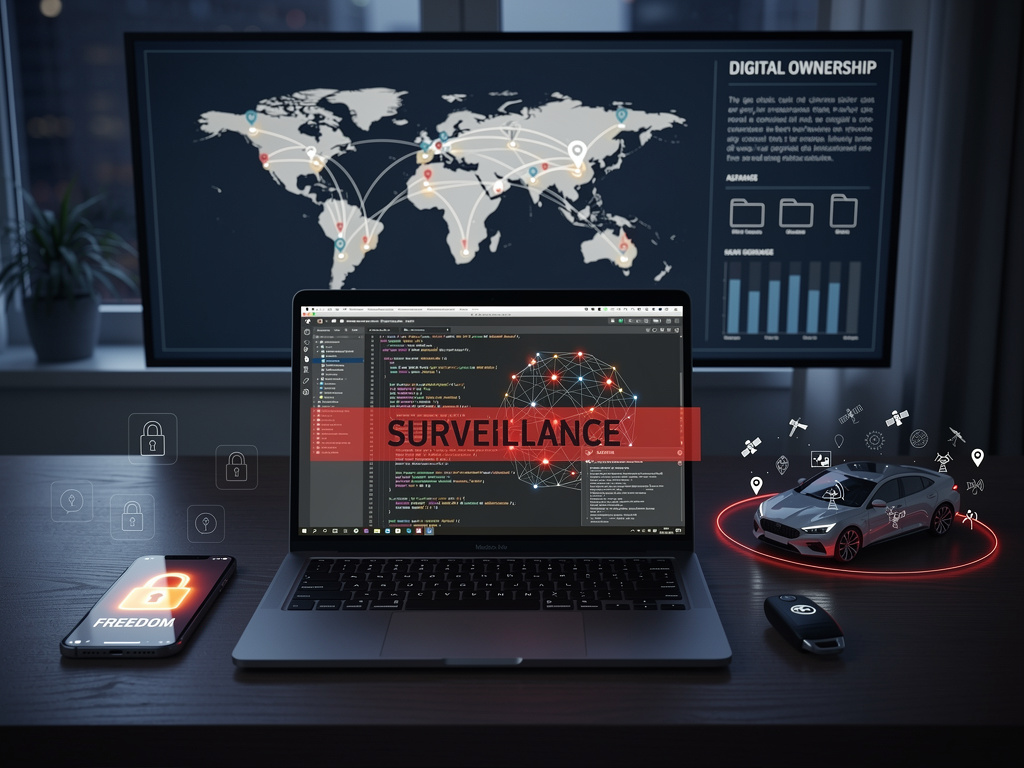
Stallman’s critique extends forcefully to the automotive industry, where the modern vehicle has transformed from a mechanical conveyance into a powerful, rolling computer. He describes today’s connected cars as “computers designed to eavesdrop and control you,” a characterization that may seem hyperbolic until examined against the industry’s data collection practices. These vehicles are equipped with an array of sensors that monitor not just location and speed, but driving behaviors, in-cabin conversations, and even, in some cases, biometric information.
His warnings are strongly substantiated by independent research. A scathing 2023 report from the Mozilla Foundation, titled “*Privacy Not Included,” investigated 25 major car brands and concluded that automobiles are “the official worst category of products for privacy that we have ever reviewed.” As reported by Mozilla, 84% of the car brands studied share or sell user data, and 76% collect deeply personal information, including data on a driver’s “sexual activity” and “genetic information.” This vast data-gathering apparatus operates with what the report calls a “data privacy nightmare” of vague consent agreements that leave consumers with little real choice or control.
Beyond surveillance, Stallman points to the issue of remote control, where manufacturers retain the ability to disable a vehicle’s functions, a power that could be used for purposes ranging from vehicle repossession to state-level control. This dynamic fundamentally alters the concept of ownership. Consumers may hold the title to their car, but the manufacturer retains ultimate authority over its core functions, a model increasingly reliant on recurring revenue through subscriptions for features like heated seats or enhanced performance, which The Verge has reported on as a growing and controversial industry trend.
‘Stalin’s Dream’ in Every Pocket
Perhaps Stallman’s most famous and provocative indictment is reserved for the smartphone, a device he has long referred to as “Stalin’s dream.” The epithet captures his view of the device as a perfect tool for surveillance and control, combining a tracking device, a listening device, and a general-purpose computer running non-free software into a single, indispensable package. He argues that the convenience of these devices masks a Faustian bargain where users trade their privacy and autonomy for access to digital services.
The architecture of the modern mobile ecosystem lends significant weight to his concerns. The dominant operating systems, Google’s Android and Apple’s iOS, function as walled gardens where the platform owners exert immense control over software distribution, payments, and hardware functionality. While Apple’s App Tracking Transparency framework was a step toward user control, the data broker industry continues to thrive on location and behavioral data harvested from mobile apps. As detailed in a U.S. Federal Trade Commission report, these brokers amass and sell vast profiles of consumer information, often without the individual’s full awareness, a practice that the FTC has called a “shadowy ecosystem.”
Stallman’s critique is not merely about privacy from corporate entities but also from governments, which can compel tech companies to provide user data or exploit the device’s capabilities for surveillance. His proposed solution—using de-Googled phones or avoiding mobile phones altogether—remains untenable for most people in a world where digital access is increasingly essential for work, social life, and basic services. Yet, the core of his warning persists: the centralized control inherent in the smartphone model creates a potent infrastructure for monitoring and influence.
The Enduring Battle Over Digital Ownership
Underpinning all of these critiques is Stallman’s decades-long war against what he calls “Digital Restrictions Management” (DRM). He rejects the industry term “Digital Rights Management,” arguing that the technology’s sole purpose is to restrict the user, not protect the rights of the creator. By embedding software locks into media, devices, and equipment, companies can dictate how a consumer uses a product they have purchased, effectively turning owners into mere licensees.
This battle has expanded far beyond its original front in music and movies. It is now central to the burgeoning “Right to Repair” movement, which advocates for consumer and independent access to the parts, tools, and information needed to fix modern electronics. Farmers, for instance, have found themselves locked out of repairing their own tractors by manufacturers like John Deere, who use software locks to force customers to use authorized (and more expensive) dealer services, a conflict that has led to widespread activism and proposed legislation across the United States, as chronicled by Wired.
From smart coffee makers that refuse to brew third-party pods to printers that reject unapproved ink cartridges, DRM has become a key mechanism for enforcing brand loyalty and creating closed ecosystems. For Stallman, this represents a fundamental assault on a user’s right to control, understand, and modify their own property. It is the digital manifestation of a business model that prioritizes corporate control and recurring revenue over the traditional rights of ownership.
A Prophet’s Relevance in the Modern Tech Ecosystem
It is easy to dismiss Richard Stallman as a purist whose ideals are incompatible with the realities of the modern digital economy. His absolutist positions often stand in stark contrast to the incremental, regulation-focused approaches of mainstream privacy advocates. Yet, to do so is to miss the enduring power of his critique. He functions as the conscience of the tech industry, persistently asking the foundational questions that are often obscured by market imperatives and technological hype.
While regulators in Europe and the U.S. grapple with the complexities of laws like the GDPR and the Digital Markets Act, Stallman’s philosophy challenges them to look beyond data protection and antitrust to the more fundamental issue of user freedom. Are these regulations merely managing the terms of our digital servitude, or are they genuinely empowering users? His work suggests that true freedom requires not just rules about how our data is used, but the ability to control the very software that mediates our lives.
As artificial intelligence becomes more deeply embedded in our social and economic fabric, as our cars and homes become extensions of corporate networks, and as ownership is supplanted by subscription, Stallman’s warnings are no longer the fringe concerns of a small community of hackers. They articulate the central anxieties of a society waking up to the profound power imbalances being codified in the digital age. The questions he has been asking for over forty years are now, more than ever, everyone’s to answer.


 WebProNews is an iEntry Publication