
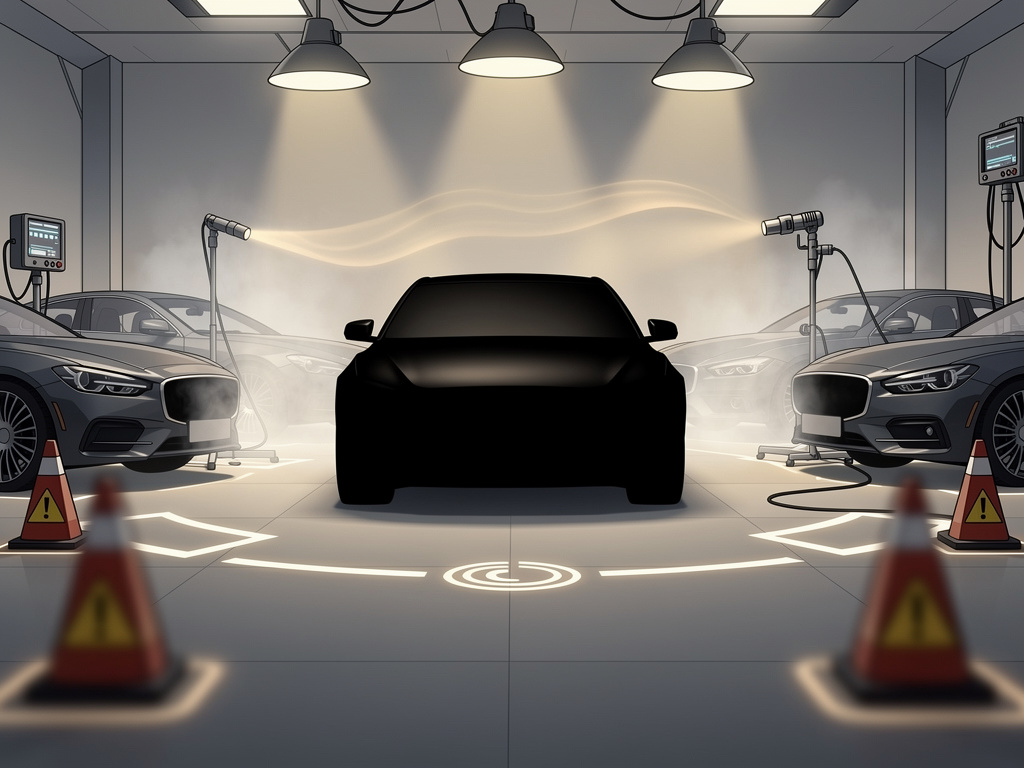
Objects lose their shape. Curves flatten. Light simply stops. A new coating from researchers at Singapore-based Nipsea Group absorbs 99.9% of visible light. It turns cars into something that looks less like metal and glass and more like a cutout in space itself.
Call it optical trickery. Or advanced materials science. Either way, the effect hits hard. Drivers and bystanders alike report the same reaction. It feels like your brain has been hacked.
The Science Behind Light-Trapping Paint
Conventional black car paint reflects enough light to reveal contours, highlights and imperfections. Not this one. Nipsea’s formulation relies on a composite of carbon black and carbon nanotubes. These materials interact through pi-stacking. The result lines up in a connecting-the-dots pattern that traps photons with exceptional efficiency.
Average reflectance sits at roughly 0.08% across the visible spectrum. That’s close to Vantablack’s performance. Surrey Nanosystems’ creation, which once coated a BMW X6 concept, achieved around 0.05% reflectance in some versions and made the vehicle appear almost two-dimensional. BMW described the look bluntly. It “can be interpreted by the brain as staring into a hole or even a void.”
But Vantablack proved too fragile for everyday roads. It never reached commercial vehicles. Nipsea aimed for something tougher. Research chemist Zhiwei Liu and his team detailed their work in a recent paper. “In China, car color has become a key selling point,” Liu said, according to the Gizmodo report. “Deep black finishes have long been the premium choice and signature color for luxury cars due to their elegant appearance, powerful visual impact, and luxurious undertone.”
And. The new coating stayed stable. Panels endured 10 days in a 40°C water bath. They faced 95% humidity for 14 days. No significant defects appeared. Adhesion tests passed. A glossy overcoat helped adapt the technology for automotive surfaces. Those results, published in the journal Matter & Light, suggest real-world potential. (Link to the paper via Cell Press.)
Yet challenges remain. Safety questions linger. A car that seems to disappear could confuse other drivers, especially at night or in varying light. Aesthetic tastes differ too. Some owners might crave the drama. Others could find the flat, featureless look unsettling after weeks behind the wheel.
But the demand exists. Chinese luxury buyers already favor the deepest blacks available. This formulation could satisfy them while offering better durability than earlier nanotube-based options.
YouTubers have demonstrated similar effects for years with off-the-shelf products. DipYourCar sprayed a Mitsubishi Lancer Evolution with Musou Black, a Japanese acrylic paint that absorbs 99.4% of light. The car looked like a silhouette or a floating set of windows and wheels. (Futurism coverage from 2020.) Recent videos from the same channel in 2025 revisited the material, confirming it holds much of its ultra-dark quality even after time and wear.
Marko Terzo’s Hummer project went viral months ago. Coated in the same ultra-black paint, the SUV appeared as a flat shadow. Reflections vanished. Depth disappeared. Commenters called it a “hole in reality.” Those consumer experiments built excitement. Nipsea’s peer-reviewed advance now adds credibility and automotive-grade resilience.
Applications stretch beyond looks. Satellite makers and stealth designers have long sought materials that swallow radar and visible light. Vantablack found uses in space instruments to reduce glare. The new coating might follow similar paths. Or it could stay on the road, giving luxury sedans an otherworldly presence that turns heads for entirely different reasons.
Tests so far used coated panels, not full vehicles in motion. Real-road durability under UV exposure, stone chips and repeated washing still needs proving. Processability questions also persist. How easily does the material spray on complex body shapes? Will repairs match the original blackness?
Even so. The optical effect stands out. Light hits the surface and largely vanishes. What remains looks like negative space. A car-shaped absence. That visual punch explains why videos of these paints rack up millions of views. Viewers can’t look away. The brain struggles to process the missing information.
Competitors push boundaries too. Stuart Semple’s Black 4.0 acrylic claims at least 99% absorption and targets artists shut out of Vantablack by exclusive agreements. It doesn’t match the new composite’s tested stability for cars. But it shows the race continues across industries.
Nipsea operates as part of a larger paints and coatings giant with deep roots in Asia. Its automotive division already supplies major manufacturers. If the ultra-black coating scales, it could appear on showrooms within a few years. Not as a standard option perhaps. Premium trims and limited editions seem more likely.
One detail stands out in all demonstrations. The illusion breaks at edges. Windows, chrome trim, tires and lights still reflect. They float against the void. That contrast heightens the strangeness. Remove those elements in editing and the car ceases to exist visually.
Engineers may one day solve even that. Full-body wraps or integrated glass treatments could extend the effect. For now the technology delivers enough shock on its own.
Interest spiked again this week. The Gizmodo article published June 18, 2026, drew immediate social media reaction. X users shared the story alongside older clips of painted vehicles. Some joked about stealth driving. Others wondered about safety in traffic. Practical questions mixed with pure fascination.
Science moves fast in this space. Each new blacker black prompts fresh experiments. Rooms painted entirely in these materials feel disorienting. The walls recede into nothing. Cars may soon create the same sensation on highways.
Whether the technology reaches mass production depends on cost, regulatory approval and manufacturer appetite. Luxury brands in China stand ready to test buyer response. Early signs point to strong interest in anything that enhances visual impact and perceived exclusivity.
The paint doesn’t just absorb light. It challenges perception. Drivers may feel they pilot a shadow. Onlookers might question if the vehicle exists at all. That combination of performance data, stability tests and sheer visual power sets Nipsea’s creation apart from prior efforts.
Expect more demonstrations soon. Full car applications. Side-by-side comparisons with standard black paints. Further durability studies under real driving conditions. The results could influence not only color choices but also how designers approach vehicle aesthetics in an era of extreme materials.
One thing seems clear. The quest for the perfect black isn’t over. It’s accelerating. And each step makes vehicles look a little less solid. A little more like absences in the world around us.


 WebProNews is an iEntry Publication