
Every developer I know uses AI coding tools daily, but almost none of them trust the code. That tension defines the current state of software engineering.
Adam Conway, lead technical editor at XDA Developers, captured the sentiment in a June 26, 2026 piece: professionals reach for Claude Code, Cursor, and emerging agentic IDEs like Kiro for boilerplate, documentation queries, and unfamiliar code exploration. Yet when stakes rise, output demands line-by-line scrutiny. XDA Developers
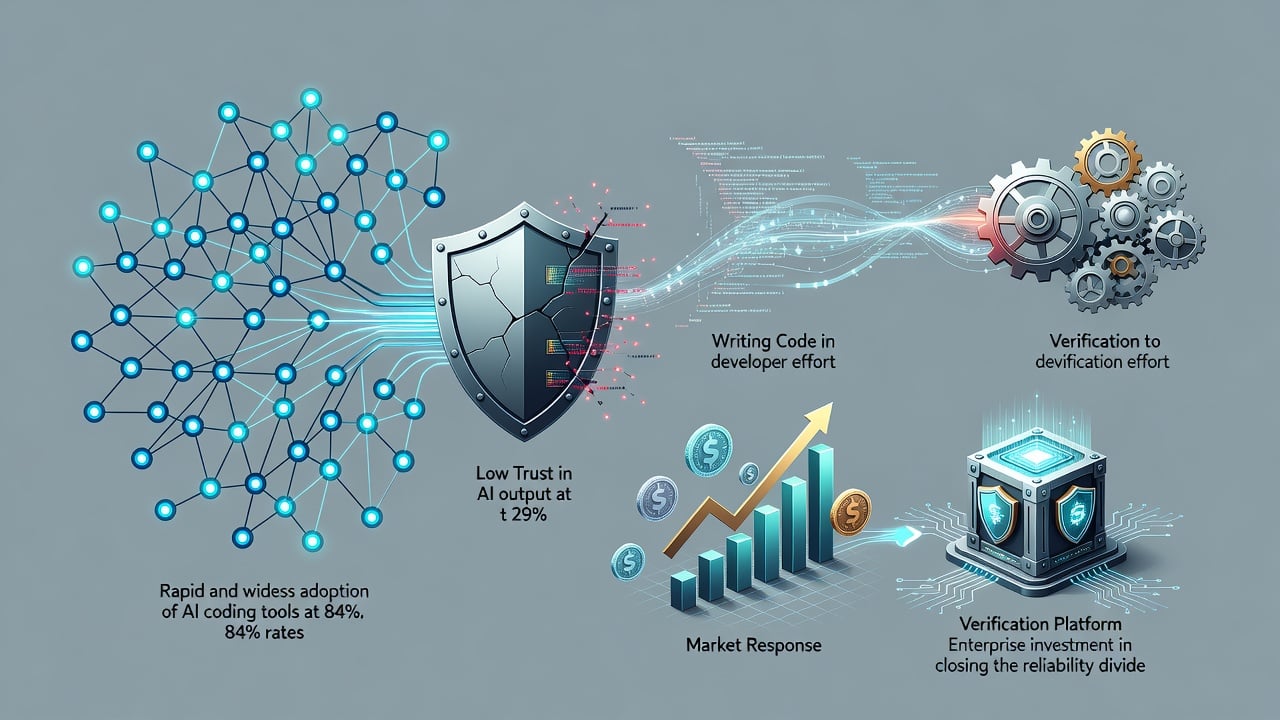
Survey data backs the pattern. Stack Overflow’s 2025 Developer Survey of roughly 49,000 respondents found 84% of developers use or plan to use AI tools, up from 76% the prior year. Daily usage sits at 51%. Trust tells a different story: only 29% say they trust AI output accuracy, down 11 points from 2024. Forty-six percent actively distrust it. Just 3% report high trust. Experienced developers show the sharpest caution, with the lowest high-trust rate and highest high-distrust rate. Stack Overflow 2025 Developer Survey
Ars Technica reported the same survey in July 2025, noting the top frustration: 45% of developers cite “AI solutions that are almost right, but not quite.” These near-misses create debugging overhead that often exceeds the time saved. More than a third of respondents trace some Stack Overflow visits to problems introduced by accepted AI suggestions. Ars Technica
Stack Overflow followed up in February 2026 with analysis of the widening gap. Usage climbed while trust fell because AI operates probabilistically. Developers expect deterministic behavior—same input, same output. AI delivers distributions of plausible results. Hallucinations compound the issue: confident references to nonexistent APIs, deprecated methods, or subtle security flaws that look polished on first read. Stack Overflow Blog
Recent X posts echo the surveys. Santiago, a computer scientist, reviewed more than 20 AI coding agents and concluded he does not trust the generated code. He advises review and testing regardless of origin. Another developer noted 42% of committed code is now AI-generated, yet 96% of developers do not fully trust it while only 48% consistently review before commit. One analysis of 470 open-source pull requests found AI-co-authored code carried 1.7 times more major issues than human-written equivalents.
Productivity claims face scrutiny too. A METR study of experienced open-source developers found they took 19% longer with AI tools on familiar repositories, contrary to expectations. Newer tools may narrow that gap, but the verification burden remains. Conway observed that AI drafts save initial effort only to shift work into intensive review, testing, and cleanup. XDA Developers
Security and maintainability concerns drive caution. Studies and vendor reports repeatedly flag AI-generated code for insecure patterns, missing authorization checks, and compliance gaps. In regulated domains, reviewers confront unfamiliar styles and must verify what they did not write. A preprint study indicated AI contributions concentrate in glue code, tests, and boilerplate while core logic and security-critical sections stay human-authored.
Companies respond with dedicated verification layers. In March 2026, Qodo raised $70 million in Series B funding, bringing its total to $120 million. The startup builds multi-agent systems for code review, testing, and governance that incorporate organizational standards, historical context, and risk tolerance rather than treating changes in isolation. Clients include Nvidia, Walmart, Red Hat, Intuit, and Texas Instruments. Founder Itamar Friedman noted that quality depends on tribal knowledge LLMs alone cannot capture. TechCrunch
Startups like Niteshift, which raised seed funding in June 2026 from investors including Reid Hoffman, target the same problem by separating coding models from orchestration and vetting infrastructure. Open-source projects report reviewer fatigue from low-quality AI contributions that require extra effort to evaluate.
Developers draw practical boundaries. Conway and others limit AI to low-risk scaffolding while retaining human ownership of architecture, security, and final integration. “Vibe coding”—prompting complete applications with minimal oversight—remains rare in professional settings; 72% of Stack Overflow respondents said it plays no role in their work. Ars Technica
The pattern holds across sources. Adoption accelerates because the tools accelerate routine tasks. Trust lags because accountability stays with the engineer who merges the code. When systems fail, no model fields the page. Organizations that treat verification as a first-class workflow—through specialized tools, training, or governance—position themselves to capture speed without accumulating hidden debt. Those that do not risk shipping plausible code that later demands expensive remediation.


 WebProNews is an iEntry Publication