
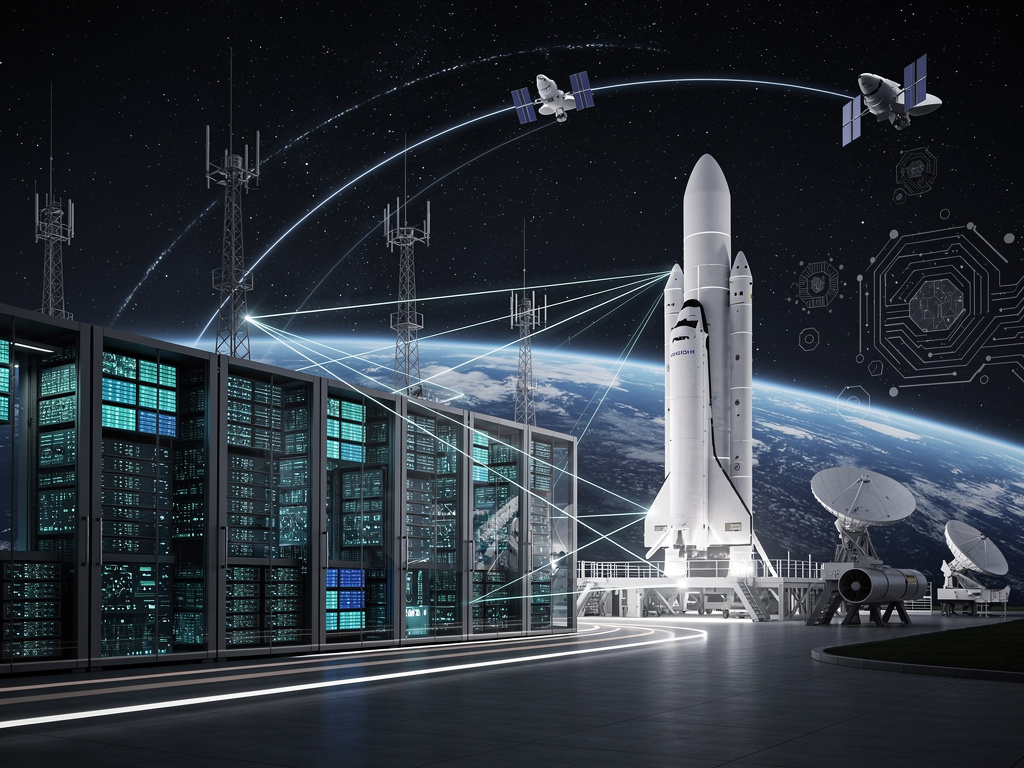
Elon Musk has orchestrated what financial analysts are calling the most consequential corporate integration in history, merging his artificial intelligence venture xAI with aerospace giant SpaceX in a deal that eclipses every previous merger and acquisition transaction on record. The combination creates an entity valued at approximately $350 billion, dwarfing the previous record-holder, the $181 billion Mannesmann-Vodafone merger of 2000, and establishes an unprecedented fusion of space exploration capabilities with cutting-edge artificial intelligence technology.
The integration, announced in early February 2026, represents more than a simple consolidation of assets. It signals a fundamental reimagining of how advanced technology companies can leverage synergies between seemingly disparate domains. According to CNBC, the combined entity positions Musk to accelerate development of AI systems specifically designed for space applications, satellite communications, and autonomous spacecraft operations—areas where the billionaire entrepreneur has long suggested artificial intelligence would prove transformative.
The transaction structure itself breaks new ground in corporate finance. Rather than a traditional merger requiring extensive regulatory approval processes, Musk has executed what legal experts describe as a strategic integration between two privately-held companies under common ownership. This approach circumvents many of the antitrust hurdles that have derailed mega-mergers in recent years, though it raises questions about concentration of technological power in the hands of a single individual.
Strategic Rationale Behind the Integration
Industry analysts point to several compelling strategic reasons driving this unprecedented combination. SpaceX’s Starlink satellite constellation, which now comprises more than 6,000 satellites providing global internet coverage, generates enormous quantities of data requiring sophisticated processing and analysis. xAI’s advanced language models and machine learning systems offer precisely the computational capabilities needed to optimize satellite network performance, predict maintenance requirements, and enhance communication protocols.
The integration also addresses SpaceX’s growing need for autonomous decision-making systems as the company pursues increasingly ambitious missions. Musk has repeatedly emphasized that future Mars colonization efforts will require spacecraft capable of making complex decisions without real-time human oversight, given communication delays of up to 20 minutes between Earth and Mars. xAI’s neural networks and reasoning systems could provide the cognitive architecture necessary for such autonomous operations.
Financial analysts note that the deal provides xAI with immediate access to SpaceX’s substantial revenue streams and established customer base, addressing one of the primary challenges facing artificial intelligence startups: achieving profitability while investing heavily in computational infrastructure. SpaceX generated an estimated $9 billion in revenue in 2025, providing a solid financial foundation for continued AI research and development investments.
Market Implications and Competitive Dynamics
The xAI-SpaceX combination fundamentally alters competitive dynamics in both the aerospace and artificial intelligence sectors. Traditional aerospace contractors like Boeing, Lockheed Martin, and Northrop Grumman now face a competitor with both advanced manufacturing capabilities and proprietary AI systems that could enhance everything from rocket design to mission planning. The integration effectively creates the world’s first vertically-integrated space and AI company, with capabilities spanning from chip design to orbital operations.
In the artificial intelligence arena, the merger positions the combined entity as a formidable challenger to established players like OpenAI, Google DeepMind, and Anthropic. Unlike these competitors, which must partner with third parties for specialized applications, the integrated company can develop and deploy AI systems directly within its own operational environment. This closed-loop approach enables rapid iteration and testing of AI capabilities in real-world scenarios that would be impossible for pure-play AI companies to access.
Technology sector observers note that the integration may trigger a wave of similar combinations as companies seek to replicate Musk’s strategy of pairing advanced AI capabilities with specific industrial applications. The vertical integration model demonstrated by this deal could become a template for how artificial intelligence companies achieve commercial viability and competitive advantage in an increasingly crowded market.
Regulatory Scrutiny and Political Dimensions
Despite the private nature of the transaction, the xAI-SpaceX integration has attracted significant attention from regulators and policymakers. The Federal Trade Commission has opened a preliminary inquiry into whether the combination raises antitrust concerns, particularly regarding SpaceX’s dominant position in commercial launch services and satellite internet provision. Legal experts suggest that while traditional merger review processes may not apply, regulators retain authority to challenge potentially anticompetitive conduct by the combined entity.
National security considerations add another layer of complexity to the integration. SpaceX holds numerous classified contracts with the Department of Defense and intelligence agencies, while xAI’s advanced AI systems raise questions about technology transfer and foreign access. The Committee on Foreign Investment in the United States has reportedly requested briefings on how the companies plan to maintain security protocols and prevent unauthorized access to sensitive technologies developed through the integration.
Congressional leaders from both parties have expressed concerns about the concentration of critical technologies under single-person control. Senator Elizabeth Warren called for hearings to examine whether existing regulatory frameworks adequately address the unique challenges posed by the integration, while Republican lawmakers have focused on ensuring that the combined entity maintains its competitive edge against Chinese space and AI programs. The political debate reflects broader anxieties about technological consolidation and the appropriate balance between innovation incentives and market competition.
Technological Synergies and Innovation Potential
The integration creates numerous opportunities for technological innovation that would be difficult or impossible for independent companies to pursue. SpaceX’s Starship program, designed to carry humans to Mars, could benefit significantly from xAI’s machine learning systems for optimizing fuel consumption, predicting component failures, and managing complex life support systems. Engineers at both companies have reportedly begun collaborating on AI-driven design tools that could accelerate spacecraft development cycles and reduce manufacturing costs.
Satellite communications represent another area where AI integration promises substantial improvements. Current Starlink systems rely on relatively simple algorithms for beam steering and bandwidth allocation. xAI’s advanced neural networks could enable dynamic optimization of network resources based on predicted demand patterns, weather conditions, and orbital mechanics, potentially increasing system capacity by 30 percent or more without launching additional satellites.
The combination also positions the integrated company to pursue entirely new markets at the intersection of space and artificial intelligence. Potential applications include AI-powered Earth observation systems for climate monitoring and disaster response, autonomous orbital manufacturing facilities, and space-based data centers that leverage the vacuum of space for cooling efficiency. Industry analysts estimate these emerging markets could generate tens of billions of dollars in annual revenue within the next decade.
Financial Structure and Valuation Considerations
The $350 billion valuation assigned to the combined entity reflects both companies’ growth trajectories and anticipated synergies from integration. SpaceX’s most recent private funding round in late 2025 valued the company at $210 billion, while xAI’s December 2025 fundraising established a $140 billion valuation. The integrated valuation represents a modest premium to the sum of standalone valuations, suggesting that financial markets remain somewhat skeptical about the magnitude of synergies Musk promises to deliver.
Private equity investors and venture capital firms that backed xAI’s rapid ascent face complex decisions about their positions in the combined entity. Some investors reportedly negotiated liquidity provisions allowing them to sell stakes at predetermined valuations, while others have committed to holding their positions through the integration period to capture potential upside from synergy realization. The lack of public market trading creates valuation uncertainty that has led some institutional investors to mark down their positions pending clearer evidence of financial performance.
Debt markets have responded more enthusiastically to the integration, with credit analysts noting that SpaceX’s stable cash flows provide a solid foundation for supporting xAI’s capital-intensive AI development efforts. The combined entity’s debt capacity could exceed $50 billion, providing substantial resources for continued investment in both space infrastructure and computational capabilities without diluting existing equity holders.
Operational Integration Challenges
Despite the strategic logic underlying the integration, combining two complex organizations presents formidable operational challenges. SpaceX’s engineering culture emphasizes rapid hardware iteration and physical testing, while xAI’s approach centers on computational experimentation and algorithmic refinement. Reconciling these different methodologies and creating productive collaboration between hardware engineers and AI researchers will require careful management and cultural integration efforts.
The companies’ geographic dispersion adds logistical complexity to integration efforts. SpaceX maintains major facilities in California, Texas, and Florida, while xAI has concentrated its operations in the San Francisco Bay Area. Musk has reportedly mandated that key technical teams from both companies relocate to a new integrated campus in Texas, but this directive has encountered resistance from employees reluctant to uproot their families and leave established technology hubs.
Talent retention represents another critical challenge for the combined entity. Both SpaceX and xAI have historically attracted top engineering talent through compelling mission statements and equity compensation packages. The integration creates uncertainty about career paths, reporting structures, and equity valuations that has prompted some key employees to explore opportunities at competing firms. Industry recruiters report increased interest from SpaceX and xAI personnel, suggesting that talent poaching could emerge as a significant issue during the integration period.
Long-Term Vision and Market Transformation
Musk has articulated an ambitious long-term vision for the integrated entity that extends far beyond near-term operational synergies. In public statements, he has described the combination as essential infrastructure for establishing a self-sustaining human presence on Mars, with AI systems managing everything from resource extraction to habitat construction. This narrative positions the integration not merely as a business transaction but as a crucial step toward ensuring human civilization’s long-term survival through multi-planetary expansion.
The integration also reflects Musk’s belief that artificial general intelligence will emerge within the next several years and that controlling the development and deployment of such systems represents an existential imperative. By combining xAI’s AI capabilities with SpaceX’s space infrastructure, Musk appears to be positioning himself to maintain influence over transformative technologies regardless of how the competitive environment evolves. This strategy hedges against scenarios where either AI or space capabilities alone prove insufficient to maintain technological leadership.
Market analysts project that the xAI-SpaceX integration will generate between $25 billion and $40 billion in annual revenue by 2030, with operating margins potentially exceeding 30 percent as AI-driven efficiencies reduce launch costs and satellite operations expenses. These projections assume successful execution of integration plans and continued technological leadership in both space and artificial intelligence domains. Achievement of these financial targets would validate Musk’s strategic vision and likely trigger similar combinations across the technology sector, fundamentally reshaping how advanced technology companies organize themselves and compete in global markets.


 WebProNews is an iEntry Publication