
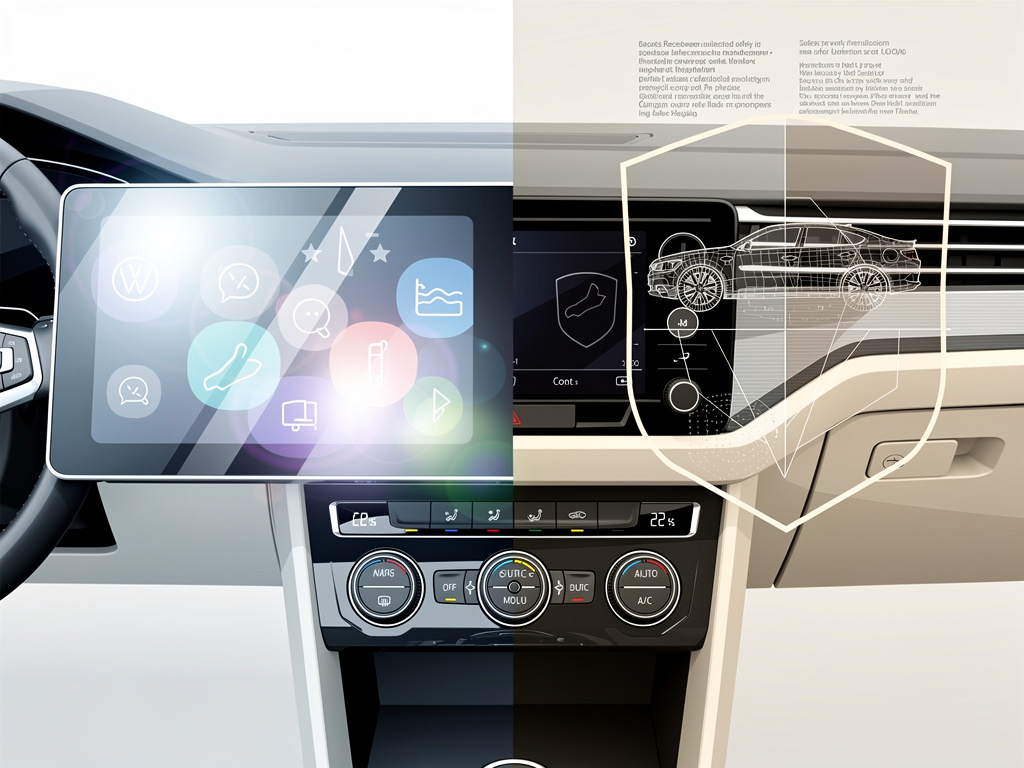
For the better part of a decade, automakers chased a singular design obsession: eliminate every physical control from the cabin and replace it with a glowing touchscreen. The idea was that screens looked modern, reduced manufacturing complexity, and gave cars the sleek, minimalist aesthetic of a smartphone on wheels. Consumers, it turned out, had a different word for it: infuriating.
Now Volkswagen’s new CEO, Thomas Schäfer, is doing something that would have seemed heretical in Detroit or Wolfsburg just five years ago. He’s putting the buttons back.
A CEO Who Actually Drives His Own Cars
In an interview highlighted by Gizmodo, Schäfer has been vocal about his dissatisfaction with the direction Volkswagen’s interiors took under his predecessors. The company’s ID. series of electric vehicles — the ID.3, ID.4, and ID.5 — were designed with touch-sensitive sliders for volume and climate control, capacitive buttons on the steering wheel, and menus buried deep inside tablet-like infotainment systems. Drivers hated them. Schäfer acknowledged as much, telling media outlets that VW “ichad gone too far” with the touchscreen-centric approach and that restoring physical controls was a priority.
This isn’t corporate lip service. The 2025 Volkswagen Golf, refreshed under Schäfer’s watch, reintroduced physical buttons for volume, climate, and driving mode selection. The capacitive touch sliders — those flat, haptic-feedback strips that never quite registered your finger the way you wanted — were removed. Real knobs returned. Tactile switches came back to the steering wheel.
The response from automotive journalists and owners has been overwhelmingly positive.
Schäfer’s reasoning is straightforward. Touchscreens demand visual attention. Physical buttons don’t. When you’re piloting two tons of steel at highway speed, that distinction isn’t a matter of preference. It’s a matter of safety. A driver reaching for a volume knob doesn’t need to look down, find the right on-screen icon, and confirm the tap registered. Muscle memory handles it. With a touchscreen, every interaction requires eyes off the road — sometimes for several seconds.
And several seconds is all it takes.
Research from the Swedish National Road and Transport Research Institute (VTI) has consistently shown that modern infotainment systems can be more distracting than texting while driving. A 2022 study by VTI tested 12 vehicles and found that performing basic tasks — like adjusting the climate or changing a radio station — took drivers’ eyes off the road for dangerously long periods in cars that relied exclusively on touchscreens. The worst offenders required more than 20 seconds of interaction. BMW’s iDrive with a physical controller performed significantly better. So did cars with conventional button layouts.
Euro NCAP, the European safety assessment body, took notice. Starting in 2026, its safety ratings will factor in whether essential vehicle functions like turn signals, hazard lights, windshield wipers, and the horn can be operated via physical, non-screen controls. Cars that bury these functions in touchscreen menus will be penalized. That’s a powerful incentive. Automakers live and die by their Euro NCAP star ratings, which directly influence purchasing decisions across Europe.
Volkswagen’s pivot, then, is partly philosophical and partly pragmatic. Schäfer genuinely seems to believe the all-touch approach was a mistake. But the regulatory winds are also shifting in his direction, and he’s positioning VW to be ahead of the curve rather than scrambling to comply.
The broader auto industry is paying attention. Hyundai and its Genesis luxury brand have maintained physical climate and audio controls even as they’ve adopted larger screens. Porsche — a VW Group sibling — never fully abandoned buttons in the Cayenne or 911, and its latest Taycan refresh has re-emphasized physical controls. Even Tesla, the company most responsible for popularizing the everything-on-a-screen philosophy, has faced persistent criticism for requiring drivers to use a touchscreen to open the glovebox or adjust windshield wiper speed.
Why the Industry Went All-In on Screens in the First Place
Understanding the backlash requires understanding what drove the trend. Touchscreens offered automakers several advantages that had nothing to do with the driver experience. Screens are cheaper to update via software. They reduce the number of physical parts — buttons, knobs, switches, wiring harnesses — that need to be designed, sourced, and assembled. A single screen can handle climate, navigation, media, phone, vehicle settings, and more. From a manufacturing standpoint, that’s enormously attractive.
There was also the Tesla effect. When the Model S arrived in 2012 with its massive 17-inch center screen, it looked like nothing else on the road. Reviewers called it futuristic. Buyers flocked to it. Legacy automakers, watching Tesla’s brand cachet soar, concluded that screens equaled modernity. The arms race began. Screens got bigger. Buttons disappeared. Mercedes-Benz introduced the Hyperscreen — a 56-inch curved display spanning the entire dashboard. BMW followed with its own panoramic screen setups.
But there’s a difference between what looks impressive in a showroom and what works on a Tuesday morning commute in traffic. Showroom appeal fades fast when you’re jabbing at a screen trying to turn down the heat while merging onto a highway.
Consumer satisfaction data reflects this. J.D. Power’s annual vehicle quality studies have repeatedly flagged infotainment systems as the single largest source of owner complaints in new vehicles. Not engine problems. Not transmission issues. Infotainment. The systems are too complex, too laggy, and too distracting. Owners of vehicles from brands that retained some physical controls consistently report higher satisfaction.
The irony is rich. Automakers removed buttons to make cars feel more premium and technologically advanced. Instead, they made them feel frustrating and cheap — because a software button that takes three taps and a swipe to access feels far less premium than a solid aluminum knob that clicks into place with satisfying precision.
Schäfer appears to understand this intuitively. In various public remarks, he’s described the previous VW interior strategy as prioritizing aesthetics over function. He’s pushed his design and engineering teams to find a balance: modern screens for navigation and complex settings, physical controls for the things drivers adjust constantly. Volume. Temperature. Fan speed. Drive modes.
It’s a hybrid approach. And it’s resonating.
The 2025 Golf’s interior has been praised by outlets including Gizmodo and numerous European automotive publications as a significant improvement over the outgoing model. The refreshed Tiguan follows a similar philosophy. And VW’s upcoming electric models are expected to adopt the same principles — screens where they make sense, buttons where they don’t.
Other automakers are watching closely. Mazda has long been an advocate of physical controls, pairing a central screen with a rotary controller and keeping climate functions on dedicated buttons. The brand’s design philosophy explicitly prioritizes minimizing driver distraction, and its cabins have won praise from driving enthusiasts and safety researchers alike. Volvo, which leaned into a Tesla-style vertical screen with the introduction of its Google-based infotainment system, has faced criticism for burying too many functions in software — though the company has argued its voice control system compensates.
Voice control, in fact, is another dimension of this debate. Some automakers have argued that natural-language voice assistants eliminate the need for physical buttons because drivers can simply speak commands. In practice, voice systems remain inconsistent. They misinterpret commands. They don’t work well in noisy environments. They require specific phrasing. And they’re useless when a passenger is sleeping and you just want to quietly lower the fan speed. A knob does that silently and instantly. No wake word required.
What Comes Next
The button backlash isn’t just a European phenomenon. American consumers have voiced the same frustrations, and U.S. publications including Car and Driver, MotorTrend, and The Drive have published extensive critiques of the all-touchscreen trend over the past two years. Social media sentiment, particularly on platforms like X (formerly Twitter) and Reddit’s car-focused communities, skews heavily in favor of physical controls for primary functions.
There’s a generational assumption baked into the touchscreen-everywhere strategy — that younger buyers, raised on smartphones, naturally prefer touch interfaces in every context. The data doesn’t support it. Younger drivers are just as frustrated by laggy, unintuitive car screens as older ones. A phone screen works because you’re stationary, the device is in your hand, and the interface is refined by companies that spend billions on user experience. Car infotainment screens are none of those things. They’re mounted far from the driver, they respond to inputs with noticeable delay, and their software is often designed by teams with a fraction of the resources Apple or Google command.
So where does the industry go from here? The most likely outcome is exactly the hybrid model Schäfer is championing. Screens will remain — they’re too versatile and too cost-effective to abandon. But the primary controls, the ones drivers reach for dozens of times per trip, will return to physical form. Knobs, buttons, switches. Possibly with updated designs that feel contemporary rather than retro, but fundamentally tactile.
Euro NCAP’s 2026 standards will accelerate this. Any automaker selling in Europe — which is virtually all of them — will need to ensure critical functions are accessible without a screen. That regulatory pressure, combined with consumer demand and the kind of executive conviction Schäfer is demonstrating, creates a powerful alignment.
Volkswagen isn’t doing anything radical. It’s doing something obvious. But in an industry that spent years ignoring what drivers actually wanted, obvious feels like a revelation. Schäfer is betting that the car of the future doesn’t need to look like a giant iPad. It needs to work like a car.
That’s a bet most drivers would take.


 WebProNews is an iEntry Publication