
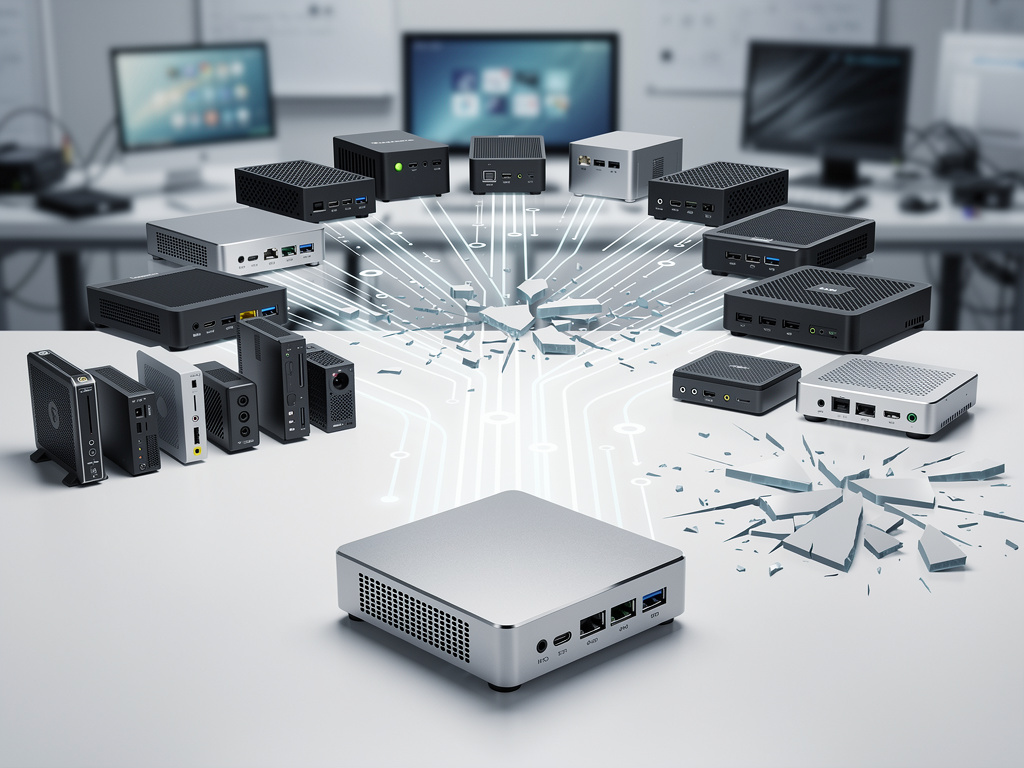
In the summer of 2023 Intel made a quiet announcement that rippled through the small-form-factor computing world. The company would stop direct investment in its Next Unit of Computing line. Partners could carry the torch. Most observers saw a sensible pivot toward core chipmaking priorities. Enthusiasts saw something else. They saw the end of a product family that had quietly become one of the most useful tools in the professional IT and home-lab arsenal.
That family began shipping in 2013. Early models used Sandy Bridge and Ivy Bridge mobile processors. They delivered reasonable performance inside a compact 4-by-4-inch chassis. Over the next decade the concept barely changed. Upgradeable SODIMM memory slots. Replaceable Wi-Fi cards. Storage options that fit the tiny board. Thunderbolt ports on many units. 2.5-gigabit Ethernet on later versions. The NUC was never the fastest machine on the market. But it rarely disappointed in the tasks that mattered to its users.
MakeUseOf captured the sentiment in an article published the same day this piece was prepared. The NUC, its writer observed, was the perfect mini PC for most users. It answered the Mac Mini directly. It excelled as an office workstation, a streaming box, a secondary machine for browsing and light productivity. Some owners turned them into Hackintosh systems before Apple Silicon ended that experiment. Others mounted them behind monitors with the included VESA brackets and forgot they existed until upgrade time came.
Intel itself never positioned the NUC as a flagship. Marketing emphasized reliability over spectacle. Even the occasional outlier, such as the Hades Canyon that paired an Intel CPU with an AMD GPU, felt like an experiment rather than a product strategy. The core appeal stayed consistent. Small size. Modest power draw. Enough ports and expansion to avoid feeling disposable. And that is precisely why its departure stings.
But Intel had larger problems. Manufacturing delays. Competitive pressure from AMD and later Qualcomm. CEO Pat Gelsinger’s plan to refocus the company on foundry leadership and advanced process technology left little room for assembling and selling complete systems. The July 2023 statement was blunt. “We have decided to stop direct investment in the Next Unit of Compute (NUC) Business and pivot our strategy to enable our ecosystem partners to continue NUC innovation and growth.” CRN reported the news alongside other divestitures. The NUC was simply one more non-core activity.
ASUS stepped in during 2024. The Taiwanese firm received a non-exclusive license. It began selling NUC-branded systems and continued some support obligations. Yet availability has remained spotty. ASUS updated its official discontinuation notice as recently as June 11, 2026. For the NUC 14 Pro, production ended on June 8, 2026. Software support continues until December 2027. Security updates run through June 2029. Similar staggered timelines apply to the NUC 13 Pro and older families. After those dates, no more driver, BIOS or firmware updates from the manufacturer. ASUS Support FAQ.
The vacuum left behind tells its own story. Hundreds of mini PCs now crowd retail sites. Chinese brands dominate with models that look similar on paper yet differ in thermal design, component quality and long-term driver support. GMKtec alone lists 39 variants. Many differ by only minor spec tweaks. Minisforum, Beelink, Geekom and others flood the channel with Ryzen and Intel Core Ultra machines. Some deliver strong performance for the price. Others cut corners on cooling or power delivery. The result is exactly the confusion XDA Developers described in January 2026. “It’s an absolute mess,” the article states. “Intel inadvertently created a mess and left the game without mopping up.”
That mess matters to industry buyers. System integrators who once specified a particular NUC model for thousands of digital-signage units or thin-client deployments now face a fragmented menu. Home-lab operators who appreciated consistent 2.5G Ethernet and straightforward Linux compatibility must now test each new vendor’s firmware. Even enthusiasts report frustration. One X user called a particular NUC “the best” while lamenting that the form factor never scaled further. Another noted Clear Linux ran gloriously on older NUC hardware before Intel discontinued that distribution too.
Look closer at the hardware that earned such affection. The NUC 12 Pro, codenamed Wall Street Canyon, earned PCMag’s Editors’ Choice in late 2022. It packed 12th-generation Alder Lake P-series processors, up to 64 gigabytes of DDR4, dual Thunderbolt 4 ports, Wi-Fi 6E and 2.5-gigabit Ethernet. All inside a chassis small enough to hide behind a monitor. Performance exceeded many 28-watt laptops of the era. Customizability remained high. PCMag review. The follow-on NUC 13 Pro and NUC 14 Pro pushed further with Raptor Lake and Meteor Lake silicon, adding AI acceleration capabilities that partners now market aggressively.
Yet those later models arrived just as Intel prepared its exit. The timing feels accidental. The company had refined the formula over ten years. It had solved the thermal, electrical and mechanical challenges of squeezing serious compute into a four-liter box. Then it handed the blueprint to others and walked away. The partners, free from Intel’s internal constraints, iterated quickly. Some added discrete graphics modules. Others embraced fanless designs or extreme miniaturization. The market exploded. Clarity suffered.
So what happens to the millions of NUCs already in the field? Many owners follow the advice laid out by MakeUseOf. Open the case. Clean the dust. Refresh the thermal paste. Reinstall a lightweight Linux distribution. Turn the box into a Plex server, a Pi-hole appliance or a dedicated 4K streaming client. The integrated graphics on even mid-generation NUCs handle modern codecs well. With fresh paste and updated drivers these machines remain useful long after their official support windows close.
Corporate IT departments face tougher choices. Warranty service still exists for units purchased through authorized channels, but the clock is ticking. Some organizations stockpile spare NUC 11 or NUC 12 units against future failures. Others have migrated to commercial mini PCs from Dell, Lenovo or HP that carry longer enterprise support commitments. The shift is pragmatic. It also marks the quiet passing of a product line that once felt almost personal.
And yet the idea refuses to die. Mini PCs sold under the NUC name still appear on Amazon, often powered by the latest Intel Core Ultra or AMD Ryzen chips. MSI offers its Cubi NUC series. ASUS continues limited ROG NUC gaming variants. Third-party clones flood the budget segment. The form factor Intel popularized has become commodity. Whether any single vendor can recapture the consistency and upgrade simplicity that defined the original line remains an open question.
Intel’s departure was a business decision. Few inside the company likely viewed it as the abandonment of a beloved product. From the outside the loss looks different. Here was a device that solved real problems for real users. It fit on a bookshelf, drew modest power, accepted standard memory and storage, and delivered years of service. It did not chase every trend. It simply worked.
That reliability is harder to find in today’s crowded mini-PC aisle. Buyers must dig through spec sheets, read obscure firmware notes and hope the chosen vendor stays in business long enough to ship updates. The contrast with the old Intel playbook is stark. One company set a standard. Many companies now chase volume. The result feels louder, faster and somehow less certain.
Perhaps the NUC’s real legacy is the expectation it created. Professionals now assume a competent computer can live in a four-inch cube. They expect upgrade paths even in compact systems. They measure new devices against the memory of a machine that rarely required excuses. Intel may have stopped making them. The standard it set continues to shape the category it helped invent.


 WebProNews is an iEntry Publication