
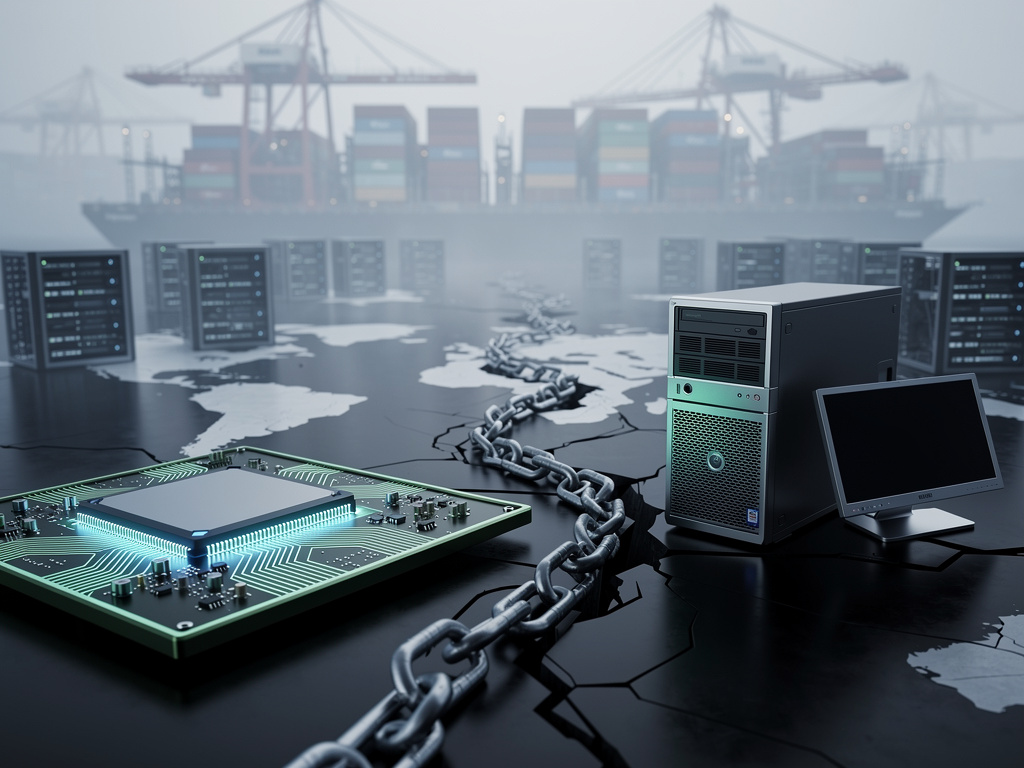
On a single trading day in late May 2025, Dell Technologies and HP Inc. each shed roughly 4% of their market value. The trigger wasn’t a product failure or an earnings miss. It was the return of tariff anxiety — a force that has become the defining variable for hardware companies trying to build a profitable future around artificial intelligence.
President Trump’s announcement of a 50% tariff on European Union imports, combined with a renewed threat of 25% levies on iPhones and other devices assembled outside the United States, sent shockwaves through the technology sector. But it was the PC and server makers — companies whose supply chains are deeply entangled with Asian manufacturing — that absorbed the hardest blows. Dell closed down about 4.1%, and HP dropped roughly 4.3%, according to reporting by The Information.
The sell-off wasn’t irrational. It was a market recalibrating the cost structures of companies that depend on global manufacturing networks to deliver everything from consumer laptops to enterprise AI servers. And it came at a moment when both Dell and HP were supposed to be riding a wave of AI-driven demand.
A Supply Chain Under Siege
To understand why tariffs hit Dell and HP so hard, you have to understand where their products are actually made. Dell assembles a significant portion of its servers and PCs in China, Vietnam, and other Southeast Asian countries. HP’s manufacturing footprint is similarly distributed across the region. When tariffs rise on goods flowing into the United States from these locations, margins compress — sometimes dramatically.
The 25% tariff threat on devices not manufactured domestically is particularly painful for HP, which ships tens of millions of consumer PCs annually. Dell faces a different but equally serious exposure on the enterprise side. Its PowerEdge server line, which has become a critical platform for deploying Nvidia GPUs in data centers, relies on components sourced globally. Higher input costs either eat into Dell’s margins or get passed along to enterprise buyers — neither outcome is good for the stock.
This isn’t the first time tariffs have disrupted these companies. During the first Trump administration, Dell and HP both scrambled to shift portions of their supply chains out of China. But reshoring is slow, expensive, and incomplete. Vietnam, which became a popular alternative, is itself now subject to elevated trade scrutiny.
The math is unforgiving. A 25% tariff on a $1,500 laptop means $375 in additional cost that has to go somewhere. Absorb it, and earnings suffer. Pass it on, and demand softens. There’s no clean answer.
Meanwhile, the broader tech sector felt the tremors. Apple dropped on the iPhone tariff threat. Semiconductor stocks wobbled. But Dell and HP, with their thinner margins and higher hardware exposure relative to software-heavy peers, were especially vulnerable.
And then there was the Nvidia story.
On the same day Dell and HP were falling, Nvidia found itself swatting down a different kind of headline. Reports had surfaced suggesting the chipmaker was exploring an acquisition — a claim Nvidia quickly denied, as The Information noted in its briefing. The denial was firm. But the mere existence of the rumor underscored how intensely the market is watching every move Nvidia makes as it cements its position at the center of the AI hardware economy.
Nvidia’s stock has been on a historic run, giving the company a market capitalization that dwarfs most of the companies it could theoretically acquire. That kind of valuation creates its own gravitational pull — analysts, traders, and rivals all assume that a company sitting on that much market power will eventually use it. So when acquisition chatter surfaces, it moves markets, even when the company says there’s nothing to it.
The juxtaposition of Dell and HP falling while Nvidia remained relatively stable tells you something about the current hierarchy in tech hardware. Nvidia designs the chips that everyone wants. Dell and HP build the boxes those chips go into. The chip designer captures the bulk of the value. The box builders fight over what’s left.
That dynamic has been true for years in the PC business, where Intel and AMD captured disproportionate profits relative to OEMs. Now it’s playing out again in AI infrastructure, with Nvidia in the dominant position.
The AI Demand Paradox
Here’s the strange part: demand for AI hardware has never been stronger. Hyperscale cloud providers — Microsoft, Google, Amazon, Meta — are spending tens of billions of dollars on data center buildouts. Dell has positioned itself as a key supplier of AI-optimized servers. HP has pushed into AI workstations and commercial PCs with dedicated neural processing units.
Both companies reported solid AI-related revenue growth in recent quarters. Dell’s Infrastructure Solutions Group, which includes its server business, has seen surging orders tied to AI deployments. HP has talked up the coming PC refresh cycle, driven partly by the integration of AI capabilities into enterprise machines running Windows.
But tariffs threaten to undercut the economics of that growth. If it costs more to build and ship an AI server, the margin on each unit shrinks — even as unit volumes rise. Revenue goes up. Profit doesn’t follow at the same rate. Wall Street notices.
There’s also a timing problem. Enterprise buyers planning large AI infrastructure purchases operate on long procurement cycles. They negotiate prices months in advance. When tariffs shift suddenly — as they have repeatedly under the current administration — vendors like Dell get caught between locked-in customer pricing and rising input costs. The squeeze is real.
Recent reporting from Reuters has highlighted how technology companies across the board are reassessing their supply chain strategies in response to the latest round of tariff escalations. Some are accelerating plans to diversify manufacturing into India and Mexico. Others are stockpiling inventory ahead of potential tariff implementation dates. None of these are cheap or simple fixes.
For Dell, the stakes are particularly high. The company has bet heavily on becoming the preferred infrastructure partner for enterprises building out AI capabilities. CEO Michael Dell has spoken publicly about the opportunity, framing it as a generational shift in enterprise IT spending. That narrative is compelling — but it assumes stable trade conditions that simply don’t exist right now.
HP faces a slightly different calculus. Its consumer PC business is more exposed to tariff-driven price increases than Dell’s enterprise-heavy mix. But HP’s commercial segment, which sells into large organizations, also faces pressure. IT budgets are finite. If hardware costs rise due to tariffs, something else gets cut — or the purchase gets delayed.
So both companies are caught in a bind. The demand is there. The ability to profitably fulfill that demand is what’s in question.
The market’s reaction on that late-May trading day was a signal. Not a panic. A signal that investors are repricing the risk embedded in hardware companies with global supply chains. Software companies, which ship products digitally and face minimal tariff exposure, didn’t take nearly the same hit. That divergence is telling.
It also raises a longer-term question about the structure of the AI hardware market. If tariffs become a permanent feature of U.S. trade policy — and there’s every indication they will — then companies like Dell and HP need to fundamentally rethink where and how they manufacture. That’s a multi-year, multi-billion-dollar undertaking. And it’s one that Nvidia, which designs chips but outsources fabrication to TSMC, doesn’t have to worry about in the same way.
The playing field isn’t level. It may not be for a long time.
For now, Dell and HP will keep pushing their AI stories. They’ll talk about server orders and PC refresh cycles and enterprise modernization. Those stories are real. But the tariff overhang is also real — and it’s the variable that neither company can control.
Investors who bought into the AI infrastructure thesis are learning a familiar lesson: in hardware, it’s never just about demand. It’s about cost, logistics, trade policy, and the thousand small decisions that determine whether a sale actually makes money. The AI boom is happening. Whether Dell and HP can fully capitalize on it depends on factors that have nothing to do with technology — and everything to do with geopolitics.
That’s the uncomfortable truth the market priced in on a single ugly afternoon.


 WebProNews is an iEntry Publication