
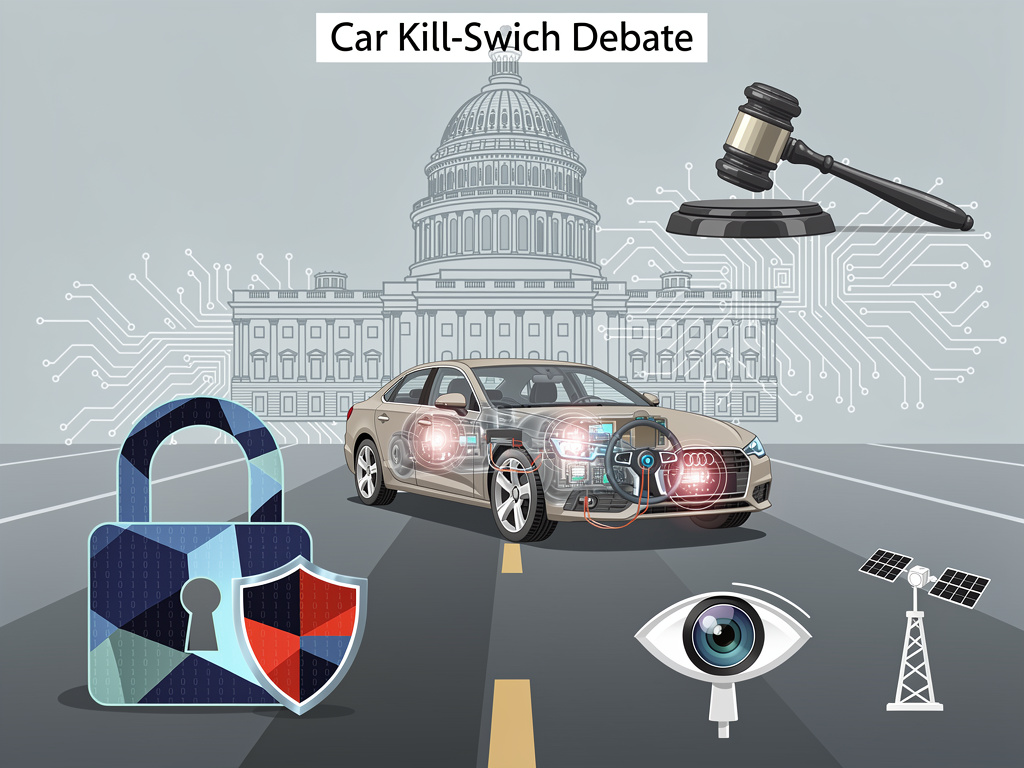
WASHINGTON—A quiet but consequential battle is raging over the future of the American automobile, and it has nothing to do with the transition to electric vehicles. Tucked deep within the 2021 Bipartisan Infrastructure Law is a provision, Section 24220, that directs federal regulators to mandate a new generation of safety technology in all new passenger vehicles. The goal is to passively detect and stop impaired drivers, a move hailed by safety advocates as a monumental step toward ending drunk driving fatalities. But a growing coalition of lawmakers and civil liberties groups see something more ominous: the dawn of a universal, government-mandated “kill switch” with profound implications for personal freedom, privacy, and cybersecurity.
The simmering conflict boiled over late last year when a legislative effort to defund the mandate was narrowly defeated on the House floor. An amendment proposed by Rep. Thomas Massie (R., Ky.) to a key transportation funding bill sought to prohibit the Department of Transportation from spending any funds to develop, finalize, or enforce the rule. The measure failed in a 201-229 vote, a close margin that signals the issue is far from settled. The failed repeal effort, highlighted in a report by Slashdot, ensures that the National Highway Traffic Safety Administration (NHTSA) will continue its work on a final rule, which is due by November 2024, keeping the controversial technology on a path toward becoming standard equipment in every new car and truck sold in the U.S. within the decade.
A Technological Mandate with Life-or-Death Stakes
The provision at the heart of the debate, officially part of the “Honoring Abbas Family Legacy to Terminate Drunk Driving Act,” requires NHTSA to set a federal standard for “advanced drunk and impaired driving prevention technology.” The language of the law is deliberately broad, calling for a system that can “passively monitor the performance of a driver of a motor vehicle to accurately identify whether that driver may be impaired.” If impairment is detected, the technology must be able to “prevent or limit motor vehicle operation.” Proponents, most notably Mothers Against Drunk Driving (MADD), championed the law as the most significant auto safety advancement since the airbag. According to MADD, the technology could save over 10,000 lives annually, a figure representing a large portion of the nation’s traffic fatalities.
The technology to meet such a mandate is no longer science fiction. Automakers are already deploying sophisticated Driver Monitoring Systems (DMS), primarily for semi-autonomous driving features like GM’s Super Cruise and Ford’s BlueCruise. These systems typically use steering wheel sensors and driver-facing infrared cameras to track eye movement and head position to ensure the driver remains attentive. The infrastructure law’s mandate would expand this concept to detect impairment from alcohol, drugs, or even distraction and drowsiness. Other potential methods being explored include touch-based sensors on the steering wheel or ignition button that can analyze blood alcohol levels through the skin, or ambient cabin sensors that can sample a driver’s exhaled breath. NHTSA is currently reviewing public comments on these technologies through an Advance Notice of Proposed Rulemaking, a process that will ultimately shape the final standard automakers must meet.
Privacy Advocates Raise Alarms Over In-Car Surveillance
For critics, the technological possibilities are precisely the problem. The prospect of a vehicle constantly monitoring its driver’s biometrics and behavior has raised significant alarms among privacy advocates and civil libertarians. “This is a privacy disaster in the making,” Rep. Massie wrote on X following the vote on his amendment. He and other opponents argue that the mandate effectively turns a private automobile into a tool of surveillance, collecting a trove of sensitive data on every trip. Key questions remain unanswered: Who owns this data? How will it be stored and protected? Could it be accessed by law enforcement without a warrant, or used by insurance companies to set premiums?
The concern is that the system’s scope could easily expand beyond its initial mission of stopping drunk drivers. A system capable of detecting alcohol impairment could potentially be modified to detect other behaviors the government or corporations wish to discourage. According to a detailed analysis by the news outlet Reason, the vague wording of the law leaves the door open for a system that could penalize drivers for a wide range of actions deemed unsafe, from eating while driving to showing signs of fatigue. This potential for “mission creep” is a central argument for those who believe the public safety benefits are outweighed by the erosion of personal autonomy and the creation of an unprecedented data collection apparatus.
The Specter of the Remote Kill Switch
Beyond passive data collection, the most contentious element of the mandate is the requirement that the system be able to “limit or prevent” the car’s operation. This has been widely interpreted as a “kill switch” that could leave a driver stranded. While proponents envision it as a life-saving intervention that stops an impaired person from starting a journey, critics point to the immense potential for error and abuse. A false positive could disable a vehicle in a dangerous situation—during a medical emergency, while fleeing a natural disaster, or in a high-crime area late at night. The liability for such failures would fall on automakers, who would be tasked with engineering a flawless system to comply with the government’s rule.
The cybersecurity implications are equally stark. Any system with the remote capability to disable a vehicle becomes a high-value target for malicious actors. Security experts warn that such a feature, if not perfectly secured, could be exploited by hackers to cause chaos, potentially disabling individual vehicles for ransom or even immobilizing entire fleets of cars at once. In an article for the Cato Institute, policy analyst Will Duffield argues that introducing this capability into every car creates a systemic vulnerability that could have catastrophic consequences for national security and public safety, far beyond the problem it is intended to solve.
The Road Ahead for Automakers and Regulators
With the repeal effort stalled, the automotive industry and federal regulators are now on the clock. NHTSA is tasked with delivering a final rule by November 2024, which will specify the technical requirements and performance standards for the anti-impairment systems. Once the rule is published, automakers will have approximately two to three years to implement the technology across all new vehicle production lines. This represents a monumental engineering, logistical, and financial challenge for an industry already grappling with the complex transition to electrification and advanced software integration.
The path forward is fraught with uncertainty. The final shape of the NHTSA rule will determine whether the technology is a minimally invasive safety feature or the intrusive surveillance system that critics fear. Legal challenges focused on Fourth Amendment protections against unreasonable searches are widely expected once a final rule is in place. Meanwhile, the narrow vote on the Massie amendment suggests the political fight is far from over, with future Congresses likely to revisit the issue. For now, the mandate remains the law of the land, placing the auto industry, regulators, and the American public on a collision course with a future where the car itself decides if you are fit to drive.


 WebProNews is an iEntry Publication