
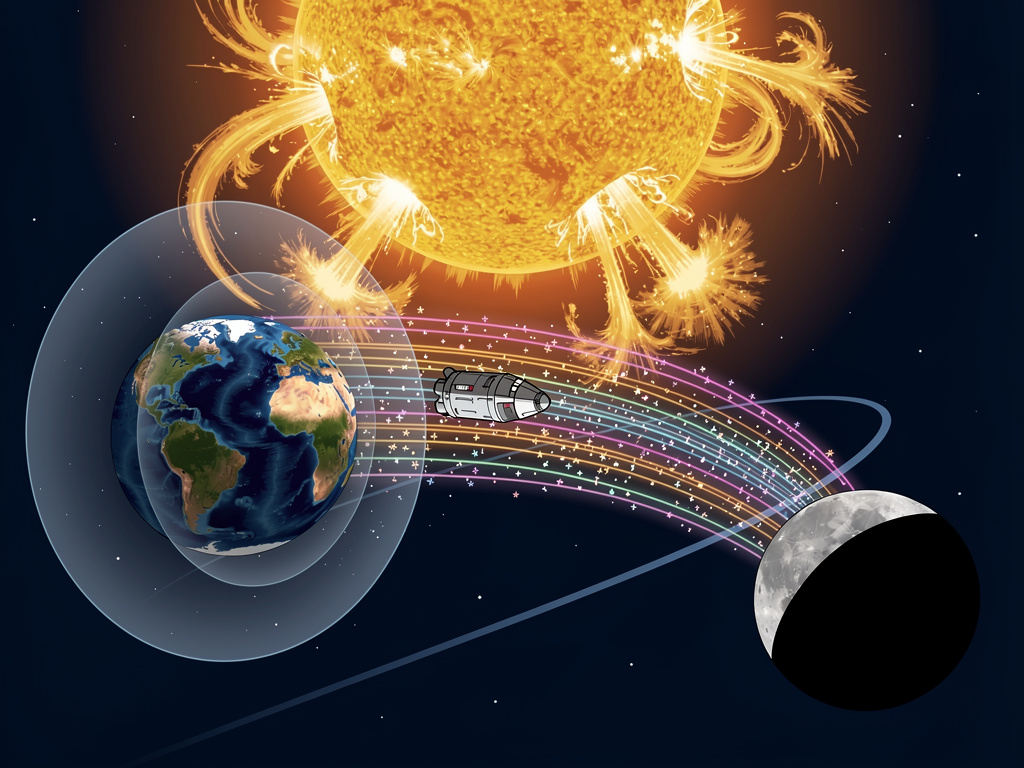
NASA has a spacecraft problem. Not the kind engineers can fix with a wrench or a software patch, but the kind that originates 93 million miles away on the surface of a roiling star. The sun’s current cycle of hyperactivity — the most intense in over two decades — is throwing a wrench into the agency’s plans to send astronauts around the moon aboard Artemis II, a mission already battered by delays, budget pressures, and technical setbacks.
The issue is straightforward in concept and devilishly complex in practice. Solar storms hurl charged particles and electromagnetic radiation toward Earth and everything in its vicinity, including spacecraft and the humans inside them. During periods of heightened solar activity, those storms become more frequent and more powerful. And right now, the sun is near the peak of Solar Cycle 25 — a peak that has dramatically exceeded predictions.
As Gizmodo reported, the sun’s latest outburst is actively complicating the timeline for Artemis II. NASA must ensure that the Orion capsule’s radiation shielding can adequately protect its four-person crew during a roughly 10-day trip around the moon and back. The spacecraft will venture beyond the protective cocoon of Earth’s magnetosphere — the magnetic field that deflects most solar radiation before it reaches the planet’s surface. Once outside that shield, astronauts become vulnerable in ways that crew aboard the International Space Station simply aren’t.
This isn’t a theoretical concern. It’s a mission-design constraint.
The Artemis II crew — NASA astronauts Reid Wiseman, Victor Glover, and Christina Koch, along with Canadian Space Agency astronaut Jeremy Hansen — would be the first humans to fly beyond low Earth orbit since Apollo 17 in December 1972. That mission flew during a relatively quiet stretch of solar activity. Artemis II won’t enjoy the same luxury.
Solar Cycle 25 began in December 2019, and forecasters at NOAA’s Space Weather Prediction Center initially expected a modest peak. They were wrong. The cycle has produced far more sunspots, solar flares, and coronal mass ejections than anticipated. In May 2024, Earth experienced its most severe geomagnetic storm in two decades, triggering aurora borealis visible as far south as Florida and northern Mexico. That storm originated from a massive sunspot cluster designated AR 3664, which unleashed multiple X-class flares — the most powerful classification — in rapid succession.
The effects on Earth were largely manageable: some GPS disruptions, minor power grid fluctuations, spectacular light shows. But for astronauts beyond the magnetosphere, the radiation dose from such an event could be dangerous. Potentially career-ending in terms of cumulative exposure limits. Possibly worse.
A Spacecraft Built for a Quieter Sun
Orion’s radiation protection architecture was designed with solar particle events in mind, but the intensity of Cycle 25 has forced NASA to reassess whether those protections are sufficient for the mission’s current window. The capsule includes a dedicated radiation shelter area where crew members can retreat during a solar storm, positioning themselves behind the densest parts of the spacecraft structure to reduce exposure. The European Service Module, built by the European Space Agency and Airbus, provides additional shielding.
But shielding has limits. And those limits matter more when the sun is this angry.
According to NASA’s own guidelines, astronauts face career exposure limits calibrated to keep their excess risk of fatal cancer below 3%. A single large solar particle event during a translunar coast could consume a significant portion of that lifetime allowance. The agency has invested in predictive models and real-time monitoring capabilities, but solar storms remain notoriously difficult to forecast with precision. Scientists can often identify when conditions are ripe for a major eruption. Predicting the exact timing, direction, and intensity of a coronal mass ejection remains elusive.
So NASA faces an unenviable calculus. Wait for solar activity to subside, and the mission slips further — adding to a delay tally that already stretches years. Push ahead, and the agency accepts elevated risk for its crew.
Artemis II was originally scheduled for a November 2024 launch. That date was pushed to September 2025, then again to April 2026. The delays stem from multiple factors: problems with Orion’s heat shield discovered after the uncrewed Artemis I flight in late 2022, issues with the spacecraft’s life support and environmental control systems, and concerns about bolt integrity in critical separation mechanisms. The solar radiation question adds yet another variable to an already crowded list of technical hurdles.
The heat shield issue alone consumed months of investigation. During Artemis I’s reentry, the heat shield experienced unexpected charring patterns — material loss that didn’t match pre-flight models. NASA concluded the anomaly wouldn’t have endangered a crew, but the agency ordered additional testing and analysis to understand the discrepancy before committing astronauts to the vehicle. That work has largely concluded, but it consumed schedule margin that didn’t exist.
Meanwhile, the Space Launch System rocket that will carry Orion to orbit has its own set of challenges. The SLS is the most powerful rocket NASA has ever built. It’s also phenomenally expensive. Each launch costs roughly $2.2 billion by the agency’s own estimates, a figure that draws persistent criticism from lawmakers and space policy analysts who point to the comparatively low per-launch costs of commercial vehicles like SpaceX’s Falcon Heavy and the forthcoming Starship system.
And yet SLS remains central to Artemis. For now.
The solar activity question intersects with broader debates about mission architecture and risk tolerance. During the Apollo era, NASA operated with a risk calculus that would be unacceptable today. The agency launched missions with failure probabilities that modern safety culture wouldn’t countenance. Apollo astronauts flew with rudimentary radiation monitoring — essentially dosimeters — and no real-time solar weather forecasting capability. They were lucky. No Apollo mission coincided with a major solar particle event, though a large flare erupted in August 1972 between the Apollo 16 and Apollo 17 missions. Had astronauts been in transit during that event, the consequences could have been severe.
NASA knows this history well. It informs every decision about Artemis crew safety.
The agency’s current approach involves close coordination with NOAA’s Space Weather Prediction Center and the use of advanced heliophysics missions — including the Parker Solar Probe and the Solar Dynamics Observatory — to monitor solar conditions in near-real-time. Launch windows can theoretically be adjusted based on solar forecasts, but the logistics of SLS processing at Kennedy Space Center make last-minute schedule changes extraordinarily difficult. The rocket requires weeks of stacking and testing in the Vehicle Assembly Building before rollout to the launch pad. Once on the pad, the vehicle has limited time before weather, technical, and scheduling constraints force a return to the assembly building.
This rigidity is a design feature of a government-built, government-operated launch system. It’s also a vulnerability when the mission timeline must flex around an unpredictable star.
Some space radiation researchers have argued that NASA should consider flying Artemis II during the descending phase of the solar cycle, when activity begins tapering off but before the next solar minimum. Solar Cycle 25 is expected to reach its maximum sometime in 2025 — though pinpointing the exact peak is only possible in retrospect — and then gradually decline over the following years. A 2027 or 2028 launch window could offer more favorable radiation conditions, though it would mean yet another significant delay for a program that’s already under intense Congressional scrutiny.
Budget pressures compound the problem. NASA’s Artemis program competes for funding with the agency’s science missions, its commercial crew and cargo programs, and an expanding portfolio of lunar surface initiatives including the Gateway orbital station and the Human Landing System contracts awarded to SpaceX and Blue Origin. Every month of delay adds cost. Every cost overrun invites oversight hearings.
The Trump administration has signaled strong support for returning Americans to the moon, but that support comes with expectations of visible progress. Artemis II is supposed to be that progress — the dramatic, crew-aboard demonstration flight that proves NASA can send humans beyond Earth orbit again. Pushing the mission further right undermines that narrative.
But launching into a solar storm undermines something more fundamental.
Industry observers note that the radiation challenge isn’t unique to Artemis. Any crewed mission beyond low Earth orbit — whether to the moon, Mars, or a near-Earth asteroid — must contend with the space radiation environment. Galactic cosmic rays, which originate outside the solar system, pose a constant background threat that’s actually worse during solar minimum when the sun’s magnetic field provides less deflection. Solar particle events are episodic but potentially acute. The optimal window is somewhere in between: enough solar activity to suppress cosmic rays, not so much that a major flare becomes likely during the mission.
Finding that window is part science, part art, part luck.
For Artemis II specifically, the mission’s relatively short duration — about 10 days — limits cumulative cosmic ray exposure. The primary concern is a discrete solar particle event during the roughly four days the crew would spend beyond the magnetosphere. NASA’s operational plan includes abort options that could shorten the translunar portion of the mission if solar conditions deteriorate, but those abort trajectories have their own constraints and can’t guarantee a rapid return to Earth’s protective magnetic field.
The crew, for their part, has continued training throughout the delays. All four astronauts are experienced spaceflyers except Hansen, who will be making his first trip to orbit. They’ve trained extensively on radiation emergency procedures, including rapid repositioning within the Orion cabin to maximize shielding during a solar event. They understand the risks. Astronauts always do.
What remains unclear is whether NASA’s institutional risk tolerance — shaped by the Challenger and Columbia disasters, by decades of safety culture evolution, by the knowledge that the world will be watching — will permit a launch during a period of elevated solar activity. The agency has never had to make this specific decision before. Apollo-era managers didn’t have the data or the models to fully appreciate what they were risking. Today’s managers have both. That knowledge is simultaneously a tool and a burden.
The sun, indifferent to schedules and budgets and political imperatives, will do what it does. NASA’s task is to find a way forward that respects both the ambition of returning humans to deep space and the obligation to bring them home alive. Those two imperatives aren’t in conflict — not yet. But the margin between them is thinner than anyone at the agency would like.
And the sun isn’t done.


 WebProNews is an iEntry Publication