
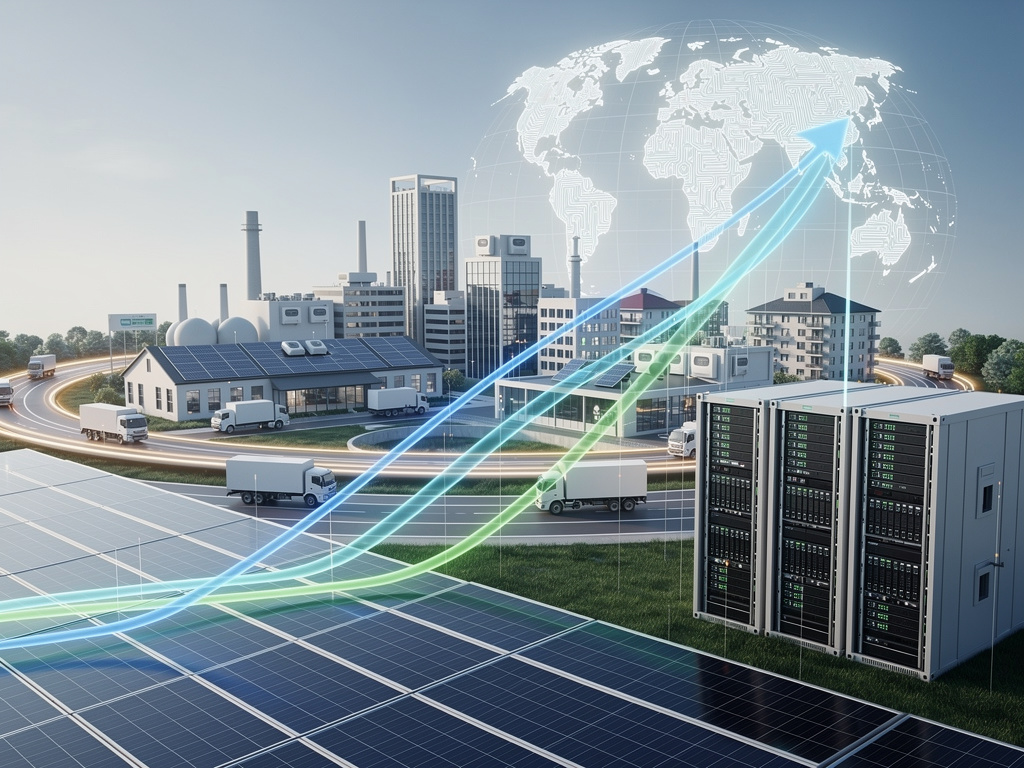
Something extraordinary is happening in global energy markets, and most people — including many industry professionals — haven’t fully grasped its speed or scale. Solar photovoltaics and lithium-ion batteries are on exponential cost curves that show no sign of flattening. The implications are staggering. Not just for electricity grids, but for transportation, heating, industrial processes, and the geopolitical order that fossil fuels built over the past century.
Tom Brown, an energy system researcher and professor at TU Berlin, laid out the case in striking detail on his blog nworbmot.org, arguing that we are heading toward a world where solar and batteries dominate not just power generation but the entire energy system. His analysis, grounded in learning curve data and systems modeling, suggests that solar electricity will become so cheap — potentially below 1 US cent per kilowatt-hour in sunny regions — that it will be economical to use it for almost everything, even processes where massive energy losses occur in conversion.
This isn’t a fringe prediction. The International Energy Agency’s latest projections, which have historically underestimated solar deployment by enormous margins, now show solar becoming the single largest source of electricity generation globally before 2030. BloombergNEF’s latest New Energy Outlook models a world where solar and wind provide the majority of global electricity by mid-century, with batteries handling an increasing share of short-duration storage.
But Brown’s argument goes further than most mainstream forecasts dare. Much further.
The Learning Curve That Won’t Quit
The core of the argument rests on one of the most powerful empirical regularities in industrial economics: Wright’s Law, also known as the learning curve or experience curve. Every time cumulative production of solar panels doubles, costs fall by roughly 25-30%. For lithium-ion batteries, the figure is around 20-25%. These relationships have held for decades across multiple doublings of production volume. Solar module prices have dropped by more than 99% since the 1970s. Battery pack prices have fallen roughly 90% since 2010.
What makes this so consequential right now is the sheer scale of current deployment. Global solar installations hit approximately 444 gigawatts in 2023, according to the IEA, and are projected to exceed 500 GW in 2024. China alone is installing solar at a pace that would have seemed hallucinatory five years ago — roughly 300 GW of new solar capacity was connected to the Chinese grid in the first half of 2024 alone, as reported by Reuters.
Each gigawatt installed makes the next gigawatt cheaper. And cheaper panels drive more installations, which drive further cost reductions. It’s a flywheel. Once it gets spinning fast enough, it becomes nearly impossible to stop.
Brown points out on his blog that solar and battery costs are now falling so fast that they’re outpacing even optimistic projections from just two or three years ago. The implications ripple outward. When electricity from solar becomes cheap enough, it starts to make economic sense to electrify processes that currently run on fossil fuels — even when the conversion is inefficient. Think electric heating, green hydrogen production via electrolysis, direct air capture of CO2, and synthetic fuel manufacturing. The raw economics start to work when your input electricity costs almost nothing for large portions of the day.
This is a critical conceptual point that many energy analysts miss. Efficiency matters less when your energy source is extraordinarily cheap and abundant during peak production hours. A process that wastes 70% of input energy can still be economical if that input energy costs a fraction of a cent per kilowatt-hour.
The math is brutal for incumbents.
Consider natural gas power plants. A new combined-cycle gas turbine might produce electricity at 4-6 cents per kWh, depending on gas prices. Solar-plus-battery systems in favorable locations are already contracting below 3 cents per kWh for dispatchable power. In some Middle Eastern and North African tenders, solar PV alone has come in below 1.5 cents per kWh. As battery costs continue to decline — and they are declining at roughly 15-20% per year — the crossover point where solar-plus-storage undercuts gas on a fully dispatchable basis is arriving in market after market.
Coal is already uncompetitive with new solar in most of the world. The remaining holdouts are places with very cheap domestic coal and limited solar resources. Those holdouts are shrinking.
Nuclear power, which generates electricity at roughly 10-18 cents per kWh for new builds in Western countries, faces an even more daunting cost gap. Brown argues on nworbmot.org that nuclear’s role in a solar-battery world becomes increasingly marginal, not because of safety or waste concerns, but simply because it can’t compete on cost. The learning curves for nuclear have historically gone in the wrong direction — costs have increased with each generation of reactors in most Western nations, a phenomenon sometimes called the “negative learning curve.”
Small modular reactors, often cited as nuclear’s salvation, have yet to demonstrate cost competitiveness at scale. NuScale, the most advanced SMR project in the United States, saw its first commercial project canceled in late 2023 after cost estimates ballooned to roughly $89 per MWh — more than triple the cost of new solar in the same region, as Utility Dive reported.
The Storage Problem Is Becoming the Storage Solution
The most common objection to a solar-dominated energy system is intermittency. The sun doesn’t shine at night. It shines less in winter, especially at higher latitudes. Clouds exist. These are real physical constraints, and they matter enormously for grid planning.
But the objection is weakening rapidly, for two reasons.
First, battery costs are plummeting. Lithium iron phosphate (LFP) battery cells from Chinese manufacturers like CATL and BYD are now available at prices below $60 per kilowatt-hour at the cell level, according to recent reporting from Bloomberg. At the pack level, prices are approaching $100/kWh. The industry consensus target of $50/kWh at the pack level — once considered aspirational for 2030 — now looks achievable by 2027 or sooner at current trajectories.
At these prices, four hours of battery storage added to a solar installation becomes remarkably cheap. Eight hours becomes feasible. And for the daily cycle — storing midday solar surplus for evening and nighttime use — batteries are already the most cost-effective solution in many markets.
Second, and less appreciated, is the sheer overcapacity strategy that cheap solar enables. Brown makes a compelling case on his blog that when solar panels cost very little, it becomes rational to massively overbuild solar capacity relative to peak demand. If you install three or four times the solar capacity you need at peak, you generate significant power even on cloudy days and during winter months at higher latitudes. Yes, you’ll curtail enormous amounts of solar generation on sunny summer days. But if the panels are cheap enough, the economics still work. You’re paying for the energy you need during the worst hours, and the surplus is essentially free.
This overbuilding strategy, combined with batteries for daily cycling and some form of longer-duration storage or flexible demand for multi-day and seasonal gaps, can get you to extremely high penetrations of solar in the energy mix. Brown’s modeling work at TU Berlin, published in peer-reviewed journals, has shown that solar-plus-battery systems can meet 80-90% of electricity demand even in relatively northern countries like Germany, if you’re willing to overbuild and accept curtailment.
The remaining 10-20% — the genuinely hard part, covering extended cloudy periods in winter — can be addressed through a combination of strategies: some wind power (which tends to produce more in winter), flexible demand, interconnections with sunnier regions, and green hydrogen or other stored fuels for the worst weeks. This is not a trivial engineering challenge. But it’s a much smaller problem than skeptics suggest, and it gets smaller every year as batteries improve and costs fall.
China is already demonstrating what this looks like in practice. The country installed more battery storage in 2023 than the rest of the world combined. Provinces like Xinjiang and Inner Mongolia are building massive solar-plus-storage complexes that dwarf anything seen in Western countries. The scale is almost incomprehensible to those accustomed to the pace of energy infrastructure development in Europe or North America.
And the deployment is accelerating. Chinese manufacturers are scaling production so aggressively that there’s now a global oversupply of both solar panels and batteries. Module prices have fallen below $0.10 per watt in Chinese wholesale markets — a level that would have been considered impossible just five years ago. This oversupply is painful for manufacturers’ margins, but it’s spectacular for deployment. Cheap hardware means more installations, which means more learning, which means even cheaper hardware.
The United States, despite significant policy support through the Inflation Reduction Act, is deploying at a fraction of China’s pace. Permitting delays, interconnection queues, trade barriers, and local opposition continue to slow projects. The Lawrence Berkeley National Laboratory reported that the average wait time for projects in U.S. interconnection queues now exceeds five years. This is a policy and institutional failure, not a technology problem.
Europe faces similar constraints, though the EU’s REPowerEU plan and individual national policies are pushing deployment faster than historical trends. Germany, despite its reputation as a solar leader, installed only about 14 GW of solar in 2023 — impressive by European standards, but roughly one-twentieth of China’s pace on a per-capita-adjusted basis.
The geopolitical implications are profound. A world powered primarily by solar and batteries is a world where energy production is far more distributed than today’s fossil fuel system. Every country has sunlight. Not every country has oil, gas, or coal. The Middle East’s strategic importance, built on petroleum reserves, diminishes in a solar world. Russia’s leverage over European energy supply evaporates. The petrodollar system faces structural challenges.
But new dependencies emerge. China dominates solar panel manufacturing, battery production, and the processing of critical minerals like lithium, cobalt, and rare earths. Roughly 80% of global solar module manufacturing capacity sits in China. For batteries, the concentration is similarly stark. This has prompted significant policy responses in the U.S. and Europe — tariffs, subsidies for domestic manufacturing, critical mineral agreements — but reshaping these supply chains takes years, and China’s cost advantages are formidable.
What the Incumbents Get Wrong
The fossil fuel industry’s response to the solar-battery juggernaut has been a mix of denial, delay, and partial adaptation. Some oil majors, notably in Europe, have invested in renewables and battery storage. Others, particularly U.S.-based companies, have doubled down on hydrocarbon production, betting that demand will persist for decades.
They’re not entirely wrong about demand persistence. Aviation, shipping, heavy industry, and petrochemicals will continue to consume fossil fuels for years. But the electricity sector — which accounts for roughly 40% of global CO2 emissions — is where the transition is happening fastest, and it’s happening faster than virtually any major oil company’s planning scenario assumed even three years ago.
Brown’s analysis on nworbmot.org suggests that the endgame is more radical than most incumbents acknowledge. In his view, solar and batteries don’t just replace coal and gas in the power sector. They eventually replace fossil fuels in transportation (through electric vehicles), in heating (through heat pumps powered by solar electricity), and in significant portions of industrial processes (through direct electrification or green hydrogen). The timeline is uncertain. The direction is not.
Electric vehicles are already following a similar learning curve dynamic. Battery costs drive EV prices, and as those costs fall, EVs reach price parity with internal combustion vehicles in segment after segment. China’s BYD is now selling EVs for under $10,000 in its domestic market. In Europe and the U.S., price parity for mass-market segments is expected within the next two to three years, even without subsidies.
The transportation transition reinforces the electricity transition. Every EV on the road is a source of flexible demand and, potentially, mobile battery storage. Vehicle-to-grid technology, while still nascent, could eventually turn millions of parked EVs into a distributed storage network that helps balance solar intermittency. The synergies are real.
Heat pumps represent another front. A modern heat pump delivers three to four units of heat for every unit of electricity consumed. Powered by solar electricity, a heat pump is dramatically cheaper to operate than a gas boiler, even in cold climates. European heat pump sales surged in 2022 following the gas price spike triggered by Russia’s invasion of Ukraine, though they’ve since moderated as gas prices partially recovered. The long-term trajectory, however, is clear. As electricity costs fall and gas infrastructure ages, electrified heating will win on economics alone.
So where does this leave us? In a world where the dominant energy technology is a semiconductor — the silicon solar cell — rather than a combustion process. Where energy storage is electrochemical rather than geological. Where the fundamental economics of energy are governed by manufacturing learning curves rather than resource extraction costs.
This is a world of abundance, not scarcity. Solar radiation hitting the Earth’s surface in a single hour contains more energy than humanity uses in an entire year. The constraint has never been the resource. It’s been the cost of converting that resource into useful energy. That constraint is dissolving.
Not evenly. Not without disruption. Not without losers. Fossil fuel workers, petrostates, utilities that bet wrong, manufacturers that moved too slowly — all will bear costs. The transition will be messy, politically contentious, and unevenly distributed across geographies and income levels.
But the learning curves don’t care about politics. They don’t care about lobbying or legacy infrastructure or sunk costs. They just keep grinding prices down, doubling after doubling, year after year. And every year that passes, the window for competing technologies to catch up narrows further.
The sun is eating the energy system. The batteries are helping it digest.
The only real question left is how fast the rest of the world’s institutions — grids, markets, regulations, trade policies — can adapt to a reality that the technology has already decided.


 WebProNews is an iEntry Publication