
Walk into any American grocery store and the math tells a familiar, frustrating story for the plant-based meat industry. A pound of Beyond Meat burger patties still runs roughly $9 to $12, while conventional ground beef sits comfortably at $5 to $6. Nearly a decade after plant-based proteins burst onto the mainstream market with promises of price parity, the gap remains stubbornly wide — and the reasons are more structural, political, and economic than most consumers realize.
The plant-based meat sector, once hailed as the future of protein, has entered a period of reckoning. Sales have plateaued after an initial surge of curiosity-driven purchases, stock prices of publicly traded companies like Beyond Meat have cratered from their IPO highs, and the fundamental promise that these products would eventually become cheaper than animal meat remains unfulfilled. Understanding why requires examining a web of factors that span from factory floors to the halls of Congress.
Scale Remains the Industry’s Most Elusive Prize
The single largest driver of the price disparity is scale — or rather, the lack of it. As Business Insider reported, plant-based meat manufacturers are still producing at volumes that are a fraction of what conventional meat processors handle. Tyson Foods, JBS, and Cargill process billions of pounds of animal protein annually across sprawling networks of facilities that have been optimized over decades. Beyond Meat and Impossible Foods, by contrast, operate a handful of plants that run well below capacity.
Manufacturing plant-based meat is surprisingly complex. The extrusion process that gives products like the Beyond Burger and Impossible Burger their fibrous, meat-like texture requires specialized equipment that is expensive to purchase, install, and maintain. When those machines aren’t running at full capacity — and right now, with demand softening, they often aren’t — the per-unit cost of production stays elevated. It is a vicious cycle: high prices suppress demand, and suppressed demand prevents the scale that would lower prices.
The Hidden Hand of Government Subsidies
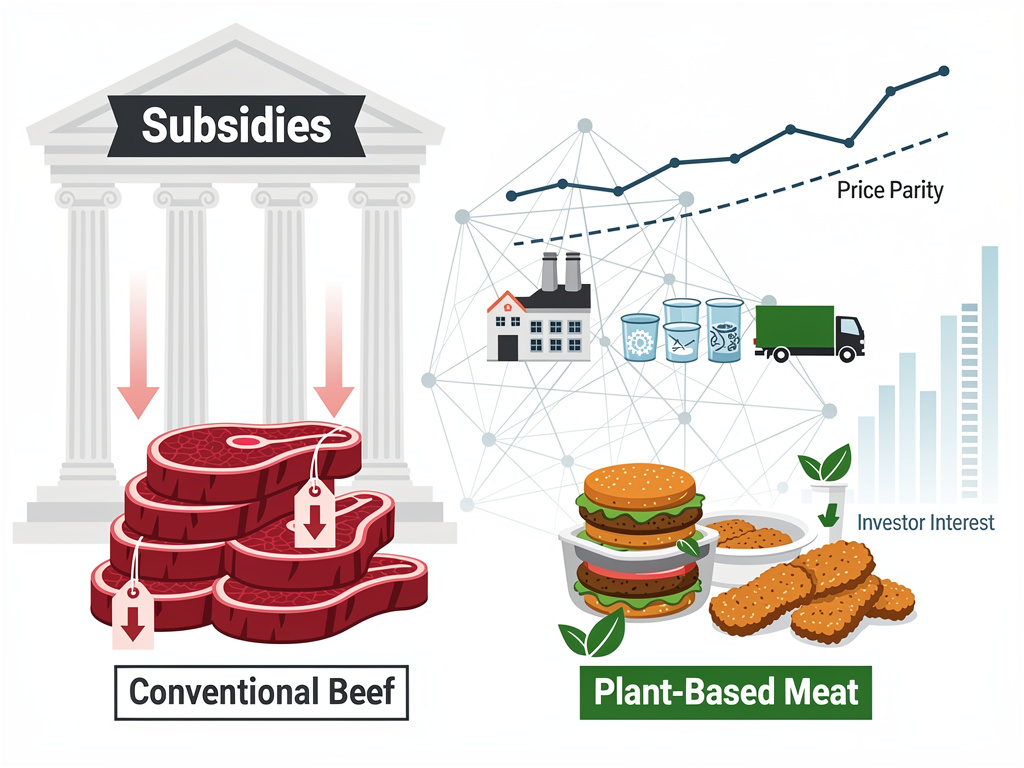
Perhaps no factor distorts the competitive playing field more than federal agricultural subsidies. The U.S. government has spent decades — and hundreds of billions of dollars — supporting the conventional livestock industry through direct payments, crop insurance, and subsidized feed grain programs. Corn and soybeans, the primary feed crops for cattle, hogs, and poultry, receive enormous federal support that effectively lowers the input costs for animal agriculture.
According to research from the American Journal of Public Health and reporting by Business Insider, the U.S. government has allocated roughly $38 billion annually in agricultural subsidies, with the vast majority flowing to animal agriculture and its feed crops. Plant-based protein companies receive virtually none of this support. The result is an artificially cheap conventional meat supply competing against plant-based products that must bear the full, unsubsidized cost of their ingredients and production. If subsidies were stripped away and the environmental externalities of animal agriculture — including greenhouse gas emissions, water pollution, and antibiotic resistance — were priced in, the cost comparison would look dramatically different.
Ingredient Costs and Supply Chain Immaturity
The ingredients themselves present another cost challenge. Plant-based meats rely on protein isolates — highly refined extracts from peas, soybeans, or other legumes — that require significant processing to produce. Pea protein isolate, a cornerstone ingredient for Beyond Meat, must be separated, purified, and concentrated before it can be used, adding cost at every step. The supply chain for these specialty ingredients is still maturing, with fewer suppliers and less competition than the commodity markets that supply conventional meat producers.
Beyond the primary protein source, plant-based meats require a roster of functional ingredients — methylcellulose for binding, coconut oil or cocoa butter for fat, beet juice extract for color — each of which adds to the bill of materials. Conventional ground beef, by contrast, is a relatively simple product: muscle tissue, fat, and not much else. The complexity of formulating a convincing plant-based analog means more ingredients, more processing steps, and higher costs. Some companies have explored simplifying their formulations to reduce costs, but doing so risks compromising the taste and texture that consumers expect.
Retail Margins and the Premium Positioning Trap
Grocery retailers also play a role in keeping prices high. Plant-based meats are typically merchandised as premium, specialty products, and retailers apply margins accordingly. While conventional ground beef often serves as a loss leader — priced low to draw shoppers into the store — plant-based alternatives carry margins that can exceed 35 to 40 percent. Retailers have little incentive to compress those margins on products that occupy a small fraction of the meat case.
There is also a branding and positioning problem. Companies like Beyond Meat and Impossible Foods initially marketed their products as premium alternatives, emphasizing taste, sustainability, and innovation. That premium positioning justified higher price points during the initial launch phase, but it has become a trap as the industry matures. Consumers who might be willing to try plant-based meat at price parity with conventional beef balk at paying a 50 to 100 percent premium, particularly during a period of persistent grocery inflation that has made shoppers more price-sensitive than they have been in years.
Demand Has Cooled, and Investors Have Noticed
The financial trajectory of the sector’s most prominent companies tells a sobering story. Beyond Meat’s stock, which soared above $230 per share shortly after its 2019 IPO, has traded in the single digits for much of the past year. The company has posted consecutive years of declining revenue and has struggled to achieve profitability. Impossible Foods, which remains private, has also reportedly seen sales growth stagnate after an initial period of rapid expansion.
Venture capital and private equity funding for plant-based protein companies has dried up considerably compared to the boom years of 2019 through 2021. According to data tracked by the Good Food Institute, global investment in alternative proteins fell sharply in 2023 and 2024, reflecting broader investor skepticism about the sector’s near-term growth prospects. Without fresh capital, companies have less ability to invest in the production capacity expansions and R&D improvements that could eventually drive costs down.
International Competition and Regulatory Headwinds
Globally, the picture is mixed. In parts of Europe and Asia, plant-based meat companies have made more progress on pricing, partly because conventional meat prices are higher in those markets and partly because some governments have been more willing to support alternative protein development. In the United States, however, regulatory headwinds have added to the industry’s challenges. Several states have passed or proposed labeling laws that restrict the use of terms like “meat” and “burger” on plant-based products, adding compliance costs and potentially confusing consumers.
The political environment has also shifted. With agricultural lobbying groups pushing back aggressively against what they characterize as unfair competition from plant-based companies, and with some lawmakers openly hostile to the sector, the prospect of favorable policy changes — such as subsidies for plant-based protein crops or carbon pricing that would increase the cost of conventional meat — appears remote in the current Congress.
What Would It Take to Close the Gap?
Industry analysts and company executives point to several potential pathways to price parity, though none are imminent. First, achieving significantly higher production volumes would spread fixed costs across more units and lower per-unit pricing. Second, advances in fermentation technology and ingredient processing could reduce the cost of key inputs like protein isolates. Third, greater competition among ingredient suppliers — already beginning to emerge as agricultural giants like ADM and Cargill invest in plant protein processing — could drive down raw material costs.
Some companies are also pursuing a different strategy entirely: rather than trying to replicate the exact taste and texture of conventional meat at a premium price, they are developing simpler, less processed plant-based products that can be sold at lower price points. These products may not fool a dedicated carnivore in a blind taste test, but they could appeal to the much larger pool of flexitarian consumers who are willing to eat plant-based meals if the price and convenience are right.
The Road Ahead Is Long, and Paved With Structural Disadvantages
The plant-based meat industry faces a fundamental challenge that no amount of clever marketing can solve: it is trying to compete against a century-old, heavily subsidized, massively scaled incumbent industry while bearing the full cost of building a new supply chain from scratch. The economics of food production are unforgiving, and the margin for error is thin.
For consumers who buy plant-based meat for environmental or ethical reasons, the premium may be worth paying. But for the industry to achieve its stated ambition of meaningfully displacing conventional animal protein, it must find a way to compete on price. Until that happens — through some combination of scale, innovation, policy change, and supply chain maturation — plant-based meat will remain what it has been for the past several years: a niche product with mainstream aspirations, sitting on the grocery shelf at a price that most shoppers are unwilling to pay.


 WebProNews is an iEntry Publication