
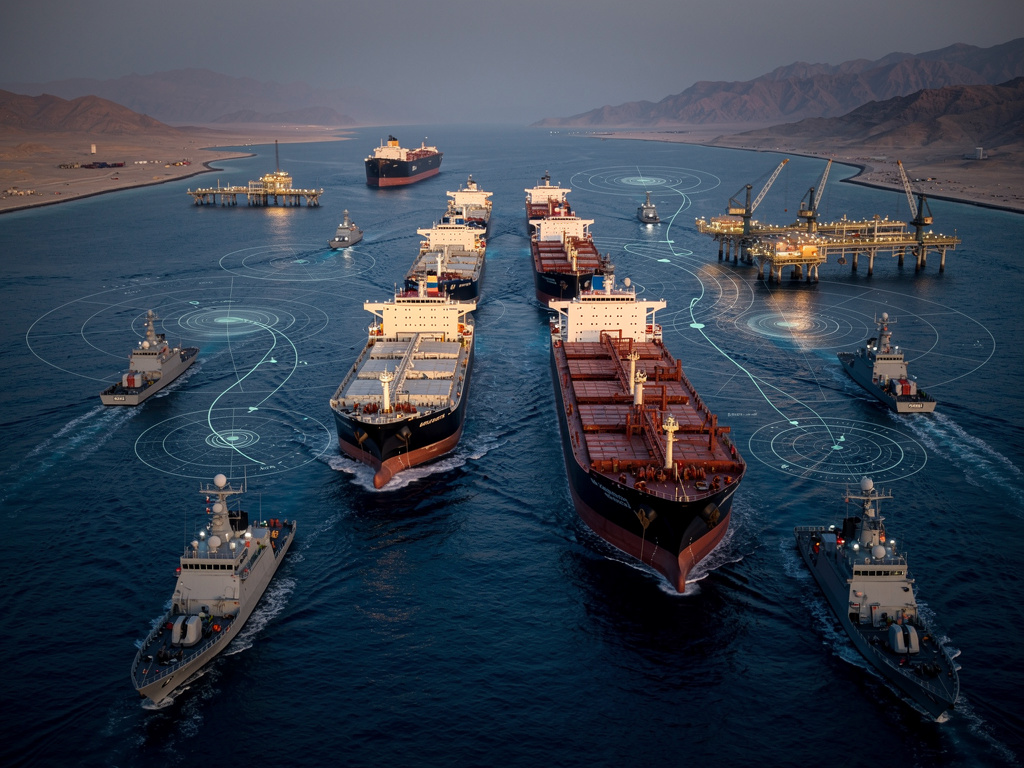
For decades, the implicit promise was simple: the United States Navy would keep the world’s most vital shipping lanes open, and global commerce would flow. That promise is now under extraordinary strain.
The Strait of Hormuz — a narrow chokepoint between Iran and Oman through which roughly 20% of the world’s oil supply passes daily — has once again become the focal point of geopolitical brinkmanship. But this time, the dynamics are different. The Trump administration’s escalating confrontation with Iran, combined with shifting American attitudes about the costs of policing global trade routes, has raised a question that energy markets, shipping executives, and allied governments are struggling to answer: Can the world still count on the U.S. as the guarantor of freedom of navigation?
The answer, increasingly, is not obvious.
A Guardian Role Under Siege
As Fortune reported, confidence in the United States’ willingness and capacity to serve as the guardian of global shipping has eroded sharply in recent months. The erosion isn’t primarily about military capability — the U.S. Fifth Fleet, headquartered in Bahrain, remains the most formidable naval force in the Persian Gulf by a wide margin. It’s about political will. And signals.
The Trump administration has sent a carrier strike group to the region while simultaneously making public statements that some analysts interpret as laying the groundwork for a military confrontation with Tehran. The paradox is stark: the same administration projecting force in the Gulf has also, through tariff policies and transactional rhetoric toward allies, undermined the multilateral framework that has historically underpinned collective maritime security. South Korea, Japan, and European nations — all heavily dependent on Gulf oil transiting Hormuz — are recalculating their assumptions about American reliability.
“The issue isn’t whether the U.S. can keep Hormuz open,” one London-based shipping analyst told clients in a recent note. “It’s whether the current political leadership views that mission as serving American interests or everyone else’s.”
That distinction matters enormously. The U.S. imports relatively little oil through Hormuz compared to Asian and European buyers. American shale production has transformed the country’s energy posture. So the old argument — that keeping Hormuz open protects American energy security — has weakened, even if disruptions there would still send global oil prices soaring and damage the U.S. economy through second-order effects.
According to the U.S. Energy Information Administration, approximately 17 million barrels of oil per day flowed through the Strait of Hormuz in recent years, making it the single most important oil transit chokepoint on Earth. Liquefied natural gas shipments from Qatar, the world’s largest LNG exporter, also pass through the strait. A sustained closure — even a partial one — would trigger an energy crisis dwarfing anything seen since the 1970s Arab oil embargo.
Iran knows this. It has known it for decades. And Tehran has built an asymmetric military strategy around that knowledge, investing heavily in fast-attack boats, anti-ship missiles, naval mines, and drone capabilities specifically designed to threaten commercial shipping in and around Hormuz. The Islamic Revolutionary Guard Corps Navy, distinct from Iran’s conventional navy, has rehearsed strait-closure scenarios repeatedly. Their doctrine doesn’t require winning a conventional naval battle. It requires creating enough chaos, enough risk, that insurers balk, tanker operators reroute, and oil prices spike.
That’s the leverage Iran holds. Not military superiority. Fear.
And fear, in shipping markets, translates directly into cost. War risk insurance premiums for vessels transiting the Persian Gulf have already climbed in recent weeks, according to Lloyd’s of London market sources. Tanker operators are watching the situation hour by hour. Some have begun quietly exploring alternative routing, though for Gulf-origin crude there is no real alternative to Hormuz — the only other export pipeline with meaningful capacity is Saudi Arabia’s East-West pipeline to the Red Sea port of Yanbu, which can handle roughly 5 million barrels per day at maximum throughput. That’s a fraction of what moves through the strait.
The Red Sea itself, of course, has its own problems. Houthi attacks on commercial shipping, which escalated dramatically in late 2023 and continued into 2024 and beyond, have already demonstrated how non-state actors can disrupt major trade arteries. The U.S.-led Operation Prosperity Guardian attempted to restore confidence in Red Sea transit but achieved only partial success. Some of America’s closest allies declined to participate. Others joined but questioned the sustainability of the mission.
These two crises — Hormuz and the Red Sea — are not unrelated. They represent a broader pattern: the global shipping system that the postwar American security order was built to protect is facing simultaneous threats at multiple chokepoints, and the political consensus in Washington for bearing the cost of that protection is fraying.
The Economics of Uncertainty
Oil markets have responded with predictable nervousness. Brent crude futures have shown increased volatility, with traders pricing in a growing risk premium tied to Gulf tensions. But the market response so far has been measured rather than panicked — partly because global oil inventories are adequate, partly because traders have been burned before by pricing in Middle East conflicts that didn’t materialize into actual supply disruptions.
That relative calm could evaporate quickly. A single incident — an Iranian mine striking a tanker, a miscalculated drone strike, even a near-miss that goes viral on social media — could trigger a price spike of $10 to $30 per barrel within days. Goldman Sachs analysts have modeled scenarios in which a full Hormuz closure, sustained for even two weeks, could push Brent above $150 per barrel. The inflationary consequences would be immediate and global.
For the shipping industry specifically, the stakes extend beyond oil. Container shipping routes connecting Asia to Europe and the Middle East would face disruption. Dry bulk carriers loading grain and minerals at Gulf ports would be affected. The entire logistics chain serving Gulf Cooperation Council economies — construction materials, consumer goods, industrial equipment — runs through waters that Iran can threaten.
Shipping companies are not sitting idle. Maersk, Hapag-Lloyd, and other major carriers have updated contingency plans. Some operators have accelerated investments in vessel tracking and communication systems designed to improve situational awareness in high-risk zones. But contingency planning has limits when the fundamental question is whether a state actor will choose to weaponize a waterway.
The insurance market is the canary in the coal mine. Lloyd’s Joint War Committee, which designates listed areas where vessels face elevated risk, has maintained the Persian Gulf on its watch list for years. But the practical impact — the actual premium charged for a single transit — fluctuates with geopolitical temperature. Right now, that temperature is rising. Shipowners report that war risk premiums for Gulf transits have increased by 30% to 50% in recent weeks, though they remain well below the spikes seen during the 2019 tanker attacks attributed to Iran.
Those 2019 incidents are instructive. In June and July of that year, several tankers were attacked near the strait — limpet mines, in most assessments, placed by Iranian operatives. The attacks were calibrated: damaging but not catastrophic, enough to send a message without triggering a full military response. The Trump administration at the time came close to retaliating militarily but pulled back. Iran learned that the threshold for American military action was higher than many assumed.
That lesson hasn’t been forgotten in Tehran. And it raises an uncomfortable possibility: Iran may calculate that it can engage in limited provocations — harassing tankers, seizing vessels under various pretexts, conducting “exercises” that disrupt traffic — without crossing the line into open conflict. This gray-zone strategy is precisely the kind of challenge that’s hardest for a conventional military superpower to counter. You can’t sink a speedboat that’s merely circling your tanker. You can’t shoot down a drone that’s merely surveilling your carrier.
But you can lose the confidence game. And that’s what’s happening.
Allied nations are increasingly hedging. Japan has explored bilateral security arrangements with Gulf states. South Korea has discussed expanding its naval presence in the region. European nations, already stretched thin by commitments in the Baltic and Mediterranean, are debating whether they need an independent Gulf maritime security capability — something that would have been unthinkable a decade ago when American supremacy in the region was taken for granted.
The irony is thick. The Trump administration’s “America First” posture, which frames alliance commitments as transactional arrangements where partners must pay their fair share, may be accelerating exactly the kind of independent allied military capacity that reduces American influence in the long run. If Japan and South Korea build their own Gulf security capabilities, they’ll also build their own relationships with Gulf states — relationships that don’t necessarily run through Washington.
What Comes Next
The near-term trajectory depends heavily on the diplomatic track with Iran, which is currently moribund. Nuclear negotiations have stalled. Sanctions remain in place. Back-channel communications exist but are fragile. And domestic politics in both Washington and Tehran reward hawkishness over compromise.
Iran’s economy, battered by years of sanctions, gives Tehran both motivation to escalate — to force concessions — and motivation to restrain itself, since a full-blown conflict would be economically catastrophic. The regime’s calculus is further complicated by internal dissent and succession questions surrounding the supreme leader’s eventual departure from the political stage.
For the global shipping industry, the immediate priority is information. Real-time intelligence about Iranian naval movements, updated risk assessments from insurers, and clear communication from the U.S. military about rules of engagement in the strait. The United Kingdom Maritime Trade Operations center in Dubai and the U.S. Naval Forces Central Command both provide advisories, but shipowners complain that the information is often too general to be operationally useful.
The deeper issue is structural. The post-1945 global trading system was built on the assumption that the world’s dominant naval power would keep the sea lanes open as a public good. That assumption held through the Cold War, through the Gulf Wars, through the piracy crisis off Somalia. It held because American policymakers, regardless of party, broadly accepted the logic: open sea lanes benefit everyone, including the United States, and the cost of maintaining them is worth bearing.
That consensus is cracking. Not broken — not yet. The Fifth Fleet is still there. Carrier strike groups still deploy. But the rhetoric has changed. The framing has shifted. And in international relations, perception shapes reality as powerfully as aircraft carriers do.
So the world watches Hormuz. Again. The strait is only 21 miles wide at its narrowest point. Shipping lanes for inbound and outbound traffic are each just two miles wide, separated by a two-mile buffer zone. Every day, tankers carrying a fifth of the world’s oil supply thread through this slender passage, relying on a security architecture that was designed in a different era, for a different America, under assumptions that may no longer hold.
Twenty-one miles. That’s the distance between stability and crisis. And right now, it feels shorter than ever.


 WebProNews is an iEntry Publication