
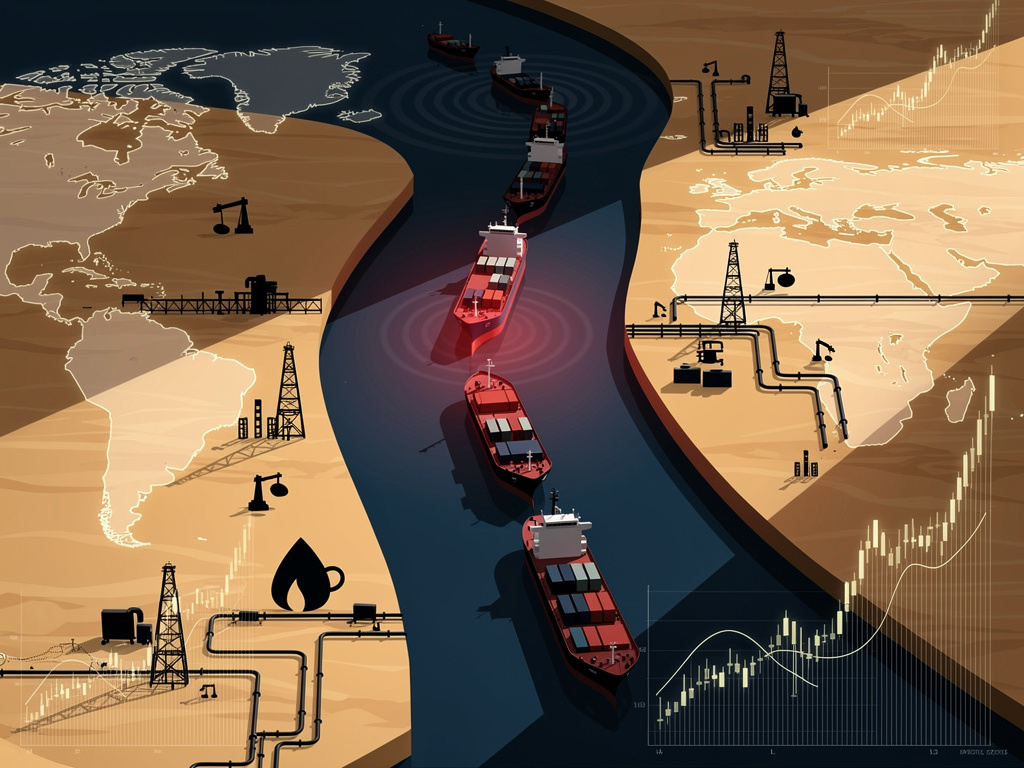
Somewhere between the jagged coastline of Iran and the rocky tip of Oman lies a narrow waterway no wider than 21 miles at its tightest point. Through it passes roughly one-fifth of the world’s daily oil supply — about 21 million barrels every single day. Tankers carrying crude from Saudi Arabia, Iraq, Kuwait, the UAE, and Qatar all funnel through this bottleneck before reaching open ocean. It is, by virtually every measure, the most economically significant strait on Earth.
And Iran controls its northern shore.
The Strait of Hormuz has been a flashpoint for decades, but the current collision course between Washington and Tehran has injected fresh urgency into a scenario that energy analysts, military planners, and economists have long dreaded: a full or partial closure of the strait. The consequences wouldn’t be confined to oil markets. They would cascade through global supply chains, spike inflation in already-strained economies, and potentially trigger a worldwide recession. Not a theoretical one. A real, grinding downturn.
As Futurism recently outlined, the math is brutally simple. The Strait of Hormuz handles approximately 20 to 21 percent of global petroleum consumption. Removing even a fraction of that volume from world markets would send oil prices into triple digits almost overnight. During the 2019 attacks on Saudi Aramco facilities — which temporarily knocked out about 5.7 million barrels per day of Saudi production — Brent crude jumped nearly 15 percent in a single trading session. A sustained closure of Hormuz would dwarf that disruption by orders of magnitude.
Iran has never been shy about brandishing this threat. Senior military commanders from the Islamic Revolutionary Guard Corps have repeatedly stated that if Iran’s oil exports are strangled by sanctions, no other nation’s oil will pass through the strait either. It’s a doctrine of mutual economic destruction, and it carries weight precisely because the geography makes it plausible. The shipping lanes through Hormuz are only about two miles wide in each direction, separated by a two-mile buffer zone. A few well-placed mines, a swarm of fast attack boats, or anti-ship cruise missiles fired from Iran’s mountainous coastline could render those lanes impassable — at least temporarily.
The Iranian military has spent years preparing for exactly this scenario. Its arsenal includes thousands of naval mines, many of them sophisticated modern designs capable of distinguishing between vessel types. The IRGC Navy operates hundreds of small, fast boats designed for swarm tactics in confined waters. And Iran’s shore-based anti-ship missile batteries, including Chinese-derived C-802 variants and domestically produced systems, can cover the entire width of the strait from hardened positions along the coast. According to reporting by Futurism, these capabilities give Iran what military strategists call an asymmetric advantage — the ability to impose enormous costs on a far more powerful adversary at relatively low expense.
But would Iran actually do it?
That question has haunted policymakers for decades, and the answer depends heavily on context. A full closure of the strait would be an act of war, not just against the United States but against virtually every major economy on the planet. China, India, Japan, and South Korea all depend heavily on Gulf oil transiting Hormuz. Even European nations that have diversified their energy sources would feel the shock through global price mechanisms. Iran’s leadership understands this, which is why the threat has historically functioned as a deterrent rather than an operational plan.
Yet deterrents only work when the party making the threat believes it has something left to lose. And that calculus shifts dramatically when a nation feels cornered. The Trump administration’s “maximum pressure” campaign, which pulled the U.S. out of the 2015 nuclear deal and reimposed crushing sanctions, pushed Iran’s economy to the brink. Oil exports plummeted. Inflation soared. The rial collapsed. In that environment, Iranian hardliners argued that the cost of closing Hormuz might actually be worth paying — because the status quo was already catastrophic.
The current geopolitical moment is, if anything, even more volatile. Tensions between the U.S. and Iran have escalated sharply in 2025, with renewed confrontations over Iran’s nuclear program and its support for proxy forces across the Middle East. Recent reporting indicates that Iran has accelerated uranium enrichment to levels that bring it closer to weapons-grade material than ever before. The diplomatic channels that once provided off-ramps have narrowed considerably.
What a Closure Would Actually Look Like
The immediate impact of a Hormuz closure would hit energy markets like a sledgehammer. Oil prices would likely spike to $150 per barrel or higher within days, according to estimates from multiple energy research firms. For context, when oil hit $147 per barrel in July 2008, it helped tip the global economy into the worst financial crisis since the Great Depression. And the world was in considerably better fiscal shape then than it is now.
But crude oil is only part of the story. Qatar — the world’s largest exporter of liquefied natural gas — ships virtually all of its LNG through the Strait of Hormuz. A closure would simultaneously disrupt global natural gas markets at a time when Europe remains acutely sensitive to supply shocks following the disruption of Russian pipeline gas. Asian LNG importers, particularly Japan and South Korea, would face immediate supply emergencies.
Then there’s the insurance market. The moment hostilities commence in or near the strait, war risk premiums on tanker insurance would skyrocket. Many shipping companies would simply refuse to send vessels into the area regardless of price. This happened on a smaller scale during the so-called “Tanker War” phase of the Iran-Iraq conflict in the 1980s, when both nations attacked commercial shipping in the Gulf. The U.S. eventually intervened with Operation Earnest Will, escorting reflagged Kuwaiti tankers through the strait. A modern equivalent would require a massive naval commitment.
The U.S. Fifth Fleet, headquartered in Bahrain, maintains a significant presence in the region precisely for this contingency. Carrier strike groups, mine countermeasure vessels, and submarine assets are regularly rotated through the area. But clearing a mined strait is painstaking, dangerous work. During the 1991 Gulf War, two U.S. Navy ships — the USS Tripoli and USS Princeton — struck Iraqi mines in a single day. Iran’s mining capability is far more extensive than Iraq’s was, and the confined geography of Hormuz makes mine clearance operations exceptionally hazardous.
Military analysts generally estimate that a determined Iranian mining campaign could close or severely restrict the strait for weeks to months, even against a full-scale U.S. military response. The economic damage during that period would be staggering. Goldman Sachs and other major banks have previously modeled scenarios in which a Hormuz closure lasting just two weeks could shave a full percentage point off global GDP growth. A longer disruption could trigger outright contraction in multiple major economies simultaneously.
The ripple effects would extend far beyond energy. Petrochemical feedstocks, fertilizers, and plastics all derive from Gulf hydrocarbons. Food prices — already elevated globally — would surge as transportation and production costs climbed. Emerging market economies with large fuel import bills and limited foreign exchange reserves would face balance-of-payments crises. Some might default on sovereign debt.
Stock markets would crater. Not gradually. Violently.
There are, of course, mitigating factors. The world has built strategic petroleum reserves specifically for supply emergencies. The U.S. Strategic Petroleum Reserve, despite drawdowns in recent years, still holds hundreds of millions of barrels. The International Energy Agency coordinates emergency stock releases among its member nations. Saudi Arabia and the UAE have invested in pipeline infrastructure that can bypass the strait, routing some oil exports through the Red Sea and the Gulf of Oman. But these alternatives can only partially offset the loss of Hormuz transit capacity. They buy time. They don’t solve the problem.
Alternative shipping routes exist in theory but not in practice at the necessary scale. The Saudi East-West Pipeline can carry about 5 million barrels per day to the Red Sea port of Yanbu, but it doesn’t run at full capacity and couldn’t be ramped up instantly. The UAE’s Habshan-Fujairah pipeline moves about 1.5 million barrels per day to a port on the Gulf of Oman, outside the strait. Together, these pipelines could handle perhaps a third of the oil that normally transits Hormuz. The rest would simply be stranded.
And here’s the part that rarely gets discussed in mainstream coverage: the psychological impact on markets would likely exceed the physical disruption. Oil prices are set at the margin. It doesn’t take the removal of 21 million barrels per day to cause a price spike — just the credible threat of sustained disruption. Traders would front-run the crisis, hoarding contracts and driving prices higher in anticipation of shortages that might not fully materialize. Panic, in commodity markets, is its own accelerant.
Iran’s leaders know all of this. The threat to close Hormuz isn’t really about closing Hormuz. It’s about the credible ability to do so, and the enormous economic leverage that credibility provides. It transforms a mid-sized economy with a GDP smaller than Turkey’s into a nation capable of holding the global financial system hostage. No nuclear weapon required.
So the question isn’t whether Iran could close the Strait of Hormuz. It demonstrably can, at least temporarily. The question is what combination of pressure, miscalculation, or desperation might push Tehran to actually pull the trigger. History suggests that nations facing existential threats — or believing they face existential threats — make decisions that look irrational in hindsight but feel inevitable in the moment. The Gulf of Tonkin. The Falklands. Iraq’s invasion of Kuwait.
For now, the strait remains open. Tankers transit daily. Oil flows. Markets function. But the margin of safety is thinner than most investors, consumers, and policymakers appreciate. Twenty-one miles of water. Twenty-one million barrels a day. And a government that has made clear, repeatedly and publicly, that it views this chokepoint as its ultimate card to play.
The global economy’s most critical supply line runs through a corridor narrow enough to see both shores from the deck of a ship. That fact alone should keep strategists up at night. In 2025, it does.


 WebProNews is an iEntry Publication