
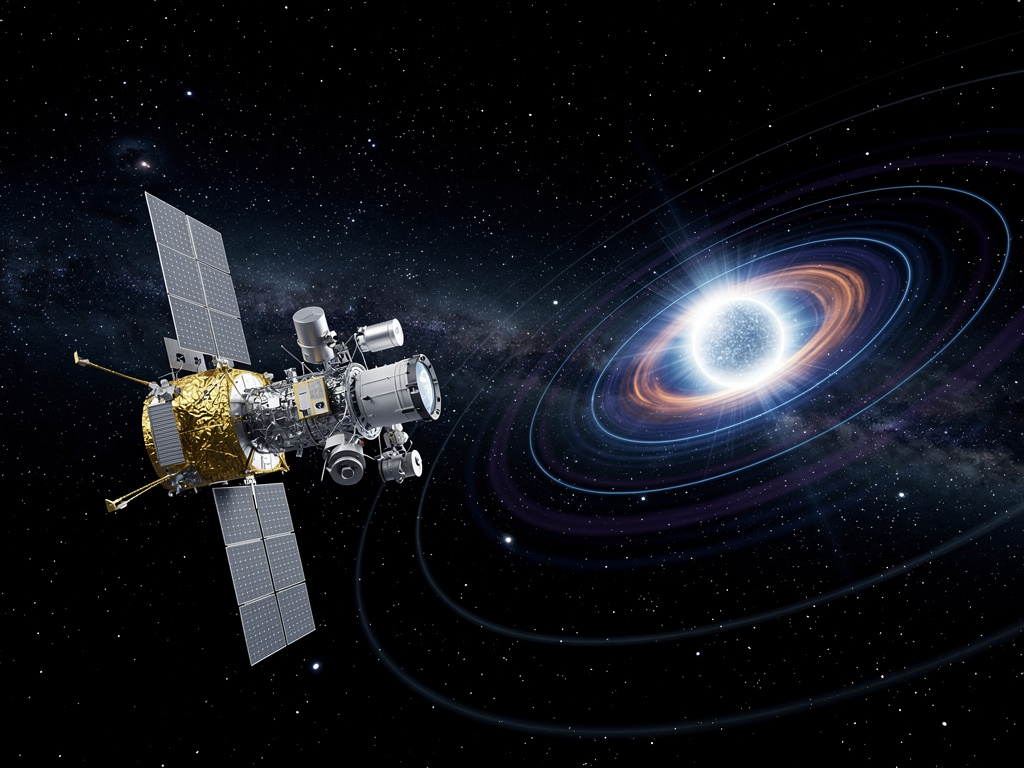
Somewhere in the direction of the constellation Ophiuchus, roughly 2,000 light-years from Earth, a dead star sits in quiet defiance of decades of astrophysical theory. It weighs about 2.09 times the mass of our Sun — a figure that, by the established rules of stellar death, should be impossible.
The object is a neutron star. Or at least, it should be. But it’s too heavy to be a neutron star by most models. And it’s too light to be a black hole. It exists in what physicists have long called the “mass gap” — a theoretically forbidden zone between roughly 2 and 5 solar masses where nothing was supposed to survive.
Now a team of astronomers, using data from the European Space Agency’s Gaia satellite combined with ground-based spectroscopy, has confirmed its existence. The discovery, published in the journal Astronomy & Astrophysics, doesn’t just add a curiosity to the catalog of known objects. It forces a reckoning with our understanding of how massive stars die, how matter behaves under the most extreme pressures in the universe, and whether the neat categories we’ve drawn around compact objects were ever correct in the first place.
As Futurism reported, the object was identified through careful analysis of a binary star system — a visible Sun-like companion star orbiting an unseen partner. The companion’s wobble, tracked over time by Gaia’s precision astrometry, betrayed the presence of something massive and dark. Follow-up spectroscopic observations pinned down the orbital parameters, and with them, the invisible object’s mass.
2.09 solar masses. Right in the gap.
Why the Mass Gap Matters — and Why Breaking It Changes Everything
To understand why this discovery carries such weight, you need to understand how stars end their lives. When a massive star exhausts its nuclear fuel, its core collapses. If the original star was between about 8 and 25 solar masses, the collapse produces a neutron star — an object so dense that a teaspoon of its material would weigh roughly a billion tons. The theoretical upper limit for a neutron star has traditionally been placed around 2 to 2.2 solar masses, a boundary known as the Tolman-Oppenheimer-Volkoff (TOV) limit.
Above that limit, gravity should win. The core should collapse further, past the neutron star stage, all the way to a black hole. But here’s the problem: the lightest known black holes weigh in at around 5 solar masses. That leaves a conspicuous void — the mass gap — where theory predicted nothing should form.
For years, the gap was treated as settled science. Supernova physics, the thinking went, simply didn’t produce remnants in that range. The explosion dynamics, the neutrino-driven winds, the fallback of material — all of it conspired to skip over the 2-to-5 solar mass window. Some theorists argued the gap was an artifact of observational bias. Others insisted it was real, a genuine feature of stellar evolution encoded in the physics of core collapse.
This new object sits squarely where nothing was supposed to be.
The research team, led by astronomers in Europe, was careful to rule out alternative explanations. Could the unseen companion be a white dwarf? No — white dwarfs max out at about 1.4 solar masses, the Chandrasekhar limit. Could it be two smaller objects masquerading as one? The orbital dynamics don’t support it. Could systematic errors in the Gaia data be inflating the mass estimate? The team ran extensive checks and found the measurement robust within its uncertainties.
What they’re left with is a compact object that defies clean classification. It might be the heaviest neutron star ever confirmed — which would mean our understanding of the equation of state of ultra-dense nuclear matter needs revision. The equation of state describes how matter behaves at densities exceeding those found in atomic nuclei, and it remains one of the great unsolved problems in physics. A neutron star at 2.09 solar masses would push the TOV limit higher than many models allow, implying that nuclear matter is stiffer — more resistant to compression — than previously thought.
Alternatively, it could be the lightest black hole ever found. That possibility carries its own implications. If black holes can form at masses this low, then the supernova mechanisms that produce them are more varied and less predictable than current simulations suggest. It would mean the mass gap isn’t a gap at all, but a region we simply hadn’t looked hard enough to populate.
There’s a third option, more exotic and speculative: the object could be something entirely new. Some theoretical physicists have proposed the existence of “strange stars” — compact objects composed not of neutrons but of strange quark matter, a hypothetical state in which quarks are deconfined from their usual homes inside protons and neutrons. Strange stars could, in principle, occupy mass ranges forbidden to conventional neutron stars. No strange star has ever been confirmed, but an object in the mass gap would be a tantalizing candidate.
The discovery arrives at a moment when the mass gap is already under siege from multiple directions. In 2019, the LIGO and Virgo gravitational wave detectors picked up a signal — designated GW190814 — from the merger of a 23-solar-mass black hole with a 2.6-solar-mass object. That smaller companion sat firmly in the gap, and its nature remains debated. Was it the heaviest neutron star or the lightest black hole ever detected through gravitational waves? Nobody knows for certain.
Then in 2024, additional gravitational wave events and electromagnetic observations continued to chip away at the gap’s boundaries. Each new detection in or near the forbidden zone weakened the case that the gap was a hard physical limit rather than a statistical artifact of small sample sizes.
But gravitational wave detections, while powerful, are fleeting. They capture mergers — violent, one-time events. The new Gaia-based discovery is different. This is a persistent system. The compact object and its companion are orbiting each other right now, available for repeated observation across multiple wavelengths and over extended timescales. That makes it an extraordinarily valuable laboratory.
Future observations could nail down the object’s nature. X-ray telescopes might detect emissions characteristic of matter accreting onto a neutron star surface — something a black hole, which has no surface, wouldn’t produce. Radio observations could search for pulsations. If the object is a rapidly spinning neutron star with a strong magnetic field, it might reveal itself as a pulsar, emitting beams of radio waves with clockwork regularity.
And then there’s the equation of state question, which has implications far beyond astrophysics. The behavior of matter at neutron-star densities connects to fundamental questions in quantum chromodynamics — the theory governing the strong nuclear force. Laboratory experiments on Earth, including heavy-ion collisions at facilities like CERN and Brookhaven, can probe similar physics, but only at temperatures and densities far from those found in neutron star cores. Every well-characterized neutron star, especially one at the extreme end of the mass range, provides data that no terrestrial experiment can replicate.
The Gaia satellite, operated by the European Space Agency, wasn’t designed specifically to hunt for mass-gap objects. Its primary mission is to create a three-dimensional map of roughly two billion stars in the Milky Way, measuring their positions, distances, and motions with unprecedented precision. But that precision has turned it into a remarkably effective tool for finding dark companions — objects that emit little or no light but betray their presence through gravitational influence on visible partners. The current discovery is one of several in recent years where Gaia’s astrometric data has revealed hidden compact objects that traditional surveys missed.
So where does this leave the mass gap? Probably not as a clean, inviolable boundary. The accumulating evidence — from gravitational waves, from Gaia, from X-ray binaries — suggests that compact objects do form in the 2-to-5 solar mass range, even if they’re rare. The question is shifting from “does the gap exist?” to “why are objects in the gap so uncommon, and what formation channels produce them?”
Some of those channels might involve binary star interactions. A neutron star that accretes material from a companion could, in principle, gain enough mass to push into the gap before the accretion process is disrupted. Alternatively, the merger of two neutron stars — an event known to occur, as spectacularly demonstrated by the 2017 detection of GW170817 — could produce a remnant in the gap, at least temporarily, before it either stabilizes or collapses to a black hole.
The theoretical landscape is rich and contested. But the new observation adds something theory alone cannot: a real object, in a real binary system, with a well-constrained mass, sitting exactly where it shouldn’t be.
For astrophysicists, that’s not a problem. That’s a gift.


 WebProNews is an iEntry Publication