
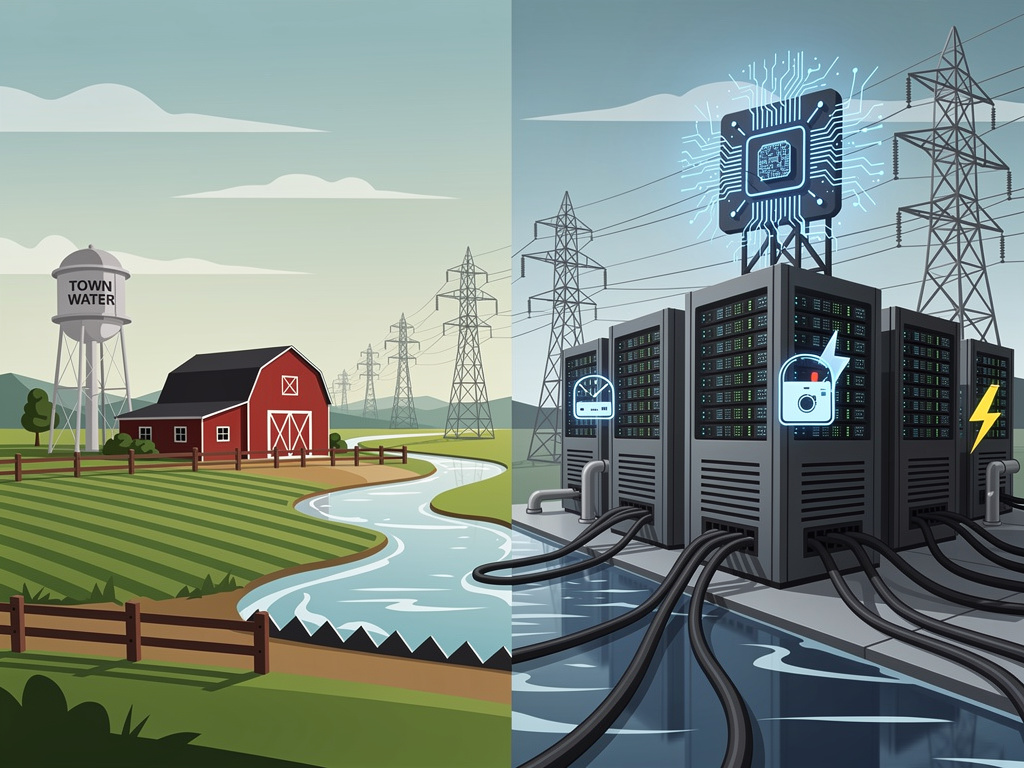
In the rolling farmlands of eastern Washington, a battle is brewing that pits some of America’s most powerful technology companies against residents of communities where cattle outnumber people. At stake is something both sides consider essential: for tech giants, the vast amounts of electricity needed to power artificial intelligence; for locals, the character and sustainability of their hometowns.
According to The Wall Street Journal, residents in places like Quincy, Washington—a town of roughly 8,000 people—are organizing to resist the proliferation of data centers that have transformed their communities over the past two decades. What began with Microsoft’s arrival in 2007 has accelerated dramatically with the artificial intelligence boom, as companies race to build the infrastructure necessary to train increasingly sophisticated AI models.
The tension reflects a fundamental disconnect in how America’s digital economy develops. While coastal executives and investors celebrate each breakthrough in machine learning, the physical infrastructure supporting these advances concentrates in rural areas where electricity is cheap and land is plentiful. The result is a collision between two Americas—one racing toward an AI-powered future, the other trying to preserve a way of life.
The Electricity Arms Race Reshaping Rural Communities
The numbers tell a stark story. Quincy’s Grant County now hosts more than 30 data centers, consuming electricity at rates that dwarf residential and agricultural use combined. These facilities, often windowless warehouses stretching across dozens of acres, have fundamentally altered the economic and physical character of communities that were, until recently, defined primarily by agriculture.
The influx hasn’t come without benefits. Data centers have brought jobs, tax revenue, and infrastructure improvements to areas that had seen decades of economic stagnation. Yet many residents question whether the tradeoff is worth it. “We’ve become a colony for Big Tech,” one local activist told The Wall Street Journal, capturing the sentiment that decisions affecting their daily lives are being made in distant boardrooms.
Water, Power, and the Hidden Costs of AI Training
The environmental implications extend beyond electricity consumption. Modern data centers require enormous quantities of water for cooling, placing additional strain on resources in regions where water rights have been contested for generations. In areas of the West already grappling with drought and competing demands from agriculture, municipalities, and ecosystems, the arrival of water-intensive data centers adds another layer of complexity.
Industry representatives argue that data centers represent efficient use of resources, pointing to innovations in cooling technology and commitments to renewable energy. Several major tech companies have pledged to achieve carbon neutrality or to power their operations entirely with clean energy. However, critics note that these commitments often rely on renewable energy credits rather than direct power sources, and that the sheer scale of new construction outpaces efficiency gains.
The Regulatory Vacuum and Local Resistance
Part of what makes this conflict so intractable is the absence of comprehensive federal or state frameworks governing data center development. Decisions typically fall to county commissioners and local planning boards—bodies that may lack the technical expertise or resources to fully evaluate proposals from some of the world’s largest corporations. This asymmetry of information and power leaves communities at a disadvantage when negotiating terms.
In response, grassroots organizations have emerged to level the playing field. Residents are educating themselves on topics ranging from electrical grid capacity to water table dynamics, transforming themselves into citizen experts capable of challenging corporate assertions. Some have successfully lobbied for moratoriums on new data center construction, while others have pushed for stricter environmental reviews and community benefit agreements.
The National Security Dimension
The debate over data center proliferation has recently acquired a national security dimension. As competition with China over AI development intensifies, some policymakers argue that restricting data center construction could handicap American competitiveness in a technology race with profound implications for economic and military power. This framing puts local resistance movements in the uncomfortable position of appearing to obstruct national interests.
However, critics of this narrative contend that national security concerns shouldn’t override environmental sustainability or community self-determination. They argue that a more distributed approach to data center development—one that spreads facilities across more locations and incorporates robust environmental safeguards—could serve both national interests and local communities more effectively than the current model of concentrated development in a handful of rural areas.
Economic Promises Versus Lived Reality
When tech companies pitch data center projects to rural communities, they typically emphasize job creation and economic development. The reality has proven more complicated. While construction phases can employ hundreds of workers, operational data centers require relatively few employees—often far fewer than the agricultural operations or manufacturing facilities they replace in terms of land use.
Moreover, the jobs that do materialize often go to workers imported from outside the community, particularly for specialized technical positions. Housing markets, meanwhile, can experience significant disruption as an influx of higher-paid tech workers drives up costs for longtime residents. In Quincy and similar communities, the transformation has created a two-tiered economy where service workers and agricultural laborers struggle with rising living costs while seeing limited access to the higher-paying jobs that ostensibly justify the disruption.
The Renewable Energy Paradox
Many data centers locate in the Pacific Northwest specifically to access hydroelectric power, which companies can market as renewable and carbon-free. Yet this creates a paradox: the availability of clean energy in these regions stems from dams built decades ago, often with significant environmental and social costs. The finite nature of this resource means that data centers are effectively competing with existing users—including residential customers and energy-intensive industries—for access to a fixed supply.
When demand exceeds local renewable capacity, utilities must turn to other sources, potentially including natural gas plants or power purchased from the broader grid. This undermines the environmental benefits that companies tout when selecting these locations. Some environmental advocates argue that the massive growth in data center electricity demand is actually slowing the transition away from fossil fuels by consuming renewable energy that could otherwise displace coal or gas generation elsewhere.
The Path Forward: Seeking Balance in an Unbalanced System
As artificial intelligence capabilities continue to advance, the demand for data center capacity shows no signs of abating. If anything, the development of larger language models and more sophisticated AI systems will require even more computational power and, by extension, more physical infrastructure. This trajectory suggests that conflicts between tech companies and rural communities will intensify unless new approaches emerge.
Some advocates propose a more deliberate, planned approach to data center development that includes meaningful community input, robust environmental review, and binding commitments on issues like water use, renewable energy sourcing, and local hiring. Others call for federal standards that would create consistency across jurisdictions and prevent a race to the bottom as communities compete for investment by relaxing environmental or labor protections.
The technology industry, for its part, has begun to acknowledge the need for better community relations, with some companies establishing community advisory boards and increasing transparency around environmental impacts. Whether these efforts represent genuine change or merely public relations remains a subject of debate among skeptics who have watched similar promises go unfulfilled in other contexts.
Implications for American Democracy and Development
At its core, the conflict over data centers in rural America raises fundamental questions about how development decisions get made in a democratic society. When the economic power of trillion-dollar corporations meets the political power of sparsely populated counties, the outcome often seems predetermined. Yet the resistance emerging in places like Quincy suggests that communities are not simply accepting this dynamic as inevitable.
The outcome of these local battles will shape not only the future of specific communities but also broader patterns of technological development in America. If rural residents succeed in imposing meaningful constraints on data center proliferation, it could force the tech industry to pursue more sustainable and distributed approaches to infrastructure development. Conversely, if corporate interests prevail without significant concessions, it may establish a precedent that communities have little recourse when powerful economic actors come calling.
What’s clear is that the artificial intelligence revolution, for all its promise of transforming how we work and live, is already transforming places in ways that many residents never anticipated and didn’t choose. The question now is whether the benefits of that transformation can be distributed more equitably, or whether rural America will continue to bear disproportionate costs for technologies that primarily benefit urban centers and coastal elites. The answer will say much about what kind of country America is becoming in the age of artificial intelligence.


 WebProNews is an iEntry Publication