
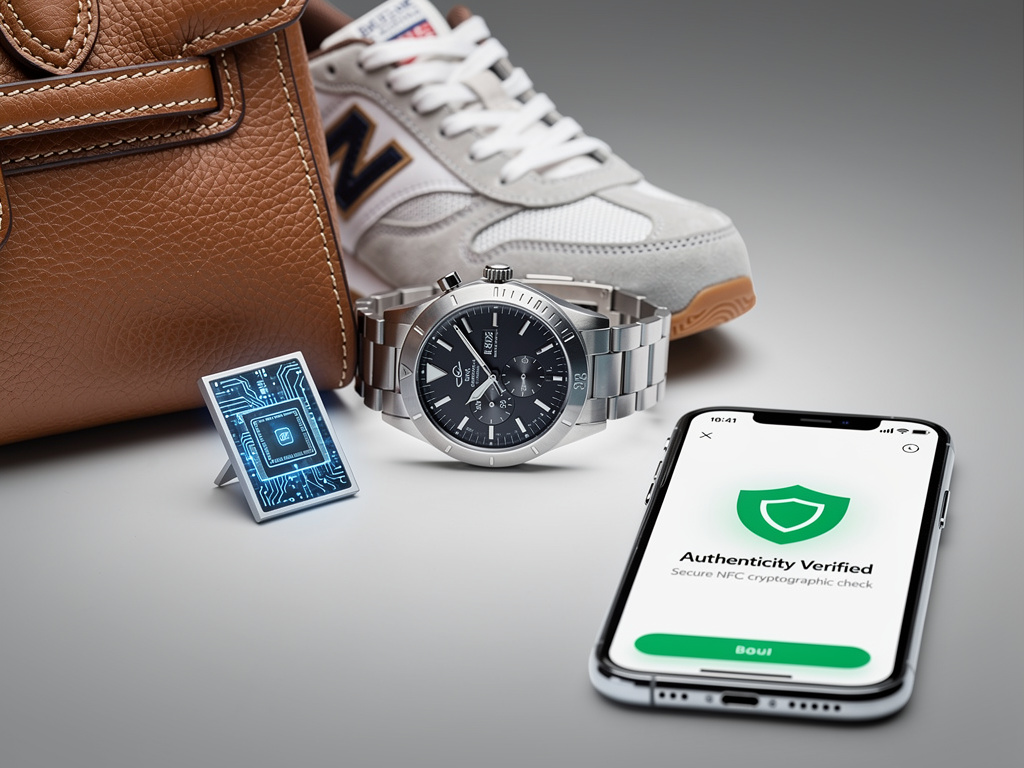
The global counterfeit goods market is a sprawling, multi-trillion-dollar problem that has long bedeviled luxury brands, from Hermès handbags to Rolex watches. Now, a former Tesla product manager believes the answer lies not in holograms, serial numbers, or blockchain ledgers — but in a tiny, tamper-proof chip embedded directly into the product itself. The venture, which has drawn early attention from both the tech and fashion worlds, represents a new front in the war between authenticity and imitation.
According to TechCrunch, the startup — founded by a former Tesla product manager whose name has become synonymous with hardware-software integration at the electric vehicle giant — is developing a near-field communication (NFC) chip that can be sewn, molded, or otherwise permanently integrated into luxury items. The chip is designed to be cryptographically unique, linking each physical product to a digital identity that can be verified instantly with a smartphone tap. The ambition is nothing less than making counterfeiting economically and technically impossible.
From Electric Vehicles to Embedded Authentication
The founder’s pedigree at Tesla is not incidental to the startup’s thesis. At Tesla, hardware and software are deeply intertwined — every vehicle is a rolling computer, its identity and capabilities defined as much by code as by steel and glass. The founder reportedly spent years working on Tesla’s supply chain authentication systems, ensuring that parts sourced from global suppliers were genuine and met rigorous specifications. That experience, as TechCrunch reported, directly informed the leap into luxury goods, where the stakes of authenticity are measured not in safety recalls but in billions of dollars of brand equity.
The startup’s approach differs meaningfully from earlier attempts at anti-counterfeiting technology. Previous solutions — QR codes, RFID tags, even blockchain-based certificates of authenticity — have all suffered from a fundamental vulnerability: they can be copied, cloned, or simply detached from the original product and reattached to a fake. The new chip, by contrast, is designed to be physically inseparable from the item. Removing it destroys the chip, rendering it useless. The cryptographic keys stored on the chip are generated in a secure enclave during manufacturing and are never transmitted in full, making cloning virtually impossible with current technology.
Why Luxury Brands Are Desperate for a Better Mousetrap
The urgency of the counterfeit problem cannot be overstated. The Organisation for Economic Co-operation and Development (OECD) has estimated that trade in counterfeit and pirated goods amounts to as much as $509 billion annually, representing roughly 2.5% of world trade. Luxury goods — handbags, watches, apparel, and accessories — account for a disproportionate share of that figure. For brands like Louis Vuitton, Gucci, and Chanel, counterfeits do more than siphon revenue; they erode the exclusivity and trust that justify premium pricing.
The problem has only intensified with the rise of sophisticated online marketplaces and social media commerce. Platforms like Instagram, TikTok, and various resale apps have made it trivially easy for counterfeiters to reach consumers directly, often with products so convincing that even seasoned authenticators struggle to tell them apart from the real thing. The secondhand luxury market, which Bain & Company has projected could reach $40 billion by 2025, is particularly vulnerable. Buyers on platforms like The RealReal, Vestiaire Collective, and StockX are often purchasing without the ability to physically inspect goods, making digital authentication not just a convenience but a necessity.
The Technical Architecture: Chips, Cryptography, and the Cloud
At the heart of the startup’s system is a chip smaller than a grain of rice, fabricated using semiconductor processes similar to those found in modern payment cards and passports. Each chip contains a secure element — a hardened microprocessor designed to resist physical tampering, side-channel attacks, and other intrusion methods. When a consumer taps the product with an NFC-enabled smartphone, the chip generates a unique, time-limited cryptographic response that is verified against a cloud-based registry. The registry, maintained by the startup, stores the product’s provenance, ownership history, and other metadata, but critically, it does not store the chip’s private key.
This architecture addresses several weaknesses of earlier systems. Because the verification is cryptographic and dynamic — each tap produces a different response — it cannot be replayed or spoofed. Because the chip is physically bonded to the product, it cannot be transplanted. And because the cloud registry is maintained independently of the brand, it can serve as a neutral, third-party arbiter of authenticity, a feature that is particularly attractive to resale platforms and insurance companies. As TechCrunch noted, the startup has already begun pilot programs with several unnamed luxury brands, with commercial deployments expected later this year.
Skeptics and the Limits of Hardware-Based Solutions
Not everyone is convinced that a chip alone can solve the counterfeit crisis. Industry analysts have pointed out that counterfeiters are remarkably adaptive. If a chip becomes the sole marker of authenticity, the incentive to reverse-engineer or circumvent it only grows. There are also practical concerns: embedding chips in soft goods like leather handbags or silk scarves requires careful engineering to ensure the chip survives years of use, cleaning, and wear without degrading or becoming detectable to the touch.
Moreover, the economics of chip-based authentication must make sense for brands across the price spectrum. For a $10,000 Birkin bag, the cost of a chip — reportedly a few dollars per unit at scale — is negligible. But for a $200 pair of designer sneakers, the calculus is tighter, and brands may resist adding cost or complexity to their manufacturing processes. The startup has acknowledged these challenges and, according to reporting from TechCrunch, is working on ultra-thin, flexible chip form factors that can be integrated into a wider range of materials and price points.
The Broader Push Toward Digital Product Passports
The startup’s efforts arrive at a moment when regulators, particularly in Europe, are pushing for greater transparency in product provenance. The European Union’s Digital Product Passport initiative, set to take effect in phases beginning in 2026, will require certain categories of goods to carry digital records of their origin, composition, and environmental impact. While the regulation is primarily aimed at sustainability, its infrastructure overlaps significantly with anti-counterfeiting technology. A chip that can authenticate a product can also carry data about its carbon footprint, the labor conditions under which it was made, and its recyclability.
This convergence of authenticity and sustainability is likely to accelerate adoption. Brands that invest in chip-based authentication today may find themselves ahead of regulatory requirements tomorrow. And for consumers, particularly younger buyers who increasingly demand transparency from the brands they support, the ability to tap a product and instantly access its full history could become a powerful differentiator.
What Comes Next: Partnerships, Scale, and the Race Against Counterfeiters
The startup is reportedly in discussions with major luxury conglomerates, including LVMH and Kering, though no deals have been publicly confirmed. It has also attracted interest from the watch industry, where the resale market for brands like Rolex, Patek Philippe, and Audemars Piguet is enormous and plagued by sophisticated fakes. The insurance industry, which loses billions annually to fraudulent claims involving counterfeit or misrepresented luxury goods, is another potential customer.
The road ahead is fraught with technical and commercial challenges. Counterfeiters will inevitably probe the system for weaknesses. Brands will need to overhaul manufacturing processes to integrate the chips at scale. And consumers will need to be educated about how to use the technology — a non-trivial task in a market where many buyers are not especially tech-savvy. But the underlying premise — that physical authentication, rooted in silicon and cryptography, can outpace the counterfeiters — is compelling. If the startup succeeds, it could fundamentally reshape how trust is established in the market for high-value goods, turning every luxury item into a verifiable, tamper-proof artifact of its own provenance.
For an industry that has spent decades playing defense against counterfeiters, the prospect of a chip that shifts the advantage back to the brands — and to the consumers who pay a premium for the real thing — is, at the very least, worth watching closely.


 WebProNews is an iEntry Publication