
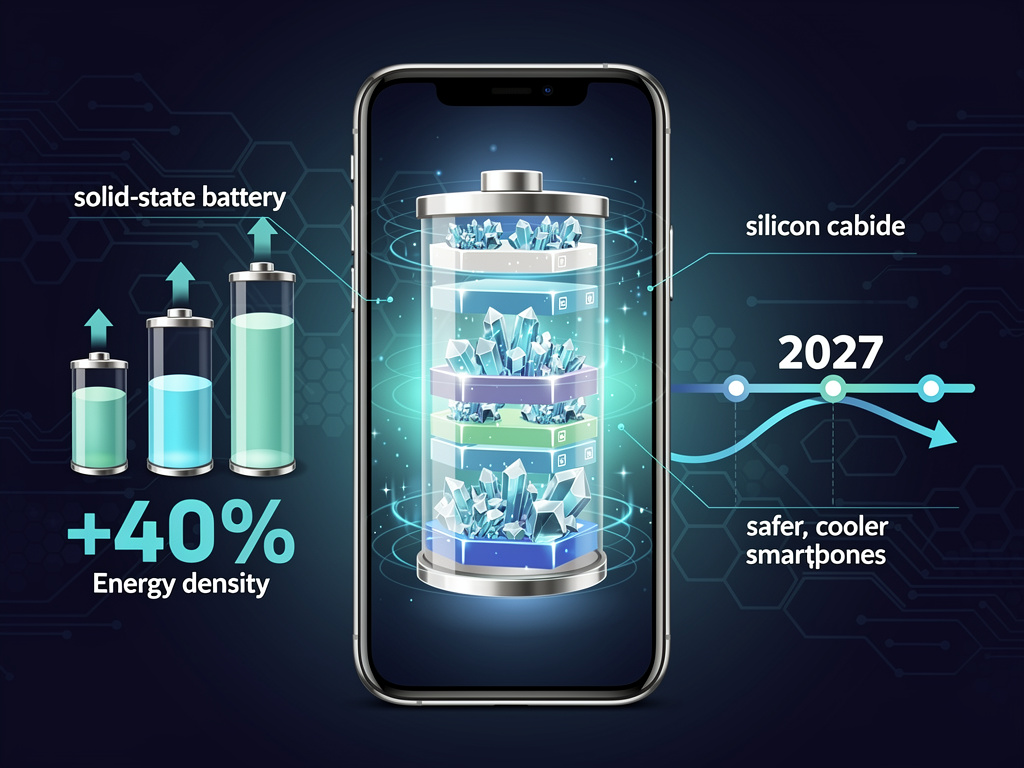
The persistent problem of smartphone overheating may soon become a relic of the past, thanks to a groundbreaking advancement in battery technology that promises to fundamentally reshape how mobile devices manage thermal performance. Researchers have developed a new solid-state battery design incorporating silicon carbide components that could keep devices significantly cooler while simultaneously delivering enhanced power density and safety characteristics that have eluded lithium-ion technology for decades.
According to Digital Trends, scientists at the Korea Electrotechnology Research Institute have created a solid-state battery that operates at substantially lower temperatures than conventional lithium-ion batteries. The innovation centers on replacing traditional liquid electrolytes with solid materials and integrating silicon carbide heat spreaders that can dissipate thermal energy up to ten times more efficiently than current smartphone battery designs. This development arrives at a critical juncture when smartphone manufacturers face mounting pressure to increase battery capacity while managing the thermal challenges posed by increasingly powerful processors and 5G connectivity.
The implications extend far beyond consumer comfort. Overheating batteries represent one of the most significant safety concerns in mobile electronics, responsible for numerous device recalls and safety incidents over the past decade. The new solid-state design addresses this vulnerability at its source by eliminating the flammable liquid electrolytes that have caused catastrophic failures in lithium-ion batteries. Industry analysts suggest this breakthrough could accelerate the timeline for widespread solid-state battery adoption by three to five years, potentially bringing the technology to market by 2027 rather than the previously projected 2030 timeframe.
Silicon Carbide: The Semiconductor Industry’s Secret Weapon Enters Battery Design
Silicon carbide has established itself as a transformative material in power electronics and semiconductor applications, prized for its exceptional thermal conductivity and ability to operate at extreme temperatures. The material can conduct heat approximately three times better than copper while maintaining electrical insulation properties, making it ideal for managing the thermal challenges inherent in high-density energy storage systems. Engineers have now adapted these properties to create battery architectures that can channel heat away from critical components before thermal runaway conditions develop.
The Korea Electrotechnology Research Institute’s design incorporates microscopic silicon carbide structures throughout the battery assembly, creating what researchers describe as a three-dimensional thermal highway network. These pathways allow heat to disperse rapidly across the entire battery surface rather than concentrating in hotspots that typically form near the battery’s center during heavy use. Laboratory testing has demonstrated that prototype batteries maintain surface temperatures below 35 degrees Celsius even under sustained high-discharge conditions that would push conventional lithium-ion batteries beyond 45 degrees Celsius.
Solid-State Technology Addresses Multiple Industry Pain Points Simultaneously
The convergence of solid-state electrolytes with silicon carbide thermal management creates synergistic benefits that address several longstanding challenges in mobile device design. Solid electrolytes eliminate the need for heavy protective casings required to contain liquid electrolytes, potentially reducing battery weight by up to 20 percent while increasing volumetric energy density. This weight reduction could enable smartphone manufacturers to either extend battery life significantly or allocate the saved space to additional features such as enhanced camera systems or larger displays.
Manufacturing scalability remains a critical consideration for any battery technology seeking to displace lithium-ion dominance in the smartphone market. The research team has developed production methods compatible with existing battery manufacturing infrastructure, requiring only moderate equipment modifications rather than complete factory overhauls. This compatibility could substantially reduce the capital investment barriers that have historically slowed adoption of alternative battery chemistries. Industry sources familiar with the technology suggest that major smartphone manufacturers have already initiated preliminary discussions regarding integration timelines and supply chain development.
Performance Metrics Exceed Industry Expectations Across Multiple Dimensions
Beyond thermal management, the new battery architecture delivers impressive performance improvements in energy density and charging speed. Prototype cells have achieved energy densities exceeding 500 watt-hours per kilogram, representing approximately a 40 percent improvement over premium lithium-ion batteries currently used in flagship smartphones. This enhanced energy density could translate to two full days of typical smartphone usage on a single charge, addressing one of consumers’ most frequently cited frustrations with current mobile devices.
Charging performance shows equally promising results. The solid-state design’s superior thermal characteristics enable faster charging rates without triggering thermal protection circuits that typically throttle charging speeds in conventional batteries. Laboratory demonstrations have shown the batteries can accept charge rates sufficient to reach 80 percent capacity in just 15 minutes, matching the fastest commercially available charging systems while generating significantly less heat. The reduced thermal stress during charging could also extend overall battery lifespan, potentially enabling smartphones to maintain 90 percent of original capacity after 1,000 charge cycles compared to the typical 80 percent retention of current lithium-ion technology.
Safety Advantages Could Transform Regulatory Approval Processes
Aviation authorities and safety regulators have imposed increasingly stringent requirements on lithium-ion batteries following multiple incidents involving thermal runaway and fires. The solid-state silicon carbide battery design’s inherent safety characteristics could streamline regulatory approval processes and potentially relax current restrictions on battery capacity in portable devices. The absence of flammable liquid electrolytes eliminates the primary ignition source in battery fires, while the enhanced thermal management prevents the temperature escalation that initiates thermal runaway reactions.
Mechanical puncture testing has demonstrated remarkable resilience compared to conventional batteries. When subjected to penetration tests that would cause lithium-ion batteries to ignite, the solid-state prototypes exhibited only localized heating without propagating thermal reactions. This safety margin could prove particularly valuable in applications beyond smartphones, including electric vehicles, drones, and aerospace systems where battery failures pose catastrophic risks. Insurance industry analysts have indicated that improved battery safety profiles could reduce liability costs for device manufacturers and potentially lower premiums for consumers.
Market Dynamics and Competitive Pressures Accelerate Development Timelines
Major smartphone manufacturers face intensifying competition to differentiate products in a maturing market where incremental improvements no longer command premium pricing. Battery technology represents one of the few remaining areas where substantial performance gains remain achievable, creating powerful incentives for rapid commercialization of breakthrough innovations. Chinese manufacturers have particularly aggressive development roadmaps, with some companies publicly committing to solid-state battery integration by 2026.
The geopolitical dimensions of battery technology development have added urgency to commercialization efforts. Governments in the United States, European Union, and East Asia have designated advanced battery technology as strategic priorities, allocating substantial research funding and offering manufacturing incentives. This government support has accelerated private sector investment, with venture capital funding for solid-state battery companies exceeding $2 billion in the past 18 months. The Korea Electrotechnology Research Institute’s silicon carbide innovation has attracted particular attention from Japanese and Korean electronics conglomerates seeking to maintain competitive positions in the global smartphone supply chain.
Integration Challenges and Manufacturing Scale-Up Considerations
Despite promising laboratory results, translating prototype performance to mass production presents formidable engineering challenges. Silicon carbide remains substantially more expensive than conventional battery materials, with current pricing approximately five times higher than equivalent copper or aluminum components. Achieving cost parity will require significant manufacturing scale and potential materials science innovations to reduce silicon carbide production costs. Industry analysts project that economies of scale could reduce silicon carbide component costs by 60 to 70 percent once annual production volumes exceed 100 million units.
Quality control and manufacturing consistency pose additional hurdles. Solid-state batteries require extremely precise layer deposition and interface engineering to achieve optimal performance and reliability. Even microscopic defects in solid electrolyte layers can create electrical shorts or reduce ionic conductivity, compromising battery performance and safety. The Korea Electrotechnology Research Institute has developed automated inspection systems using artificial intelligence to identify defects during manufacturing, achieving defect detection rates exceeding 99.9 percent in pilot production runs.
Environmental and Sustainability Implications Reshape Industry Priorities
The environmental profile of battery technology increasingly influences consumer purchasing decisions and regulatory requirements. Solid-state batteries offer potential sustainability advantages through longer operational lifespans and improved recyclability compared to conventional lithium-ion designs. The absence of liquid electrolytes simplifies end-of-life processing, as solid components can be mechanically separated and processed without the hazardous waste streams associated with electrolyte disposal. Materials recovery rates for solid-state batteries could exceed 95 percent compared to typical 70 to 80 percent recovery rates for lithium-ion batteries.
Silicon carbide’s chemical stability presents both opportunities and challenges for recycling infrastructure. The material’s resistance to chemical degradation means it can be recovered and reused with minimal processing, potentially reducing raw material consumption in battery production. However, this same stability complicates chemical recycling processes that rely on dissolving battery components for materials separation. Recycling technology developers are adapting mechanical separation techniques and exploring novel chemical processes specifically designed for solid-state battery architectures. Early-stage recycling pilots have demonstrated technical feasibility, though economic viability at commercial scale remains unproven.
Future Applications Beyond Smartphones Drive Long-Term Research Investments
While smartphones represent the initial target market, the silicon carbide solid-state battery technology holds transformative potential across numerous applications where thermal management and safety are paramount concerns. Electric vehicle manufacturers have expressed particular interest, as the technology could enable faster charging, extended range, and enhanced safety without the complex thermal management systems currently required for lithium-ion battery packs. The weight reduction potential could also improve vehicle efficiency, offsetting some of the performance penalties associated with battery mass.
Wearable devices and medical implants represent another promising application area where the combination of safety, compact size, and thermal performance creates compelling advantages. The technology could enable new categories of medical devices that require sustained power delivery in direct contact with human tissue, where temperature control is critical for patient safety and comfort. Researchers are exploring specialized variants optimized for these applications, with some designs targeting operational lifespans exceeding ten years for implantable medical devices. The convergence of improved battery technology with advancing sensor capabilities and wireless connectivity could catalyze innovation in personalized healthcare monitoring and treatment delivery systems that have remained impractical with current battery limitations.


 WebProNews is an iEntry Publication