
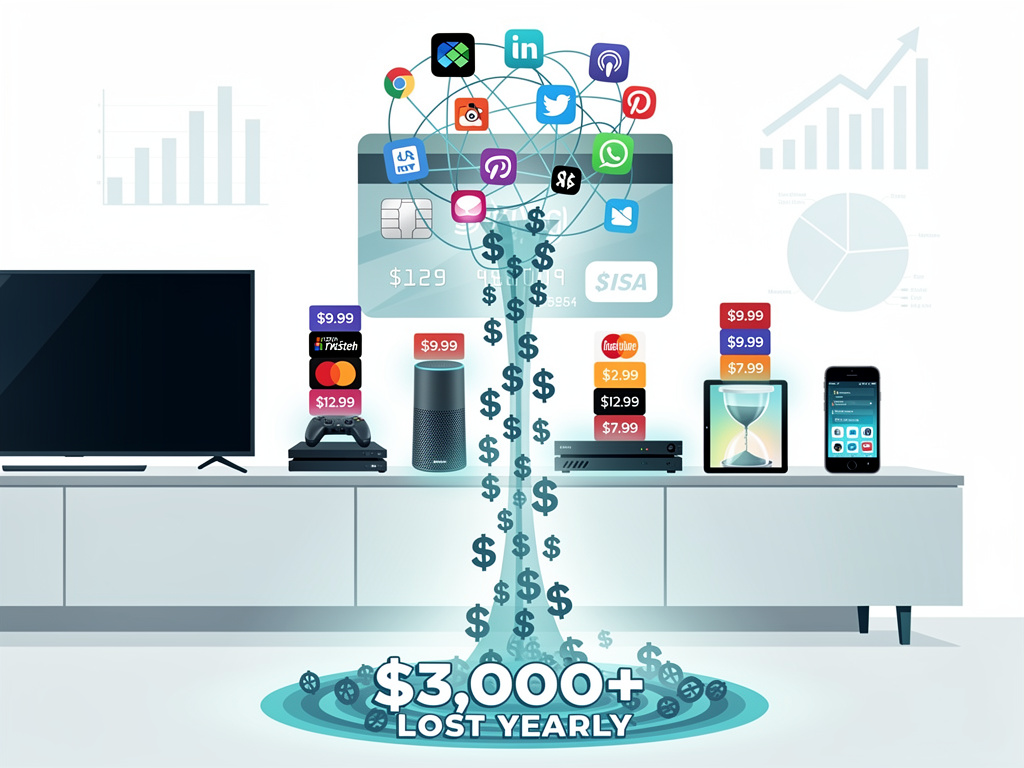
In an era where convenience reigns supreme, American families are quietly bleeding money through a phenomenon that financial advisors are calling the “subscription creep crisis.” What begins as a seemingly harmless $9.99 monthly charge for a streaming service or fitness app has metastasized into a financial hemorrhage that’s draining thousands of dollars annually from household budgets, with parents bearing the brunt of this economic burden.
According to Business Insider, the average American parent is now spending upwards of $3,000 per year on subscriptions they rarely or never use. This staggering figure represents not just a minor budgetary inconvenience, but a fundamental shift in how modern families manage their finances in an increasingly subscription-based economy. The problem has become so pervasive that it’s forcing financial experts to reconsider traditional budgeting advice and develop new frameworks for the digital age.
The subscription economy has exploded over the past decade, transforming from a novel business model into the dominant form of consumer engagement across virtually every sector. From entertainment and software to meal kits and children’s educational platforms, the monthly recurring charge has become ubiquitous. What makes this trend particularly insidious for parents is the compounding effect: a streaming service here, an educational app there, a meal delivery subscription, a fitness platform, and suddenly the monthly outflow becomes difficult to track and nearly impossible to manage effectively.
The Psychology Behind the Spending Spiral
The mechanics of subscription fatigue reveal a sophisticated interplay between consumer psychology and corporate strategy. Companies have mastered the art of making sign-ups effortless while creating deliberate friction in the cancellation process. The initial appeal is undeniable: low monthly costs, free trials that promise easy cancellation, and the allure of unlimited access to services that seem essential in the moment. For parents juggling multiple responsibilities, the promise of simplifying life through these services proves irresistible.
However, the very features that make subscriptions attractive also contribute to their staying power long past their usefulness. The charges are typically small enough to escape notice during casual review of bank statements, yet large enough to accumulate into significant annual expenses. Financial behavioral experts note that the pain of paying is diminished when charges are automated and recurring, unlike the psychological impact of making a discrete purchasing decision each time.
The Parental Penalty in the Digital Age
Parents face unique vulnerabilities in the subscription economy that childless adults largely avoid. The desire to provide educational advantages, entertainment options, and developmental tools for children creates multiple pressure points that subscription services expertly exploit. A child’s enthusiasm for a new learning app or streaming platform can override parental financial prudence, especially when the monthly cost seems negligible compared to traditional alternatives like private tutoring or cable television packages.
The COVID-19 pandemic accelerated this trend dramatically, as families sought ways to educate, entertain, and engage children during lockdowns and remote schooling periods. Many of these emergency subscriptions have persisted long after their initial purpose has been fulfilled, becoming financial ghosts that continue to drain accounts months or even years later. The transition back to in-person activities didn’t trigger corresponding cancellations, leaving families paying for both old digital solutions and new in-person activities.
The Hidden Cost of Convenience
Industry data reveals that the average household now maintains between 12 and 20 active subscriptions, though many consumers significantly underestimate this number when asked. This discrepancy between perception and reality lies at the heart of the subscription crisis. Without a centralized system for tracking these recurring charges, families often discover forgotten subscriptions only during tax preparation or when conducting comprehensive financial audits.
The financial impact extends beyond the direct cost of unused services. The money flowing toward forgotten subscriptions represents opportunity cost on a massive scale—funds that could be directed toward savings, debt reduction, or investments in tangible family experiences. For a family spending $3,000 annually on unused subscriptions, the ten-year opportunity cost, assuming modest investment returns, could exceed $40,000. This represents a substantial portion of a child’s college fund or a significant contribution toward retirement savings.
Corporate Strategies and Consumer Vulnerability
The subscription business model has proven extraordinarily profitable precisely because of consumer inertia. Companies have refined their approaches to maximize retention, even among non-active users. Cancellation processes that require multiple steps, customer service calls during limited hours, or navigation through deliberately confusing website interfaces all serve to maintain subscriber counts. Some services employ “dark patterns”—user interface designs that subtly manipulate users into making choices that benefit the company rather than the consumer.
The regulatory environment has struggled to keep pace with these practices. While some jurisdictions have implemented requirements for easier cancellation processes or clearer disclosure of renewal terms, enforcement remains inconsistent. Consumer advocacy groups have called for federal legislation that would mandate one-click cancellation options and regular reminders about upcoming renewals, but such measures face significant opposition from industry lobbying efforts.
The Emergence of Subscription Management Solutions
Recognizing the scale of the problem, a cottage industry of subscription management tools has emerged, offering to help consumers identify and cancel unwanted services. These platforms connect to users’ bank accounts and credit cards to automatically detect recurring charges, providing dashboards that visualize spending patterns and facilitate cancellations. However, these solutions introduce their own irony: they typically operate on a subscription model themselves, adding yet another recurring charge to manage.
Financial institutions have begun incorporating subscription tracking features into their banking apps, recognizing both a customer service opportunity and a competitive advantage. Some credit card companies now offer detailed categorization of recurring charges and send alerts when new subscriptions are detected or when existing subscriptions increase in price. These tools represent a step forward, though they require active engagement from consumers who are often overwhelmed by the very complexity these solutions aim to address.
Strategies for Regaining Financial Control
Financial advisors recommend a systematic approach to addressing subscription creep. The first step involves conducting a comprehensive audit of all recurring charges, which requires reviewing several months of bank and credit card statements to capture annual or quarterly subscriptions that might not appear in a single month’s transactions. This process often reveals surprising discoveries, with many families identifying subscriptions they had completely forgotten existed.
Once identified, each subscription should be evaluated based on actual usage rather than intended usage. The distinction is critical: many families maintain gym memberships, streaming services, or educational apps based on aspirational behavior rather than reality. Creating a shared family document that lists all active subscriptions, their costs, renewal dates, and primary users can prevent duplicate services and ensure that cancellation responsibilities are clearly assigned.
The Broader Economic Implications
The subscription economy’s impact on household finances reflects broader shifts in consumer behavior and corporate strategy. The transition from ownership to access has fundamentally altered how families allocate resources and plan for the future. While subscriptions can offer genuine value and flexibility, the current system disproportionately benefits corporations at the expense of consumer financial health, particularly for families already struggling with stagnant wages and rising costs in essential categories like housing, healthcare, and education.
The phenomenon also highlights growing financial literacy gaps, particularly around digital transactions and recurring payments. Traditional financial education focuses on discrete purchasing decisions and one-time expenditures, leaving consumers ill-equipped to manage the cumulative impact of numerous small, automated charges. Educational institutions and financial counselors are beginning to address this gap, but the pace of change in the subscription economy continues to outstrip the development of consumer protective knowledge and skills.
Looking Forward: A Call for Systemic Change
Addressing the subscription crisis will require coordinated action from multiple stakeholders. Consumers must develop more rigorous personal financial management practices, including regular subscription audits and stricter criteria for new sign-ups. The industry should adopt more transparent and consumer-friendly practices, including simplified cancellation processes and proactive communication about upcoming renewals and price changes.
Policymakers face pressure to implement stronger consumer protections that acknowledge the unique challenges of the subscription economy. Proposed measures include mandatory cooling-off periods for new subscriptions, requirements for annual usage reports sent to subscribers, and standardized cancellation procedures across all industries. While such regulations may face resistance from businesses that have built their models around consumer inertia, the scale of the problem suggests that voluntary industry reform is unlikely to be sufficient. For American parents navigating an increasingly complex financial environment, the path to recovery begins with awareness, continues through systematic action, and ultimately requires a fundamental reassessment of how families engage with the subscription economy.


 WebProNews is an iEntry Publication