
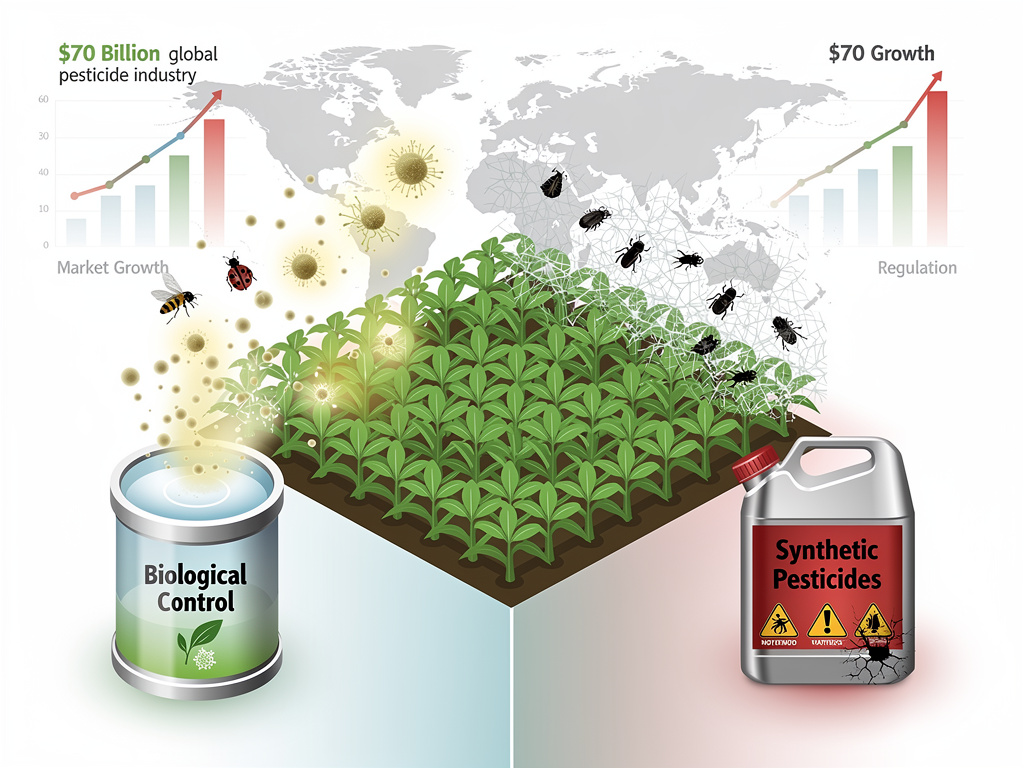
In the sterile laboratories of agricultural biotechnology firms, scientists are cultivating what may become the most significant advancement in pest management since the introduction of synthetic pesticides in the 1940s. Unlike their chemical predecessors, these weapons against crop-destroying insects are alive—microscopic fungal spores engineered to seek out and eliminate specific pest populations while leaving beneficial insects unharmed. This biological approach represents a fundamental shift in how humanity wages war against the six-legged adversaries that consume nearly 20% of global crop production annually.
According to Ars Technica, researchers have successfully demonstrated that genetically modified strains of entomopathogenic fungi—organisms that naturally infect and kill insects—can be tailored to target specific pest species with unprecedented precision. The breakthrough centers on the ability to enhance the fungi’s natural killing mechanisms while simultaneously programming them to recognize particular insect biochemical signatures, effectively creating living smart weapons that distinguish between harmful pests and beneficial pollinators.
The implications extend far beyond academic curiosity. With global pesticide resistance reaching crisis levels and regulatory pressure mounting against broad-spectrum chemical insecticides, the agricultural industry faces an existential challenge. Traditional synthetic pesticides, which generated $70 billion in global sales in 2023, are increasingly ineffective as pest populations evolve resistance mechanisms. Meanwhile, environmental regulations grow stricter as evidence mounts regarding these chemicals’ impact on pollinator populations, soil microbiomes, and human health.
The Biological Mechanism Behind Fungal Insecticides
Entomopathogenic fungi operate through a remarkably sophisticated infection process that begins when microscopic spores land on an insect’s exoskeleton. Unlike chemical pesticides that must be ingested or absorbed, these fungal agents actively penetrate the insect’s protective outer layer through a combination of mechanical pressure and enzymatic degradation. Once inside, the fungus proliferates throughout the insect’s body cavity, consuming internal tissues and eventually killing the host within days to weeks, depending on environmental conditions and fungal strain.
The genus Metarhizium, one of the most extensively studied entomopathogenic fungi, has demonstrated particular promise in commercial applications. Wild-type strains of this fungus already infect more than 200 insect species globally, but their effectiveness has historically been limited by environmental sensitivity and relatively slow kill times compared to synthetic alternatives. Recent genetic modifications have addressed both limitations, creating strains that remain viable under a broader range of temperature and humidity conditions while accelerating the infection timeline.
What distinguishes the latest generation of fungal bioinsecticides from earlier attempts is the integration of targeted specificity. Scientists have identified and isolated the genetic sequences responsible for host recognition, allowing them to essentially program the fungus to identify particular pest species based on unique cuticular hydrocarbons—the waxy compounds that coat insect exoskeletons. This molecular-level targeting means a fungal strain designed to combat aphids will largely ignore ladybugs, even when both insects occupy the same plant.
Economic Pressures Driving Biological Alternatives
The economic calculus favoring biological pest control has shifted dramatically in recent years. Developing a new synthetic pesticide and bringing it through regulatory approval now costs pharmaceutical companies upward of $280 million and requires approximately 11 years from discovery to market, according to industry estimates. By contrast, biological control agents, classified differently under most regulatory frameworks, often face expedited approval processes and lower development costs, particularly when derived from naturally occurring organisms with established safety profiles.
Major agricultural corporations have taken notice. Investment in biological pest control technologies has increased by approximately 15% annually since 2020, with venture capital firms pouring hundreds of millions into startups focused on microbial solutions. This financial backing has accelerated research timelines and enabled field trials at scales previously impossible for academic laboratories. The result is a rapidly maturing technology moving from controlled greenhouse studies to commercial agricultural deployment.
Farmers, the ultimate end-users of these technologies, face their own economic pressures that make biological alternatives increasingly attractive. Pesticide resistance has created a costly treadmill where growers must apply chemicals more frequently or in higher concentrations to achieve the same pest suppression, driving up input costs while often reducing yields. Organic and sustainably certified produce commands premium prices in consumer markets, but achieving certification requires abandoning synthetic pesticides entirely. Fungal bioinsecticides, being naturally derived and highly specific, typically qualify for organic certification, opening premium market access for adopters.
Field Performance and Real-World Challenges
Despite laboratory promise, transitioning fungal bioinsecticides from controlled environments to working farms presents substantial challenges. Unlike synthetic chemicals that remain stable in storage and predictable in application, living organisms respond dynamically to environmental conditions. Temperature extremes, ultraviolet radiation, and low humidity can all reduce fungal viability, potentially rendering applications ineffective. Early commercial formulations addressed these vulnerabilities through protective coatings and carrier substances, but field performance remained inconsistent.
Recent innovations in formulation technology have significantly improved reliability. Microencapsulation techniques now protect fungal spores from environmental stressors while controlling their release timing. Some formulations incorporate UV-protective compounds and desiccation-resistant additives that extend spore viability from hours to weeks post-application. These advances have made fungal insecticides practical for large-scale row crop agriculture, not just the greenhouse and specialty crop applications where they first gained commercial traction.
Field trial data increasingly supports commercial viability. Multi-year studies in various crop systems have demonstrated that properly formulated and applied fungal insecticides can achieve pest suppression rates comparable to conventional chemicals, typically ranging from 70% to 90% mortality in target populations. Critically, these results persist across application cycles without the resistance development that plagues synthetic alternatives, as insects cannot easily evolve defenses against the complex, multi-faceted infection process employed by entomopathogenic fungi.
Regulatory Frameworks and Safety Considerations
The regulatory pathway for biological pesticides differs substantially from synthetic chemicals, reflecting both their distinct mechanisms and safety profiles. In the United States, the Environmental Protection Agency regulates biological control agents under the Federal Insecticide, Fungicide, and Rodenticide Act, but applies different standards than those used for conventional pesticides. Naturally occurring organisms with documented safety histories often qualify for expedited review, particularly when genetic modifications involve only minor alterations to existing genes rather than insertion of foreign genetic material.
Safety assessments focus on different parameters than chemical evaluations. Rather than measuring acute toxicity levels and environmental persistence, regulators examine host range specificity, potential for non-target effects, and environmental fate. The question is not whether the organism is toxic, but whether it might infect unintended species or establish persistent populations in natural ecosystems. Extensive testing protocols require demonstrating that modified fungal strains maintain narrow host ranges and do not pose risks to vertebrates, beneficial insects, or plant health.
International regulatory harmonization remains incomplete, creating market access challenges for companies developing fungal bioinsecticides. While the European Union, United States, and several other major agricultural markets have established biological pesticide frameworks, approval requirements vary significantly. Some jurisdictions treat genetically modified biological control agents equivalently to transgenic crops, triggering lengthy approval processes, while others apply more streamlined pathways. This regulatory fragmentation increases development costs and slows global commercialization.
Integration with Precision Agriculture Technologies
The convergence of biological pest control with precision agriculture technologies is creating unprecedented opportunities for targeted intervention. Modern farming increasingly relies on sensor networks, drone surveillance, and artificial intelligence to monitor crop health and detect pest infestations at early stages. These same technologies enable precise application of fungal bioinsecticides exactly where and when needed, maximizing efficacy while minimizing costs and environmental impact.
Drone-based application systems have proven particularly synergistic with fungal insecticides. Unlike tractor-mounted sprayers that compact soil and damage crops, drones can apply treatments to specific field sections identified through remote sensing as harboring pest populations. The fine droplet sizes produced by drone sprayers also prove ideal for distributing microscopic fungal spores, ensuring even coverage and optimal deposition on target insects. Some systems now integrate real-time pest identification algorithms that adjust spray parameters based on detected pest species, automatically selecting appropriate fungal strains from multi-chamber tanks.
Data analytics platforms are transforming how growers deploy biological controls. By aggregating information on weather conditions, pest pressure, crop growth stages, and treatment histories, these systems can predict optimal application timing and recommend specific fungal strains or formulations. Machine learning models trained on thousands of field applications are beginning to outperform human agronomists in timing decisions, identifying the narrow windows when environmental conditions favor fungal infection while pest populations are vulnerable.
Market Dynamics and Industry Transformation
The biological pesticide market, currently valued at approximately $6 billion globally, represents just 8% of total crop protection sales but is growing at nearly four times the rate of synthetic pesticides. Fungal bioinsecticides constitute a significant and rapidly expanding segment within this market. Industry analysts project the biological insecticide category could reach $15 billion by 2030, driven by regulatory pressures on synthetic chemicals, consumer demand for sustainably produced food, and improving product performance.
Major agrochemical corporations have responded to this shift through a combination of internal research investments and strategic acquisitions of biotechnology startups. Companies that built their businesses on synthetic chemistry now maintain substantial biological research divisions, recognizing that future growth lies in living solutions rather than manufactured molecules. This corporate evolution mirrors the pharmaceutical industry’s earlier embrace of biologics and biosimilars as complements to traditional small-molecule drugs.
The competitive dynamics favor companies that can integrate biological and chemical approaches into comprehensive pest management systems. Rather than viewing fungal bioinsecticides as replacements for all synthetic pesticides, sophisticated growers employ them as components of integrated pest management programs that combine multiple control tactics. This systems-level approach reduces selection pressure for resistance, leverages the strengths of different control methods, and provides redundancy when individual tactics underperform due to environmental conditions or pest population dynamics.
Environmental and Ecological Implications
The environmental benefits of replacing broad-spectrum synthetic insecticides with targeted fungal alternatives extend beyond the obvious reduction in chemical residues. Ecological studies in agricultural systems using fungal bioinsecticides have documented increased beneficial insect populations, including predatory beetles, parasitic wasps, and pollinators. By eliminating the collateral damage inflicted by conventional pesticides on these organisms, fungal treatments enable natural pest suppression mechanisms to function alongside biological control agents, creating synergistic effects.
Soil health implications also favor fungal approaches. Many entomopathogenic fungi establish saprophytic relationships with plant roots after completing their insecticidal function, potentially providing additional benefits through enhanced nutrient cycling or pathogen suppression. While research on these secondary effects remains preliminary, early findings suggest that regular applications of certain fungal bioinsecticides may improve soil microbial diversity and function, contrasting sharply with synthetic pesticides that often disrupt soil ecosystems.
Questions remain regarding long-term ecological impacts of releasing modified fungal strains into agricultural environments. While current evidence suggests engineered strains do not persist or spread beyond treated areas, comprehensive monitoring programs tracking environmental fate over multiple growing seasons are still accumulating data. The scientific community generally regards the risks as manageable and substantially lower than those associated with synthetic alternatives, but maintains appropriate caution regarding potential unintended consequences of introducing modified organisms into complex ecosystems.
The Path Forward for Agricultural Biotechnology
The success of fungal bioinsecticides is catalyzing broader interest in agricultural biotechnology solutions that work with natural systems rather than against them. Researchers are now applying similar genetic engineering approaches to other beneficial microorganisms, developing bacterial and viral biocontrol agents, biofungicides, and even bioherbicides. This expanding toolkit of living crop protection products promises to address the full spectrum of agricultural pests while maintaining environmental compatibility.
Technical challenges remain before fungal bioinsecticides achieve parity with synthetic alternatives across all applications. Storage stability, shelf life, and performance consistency under variable field conditions continue to require formulation innovations. Cost competitiveness, while improving, still favors synthetic chemicals in some commodity crop systems where profit margins are razor-thin. Grower education and technical support infrastructure must expand to enable proper deployment of products that require different handling and application protocols than conventional pesticides.
Despite these obstacles, the trajectory appears clear. As regulatory pressure on synthetic pesticides intensifies, resistance mechanisms spread, and consumer preferences shift toward sustainably produced food, the economic and practical advantages of biological alternatives will only strengthen. Fungal bioinsecticides, once a niche technology relegated to organic production and specialty crops, are positioned to become mainstream tools in conventional agriculture. The question is no longer whether living pest control agents will replace significant portions of the chemical pesticide market, but how quickly this transition will occur and what forms the next generation of agricultural biotechnology will take.


 WebProNews is an iEntry Publication