
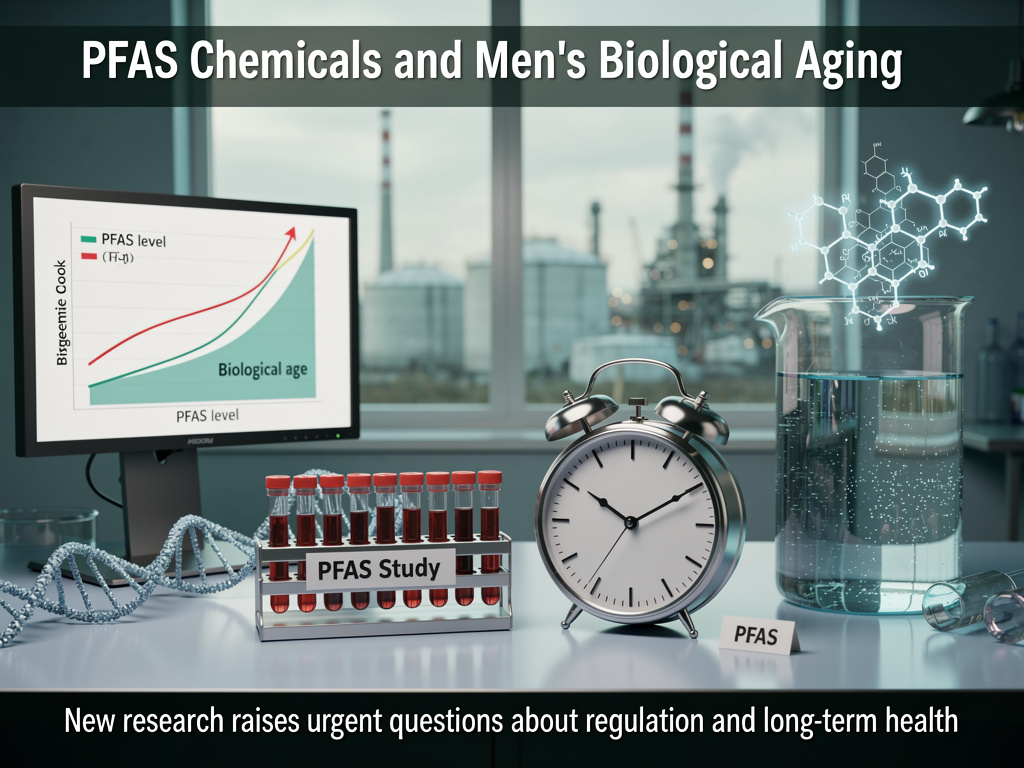
A growing body of scientific evidence is drawing a disturbing connection between ubiquitous industrial compounds known as PFAS — per- and polyfluoroalkyl substances — and accelerated biological aging in men. The findings, reported by CNN, suggest that these so-called “forever chemicals,” which persist in the environment and accumulate in the human body over decades, may be quietly turning back the clock on male health, pushing biological age well beyond what the calendar would suggest.
PFAS are a class of more than 12,000 synthetic chemicals that have been used since the 1940s in everything from nonstick cookware and water-resistant clothing to food packaging and firefighting foam. Their molecular structure — built on extraordinarily strong carbon-fluorine bonds — makes them virtually indestructible in nature. They do not break down in soil, water, or the human body, which is precisely why scientists have branded them “forever chemicals.” Today, PFAS contamination has been detected in the blood of approximately 98% of Americans, according to estimates from the Centers for Disease Control and Prevention’s National Health and Nutrition Examination Survey.
What the New Research Reveals About Men and Aging
The research spotlighted by CNN centers on the concept of biological age — a measure of how old a person’s body appears at the cellular level, as opposed to chronological age. Scientists use epigenetic clocks, which analyze patterns of DNA methylation, to estimate biological age. These clocks have become increasingly reliable indicators of disease risk, functional decline, and mortality. The study found that men with higher concentrations of certain PFAS compounds in their blood exhibited markers of accelerated biological aging, even after researchers controlled for other factors such as smoking, diet, and socioeconomic status.
The implications are sobering. If PFAS exposure is indeed pushing men’s biological clocks forward, it could help explain rising rates of age-related diseases — including cardiovascular disease, metabolic syndrome, and certain cancers — in populations with high environmental exposure. The research adds to a mounting catalog of health concerns associated with PFAS, which have previously been linked to thyroid disease, immune system suppression, reproductive harm, and elevated cholesterol levels.
Why Men May Be Particularly Vulnerable
One of the more striking aspects of the findings is the apparent sex-specific nature of the association. While PFAS exposure affects both men and women, the accelerated aging signal appeared more pronounced in male subjects. Researchers have offered several hypotheses for this disparity. Men tend to have fewer biological pathways for eliminating PFAS from their bodies compared to women, who excrete some PFAS through menstruation and breastfeeding. This means that over a lifetime, men may accumulate higher body burdens of these chemicals, amplifying their toxic effects on cellular machinery.
Additionally, hormonal differences may play a role. PFAS compounds are known endocrine disruptors, and some research suggests they interfere with testosterone metabolism and androgen receptor signaling. Given that testosterone levels naturally decline with age in men, the compounding effect of PFAS-driven hormonal disruption could accelerate the physiological hallmarks of aging. The interaction between chemical exposure and hormonal biology represents a frontier that epidemiologists and toxicologists are only beginning to map in detail.
The Epigenetic Clock: A New Lens on Environmental Toxicology
The use of epigenetic clocks in environmental health research represents a significant methodological advance. Traditional epidemiological studies often rely on disease incidence or mortality as endpoints, which can take decades to manifest. Epigenetic aging, by contrast, provides a real-time biomarker that can detect subclinical harm long before a disease diagnosis. Steve Horvath, the UCLA geneticist who pioneered some of the most widely used epigenetic clocks, has described biological age acceleration as a “canary in the coal mine” for long-term health outcomes.
By applying these tools to PFAS-exposed populations, researchers can identify damage that might otherwise remain invisible for years. The study discussed by CNN used one or more of these validated epigenetic clocks to demonstrate a statistically significant association between PFAS blood levels and biological age acceleration in men. This approach is gaining traction across environmental health research, with scientists applying similar methods to study the aging effects of air pollution, heavy metals, and pesticide exposure.
A Regulatory Reckoning That Remains Incomplete
The scientific alarm over PFAS has prompted regulatory action, though critics argue the response has been far too slow. In 2024, the U.S. Environmental Protection Agency finalized the first-ever national drinking water standard for six PFAS compounds, setting maximum contaminant levels at four parts per trillion for PFOA and PFOS — two of the most studied and harmful members of the PFAS family. The rule requires public water systems to monitor for these chemicals and reduce levels where they exceed the new thresholds.
Yet enforcement and compliance remain uneven. Thousands of communities across the United States have documented PFAS contamination in their water supplies, particularly near military bases, airports, and industrial facilities where aqueous film-forming foam (AFFF) was used for decades. The Department of Defense alone has identified more than 700 installations with known or suspected PFAS contamination. Cleanup costs are projected to run into the tens of billions of dollars, and litigation against PFAS manufacturers — most notably 3M and DuPont — has resulted in multi-billion-dollar settlements, though affected communities argue the sums are insufficient to address the full scope of the damage.
The Burden of Proof and the Weight of Industry
The PFAS story carries echoes of earlier public health battles over lead, asbestos, and tobacco. In each case, industry knew about potential harms long before the public did, and regulatory action lagged behind the science by decades. Internal documents from 3M and DuPont, unearthed through litigation, revealed that both companies were aware of PFAS toxicity as early as the 1960s and 1970s but continued production and resisted disclosure. The parallels have not been lost on environmental advocates, who argue that the current research on aging effects only strengthens the case for more aggressive regulation and corporate accountability.
For individual men concerned about their exposure, the options are limited but not nonexistent. Activated carbon and reverse osmosis filtration systems can reduce PFAS levels in drinking water. Avoiding products marketed as stain-resistant or water-repellent can reduce exposure through consumer goods. Blood testing for PFAS is available, though it is not yet part of routine medical screening. Some researchers have called for PFAS blood testing to be incorporated into standard health panels, particularly for populations living near known contamination sites.
What Comes Next for Science and Public Health Policy
The research linking PFAS to accelerated biological aging in men is part of a broader scientific effort to understand how environmental exposures interact with the fundamental mechanisms of aging. The field of geroscience — which studies the biological processes underlying aging and age-related disease — has increasingly turned its attention to environmental determinants. If chemical exposures can accelerate epigenetic aging, then reducing those exposures becomes not just an environmental policy priority but a public health strategy for extending healthy lifespan.
Longitudinal studies are now underway to track PFAS-exposed populations over time and determine whether the biological age acceleration observed in cross-sectional studies translates into earlier onset of disease and death. The National Institutes of Health has funded several such initiatives, and international collaborations — particularly with researchers in Scandinavia, where population registries and biobanks provide uniquely powerful datasets — are expected to yield results in the coming years.
The Invisible Threat That Demands Visible Action
The tragedy of PFAS is one of invisibility. These chemicals are odorless, tasteless, and undetectable without specialized laboratory equipment. They are in the rain, in the soil, in the blood of newborns. And now, according to the latest research, they may be aging men from the inside out — silently, relentlessly, and at a pace that outstrips the body’s own biological clock. The question facing regulators, manufacturers, and the public is no longer whether PFAS are harmful, but how much harm has already been done and what can still be prevented.
For the millions of men unknowingly carrying elevated levels of forever chemicals in their bloodstreams, the findings reported by CNN are a call to attention — not to panic, but to demand the kind of sustained scientific inquiry and regulatory courage that the scale of this contamination requires. The clock, it turns out, may be ticking faster than anyone realized.


 WebProNews is an iEntry Publication