
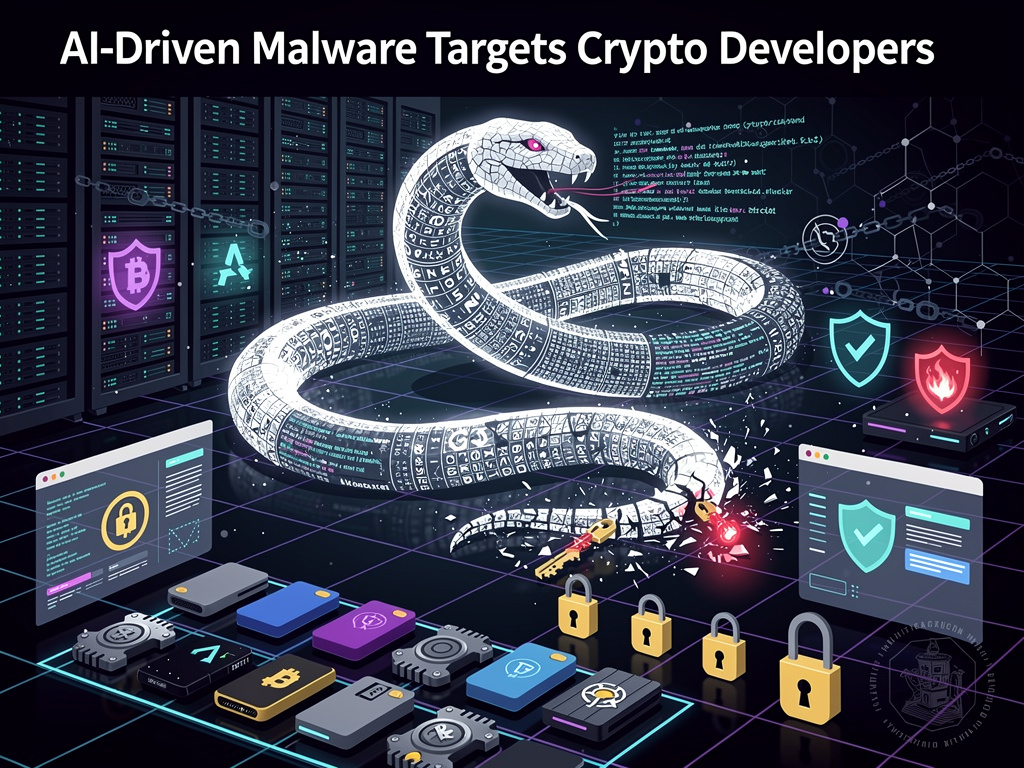
In the ceaseless cat-and-mouse game of cybersecurity, attackers have deployed a formidable new weapon: artificial intelligence. A sophisticated information-stealing malware, dubbed “WhiteSnake Stealer,” is actively leveraging large language models (LLMs) to dynamically alter its own code, creating a nearly endless stream of unique versions designed to slip past conventional security software. This development marks a significant escalation in the cyber arms race, moving malware from static, predictable threats to intelligent, adaptive adversaries.
The primary targets of this new campaign are cryptocurrency developers, a group holding the digital keys to potentially vast fortunes. According to a detailed analysis by cybersecurity firm Cyfirma, WhiteSnake is a data-harvesting tool of alarming efficiency. Once it infects a system, the Go-based malware meticulously extracts sensitive information from web browsers, password managers, and, most critically, cryptocurrency wallets such as MetaMask and Coinbase. The malware demonstrates a clear intent to compromise the core assets of the digital economy.
A New Breed of Polymorphic Predator
The most alarming innovation within WhiteSnake is its use of an LLM to achieve a high degree of polymorphism. For decades, malware authors have used techniques to change the appearance of their code to evade signature-based detection. However, these methods often followed predictable patterns. WhiteSnake’s approach is a generational leap forward. The malware uses an LLM to generate unique, obfuscated VBScript and PowerShell code for its loader component with each new infection. This automated process creates functionally identical but structurally distinct versions of the malware, rendering traditional antivirus signatures almost immediately obsolete.
This AI-driven obfuscation presents a daunting challenge for security teams. By automating the process of rewriting its own attack code, the malware’s creators have effectively outsourced the task of evasion to a machine. As noted in a report by TechRadar, this technique ensures the malware remains a moving target, significantly increasing the difficulty and cost of detection and analysis for defenders. The LLM doesn’t just change a few lines of code; it can re-imagine the entire structure of the malicious script, making it appear benign to automated scanning tools.
The Lucrative Hunt for Crypto Keys
The selection of cryptocurrency developers as a prime target is a calculated and strategic decision. These individuals are high-value targets because they possess the credentials and private keys that control access to decentralized applications, smart contracts, and cryptocurrency exchanges. A single successful breach can lead to the theft of millions of dollars in digital assets not only from the individual but also from the projects and user communities they support. This represents a potent form of supply chain attack within the Web3 ecosystem.
The financial incentive is staggering. In 2023 alone, cybercriminals siphoned over $2 billion through various hacks and scams targeting the crypto sector, as documented by Forbes. By targeting the developers who build and maintain these systems, attackers aim to bypass project-level security measures and go straight to the source of administrative control. WhiteSnake’s ability to steal credentials from a wide array of applications, including Discord and Telegram, which are central communication hubs for crypto projects, further enhances its effectiveness in compromising entire organizations.
An Emerging Pattern of AI-Driven Attacks
WhiteSnake Stealer is not an isolated phenomenon but rather a harbinger of a broader trend. The same generative AI technology that powers tools like ChatGPT is being rapidly weaponized by threat actors. Another recent example is a tool known as “BlackMamba,” which leverages generative AI to craft highly convincing and personalized phishing emails at scale. For a modest monthly fee, cybercriminals can access a service that automates the creation of sophisticated social engineering lures, dramatically increasing the efficiency of their campaigns, according to security firm SlashNext.
This proliferation of AI-powered attack tools is effectively democratizing cybercrime. Techniques that once required deep technical expertise and significant resources are now becoming accessible to a wider range of less-skilled actors. Generative AI can be used to write malware code, create polymorphic variants, craft compelling phishing content, and even automate elements of command-and-control infrastructure. This lowers the barrier to entry for launching sophisticated attacks, increasing the volume and complexity of threats that organizations must defend against.
The Challenge for Modern Cyber Defenses
The rise of AI-generated malware forces a critical re-evaluation of established cybersecurity strategies. Defenses reliant on spotting known threats through file signatures or simple heuristics are proving increasingly inadequate. As threat actors use AI to create a firehose of unique malware samples, defenders must shift their focus from what a threat *looks like* to what it *does*. This places a greater emphasis on behavioral analysis and endpoint detection and response (EDR) solutions that can identify malicious activity based on its actions, regardless of the underlying code’s structure.
This new reality is supercharging the need for AI on the defensive side of the equation. Security vendors and internal security operations centers (SOCs) must deploy their own machine learning models to detect anomalies, identify patterns of malicious behavior, and respond to threats at machine speed. The era of AI-powered polymorphic malware necessitates a move toward a zero-trust architecture, where no user or application is trusted by default and verification is required for every access request, a trend highlighted by industry publication Dark Reading. This is especially critical in software development environments where access to source code and production systems is paramount.
Inside the Serpent’s Nest
A closer look at WhiteSnake’s operational mechanics reveals a threat actor who is both sophisticated and pragmatic. The malware’s use of the Go programming language makes it inherently difficult to reverse-engineer and allows for easier cross-compilation to target multiple operating systems. Its method for command-and-control (C2) and data exfiltration further demonstrates its evasiveness. Instead of communicating with a dedicated malicious server that could be easily blacklisted, WhiteSnake uses popular, legitimate services.
Cyfirma’s research shows that the malware uses the messaging app Telegram to receive commands from its operators and exfiltrates stolen data through Pastebin, a site commonly used by developers for sharing text and code snippets. By piggybacking on the encrypted traffic of these legitimate platforms, the malware’s communications blend in with normal network activity, making it exceptionally difficult for network security tools to flag. This combination of an AI-generated loader and the use of legitimate services for C2 creates a highly resilient and stealthy threat.
Fortifying the Front Lines in an AI Arms Race
As attackers integrate AI into their toolkits, organizations must respond by reinforcing both their technical and human defenses. For high-value targets like developers, this means a renewed focus on security fundamentals. Mandatory multi-factor authentication (MFA) on all accounts, especially for code repositories, cloud services, and communication platforms, is no longer optional. Furthermore, organizations must invest in continuous security awareness training that educates employees on the nuances of AI-generated phishing and social engineering tactics.
The emergence of threats like WhiteSnake Stealer confirms that the theoretical risk of AI-weaponization is now a practical reality. The same powerful models that promise to revolutionize industries are also providing adversaries with unprecedented capabilities to create evasive, intelligent, and scalable attacks. This marks a pivotal moment in cybersecurity, where the advantage will go to those who can most effectively harness the power of artificial intelligence not just for attack, but for a more dynamic and predictive defense.


 WebProNews is an iEntry Publication