
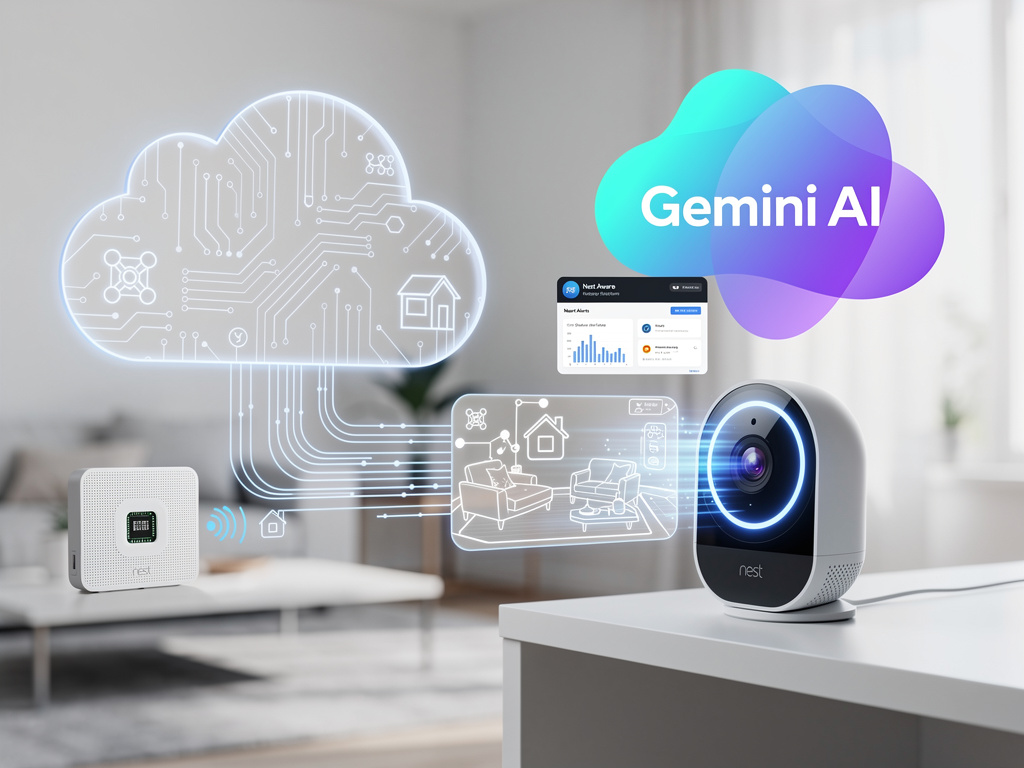
For the better part of a decade, the promise of the connected home has outpaced its reality. Security cameras, the supposed eyes of the automated household, have largely functioned as dumb sensors—triggering notifications for shifting shadows or passing cars with frustrating regularity. Google is now attempting to bridge this intelligence gap by integrating its Gemini multimodal AI models directly into Nest camera feeds, a move that fundamentally alters the technical and ethical architecture of home security.
The update, currently rolling out to select users in Google’s Public Preview program, represents a departure from simple computer vision. Instead of merely drawing bounding boxes around humans or packages, the system employs Vision Language Models (VLMs) capable of interpreting context. As reported by CNET, this enables the software to answer natural language queries about video history, such as “Did the dog go in the garden today?” or “Show me when the delivery truck arrived.” While this offers a significant utility upgrade for consumers, it forces a renegotiation of privacy standards that the industry has spent years establishing.
From Pixel Counting to Contextual Awareness
To understand the magnitude of this shift, one must look at the underlying technology. Traditional smart cameras rely on Convolutional Neural Networks (CNNs) trained to recognize specific shapes—a person, a vehicle, a dog. These systems are rigid; if a camera sees a person riding a bicycle, it might toggle between detecting a “person” and a “vehicle,” but it lacks the semantic understanding to describe the activity. Google’s integration of Gemini introduces generative capabilities that analyze video frames not just as data points, but as narrative content.
This allows the system to generate text descriptions of visual events. A user searching their history for “kids playing soccer” can retrieve relevant clips even if the system was never explicitly programmed to identify a soccer ball. This flexibility is critical for Google’s broader strategy to dominate the ambient computing sector, moving beyond command-and-control interfaces to proactive assistance. However, this level of processing requires computational power that far exceeds the capabilities of the low-power ARM chips found in current Nest hardware.
The Infrastructure of Intelligence and the Cloud Mandate
The deployment of Gemini necessitates a pivot back to cloud-centric processing, a reversal of recent industry trends that favored “edge computing”—processing data locally on the device to enhance speed and privacy. Generative AI models are simply too large to run efficiently on a doorbell camera. Consequently, video data must be transmitted to Google’s servers to be analyzed by the Gemini models. This architectural necessity creates a distinct bifurcation in the market between companies prioritizing local processing and those prioritizing advanced intelligence.
According to Google’s recent announcements, the company is acutely aware of the optics. They maintain that while the video is processed in the cloud to generate these AI descriptions, the data remains within a secure container associated with the user’s account. Yet, for industry observers, the distinction between “processing” and “training” remains a critical friction point. Google has stated that video data processed by Gemini for these specific features is not used to train the foundational public models, but the sheer volume of intimate home data traversing Google’s infrastructure raises inevitable security questions.
Redefining Privacy Policies for the Generative Era
The introduction of Large Language Models (LLMs) into security feeds complicates the privacy narrative. Previously, metadata was relatively simple: a timestamp and a tag (e.g., “Person detected”). Now, the metadata includes detailed, AI-generated descriptions of private activities. If a camera observes a family argument or a medical emergency, Gemini could theoretically transcribe and describe those events in searchable text. This creates a new category of sensitive data—semantic logs of daily life—that is potentially more invasive than raw video because it is indexed and searchable.
Google has implemented safeguards, emphasizing that the AI is designed to be helpful rather than intrusive. As noted in the CNET analysis, the company insists that human review of this footage is nonexistent for the vast majority of users, occurring only in extreme debugging scenarios where users have explicitly opted in. However, the centralization of this data creates a high-value target. A breach involving searchable text descriptions of home activities could be far more damaging than a breach of unindexed video files, as bad actors could rapidly query the database for specific vulnerabilities or habits.
The Economic Imperative for Subscription Services
Beyond the technical and ethical dimensions, this move is a strategic play to bolster the value proposition of the Nest Aware subscription service. The consumer hardware market has faced saturation and lengthened replacement cycles. To maintain revenue growth, manufacturers must convert hardware buyers into recurring subscribers. By gating these advanced AI features behind the Nest Aware Plus paywall, Google is attempting to transform the smart camera from a one-time purchase into a continuous service dependency.
This contrasts with the approach taken by some competitors who offer local storage options without monthly fees. Google is betting that the convenience of natural language search—the ability to ask, “Where did I leave my keys?” and have the camera find the answer—will outweigh consumer reluctance to pay monthly fees or share data with the cloud. It is a test of the market’s elasticity regarding privacy: how much personal data are consumers willing to trade for a truly smart assistant?
Competitive Divergence in the Home Security Sector
Google’s strategy places it on a divergent path from Apple. Apple’s HomeKit Secure Video emphasizes end-to-end encryption and local processing via a home hub (like an Apple TV or HomePod), ensuring that even Apple cannot view the footage. While this maximizes privacy, it limits the complexity of AI analysis to what the local processor can handle. Google, leveraging its massive cloud infrastructure and the Gemini model, is taking the opposite route: maximizing intelligence at the cost of data centralization.
Amazon’s Ring is also integrating LLMs, but Google’s integration of Gemini across its entire suite—from email to photos to home security—suggests a more unified ambition. They aim to create a “context graph” of the user’s life. If Gemini knows your calendar (from Gmail) and sees you leaving the house (via Nest), it can infer context that a standalone security system cannot. This interoperability is Google’s primary moat against competitors, but it also consolidates an unprecedented amount of behavioral data under one corporate roof.
Navigating the Risk of Algorithmic Hallucination
A specific challenge for generative AI in security is the phenomenon of “hallucination,” where the model confidently invents details. In a text summarization task, a hallucination is an annoyance; in a home security context, it is a liability. If Gemini incorrectly identifies a delivery person as a threat, or misinterprets a child playing as a dangerous situation, the consequences could range from false police dispatches to eroded user trust.
Industry insiders suggest that Google is likely employing a “confidence threshold” mechanism, where the AI only presents descriptions when it is statistically certain. However, the probabilistic nature of VLMs means that error rates can never be zero. As these features roll out to the wider public beyond the initial preview, the tolerance for these errors will be tested. The legal implications of an AI making a false accusation based on a camera feed are murky and largely untested in courts.
The Future of the Autonomous Home
The integration of Gemini into Nest cameras is merely the opening salvo in a broader transition toward the autonomous home. The end goal is not just a camera that can answer questions, but a system that can take action based on visual data. If the camera sees a window left open while the thermostat is running, it should theoretically communicate with the HVAC system to adjust the temperature. This level of automation requires the high-level semantic understanding that only multimodal AI can provide.
Current implementations are restricted to information retrieval, but the roadmap is clear. By turning video feeds into structured data, Google is laying the groundwork for a home operating system that understands human intent and physical state. The success of this initiative will depend heavily on execution—specifically, whether Google can deliver this intelligence without latency and without the privacy scandals that have plagued the IoT sector in the past. For now, the industry watches as the smart home moves from detecting motion to understanding life.


 WebProNews is an iEntry Publication