
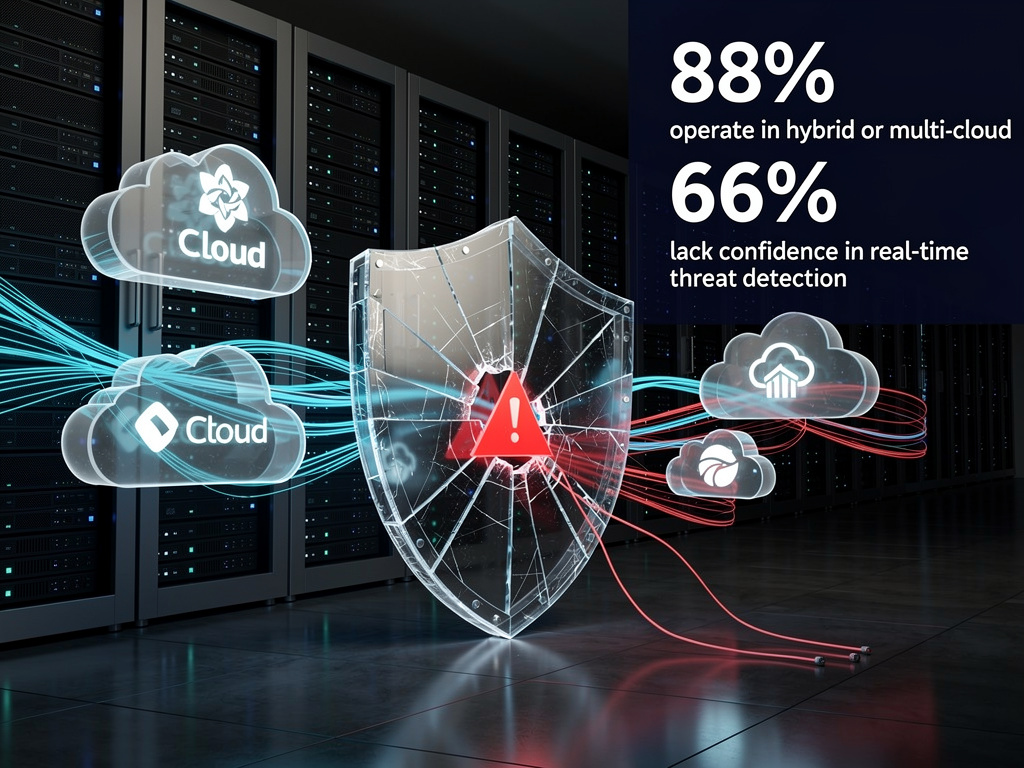
The rapid adoption of multi-cloud strategies has created a dangerous paradox for enterprise security teams: as organizations spread their digital infrastructure across an average of three or more cloud platforms, their ability to detect and respond to threats in real-time has deteriorated significantly. According to a recent report highlighted by Virtualization Review, 88% of organizations now operate across hybrid or multi-cloud environments, yet 66% admit they lack confidence in their real-time threat detection capabilities.
This confidence gap represents more than just a technical challenge—it signals a fundamental shift in how enterprises must approach cybersecurity in an era where cloud infrastructure has become the backbone of digital operations. The proliferation of cloud services from Amazon Web Services, Microsoft Azure, Google Cloud Platform, and numerous specialized providers has created an environment where security teams struggle to maintain visibility across disparate systems, each with its own security protocols, logging mechanisms, and potential vulnerabilities.
The problem has intensified as organizations have moved beyond simple cloud adoption to complex multi-cloud architectures designed to avoid vendor lock-in, optimize costs, and leverage best-of-breed services. While these strategies offer business advantages, they have simultaneously created security blind spots that threat actors are increasingly exploiting. Security professionals now face the daunting task of monitoring multiple control planes, managing inconsistent security policies, and correlating threat intelligence across platforms that were never designed to work together seamlessly.
The Architecture of Vulnerability: Understanding Multi-Cloud Security Challenges
The complexity inherent in multi-cloud environments stems from several interconnected factors. First, each cloud provider implements security differently, with unique identity and access management systems, network architectures, and compliance frameworks. What constitutes a security event in AWS may be logged and categorized differently in Azure, making it difficult for security information and event management (SIEM) systems to provide unified threat detection across platforms.
Second, the sheer volume of security alerts generated by multiple cloud platforms has created what industry experts call “alert fatigue.” Security teams receive thousands of notifications daily, many of them false positives or low-priority events that obscure genuine threats. Without sophisticated correlation and prioritization capabilities, critical security incidents can remain undetected for hours or even days—an eternity in cybersecurity terms where attackers can exfiltrate sensitive data or establish persistent access within minutes.
Third, the shared responsibility model that governs cloud security has created confusion about who is responsible for what. While cloud providers secure the underlying infrastructure, customers remain responsible for securing their data, applications, and access controls. This division of responsibility becomes exponentially more complex in multi-cloud environments, where different providers may interpret shared responsibility differently, leaving potential security gaps that neither party adequately addresses.
The Real-Time Detection Deficit: Why Two-Thirds of Organizations Are Flying Blind
The 66% confidence gap in real-time threat detection revealed in the Virtualization Review report reflects several systemic issues plaguing enterprise cloud security. Many organizations continue to rely on traditional security tools designed for on-premises infrastructure, attempting to retrofit them for cloud environments where they lack the necessary visibility and integration capabilities. These legacy systems often cannot access cloud-native logs, monitor serverless functions, or track ephemeral containers that exist for mere seconds before disappearing.
Furthermore, the skills gap in cloud security has widened as the technology has evolved faster than training programs can keep pace. Security professionals who excelled at protecting perimeter-based networks find themselves struggling with the distributed, API-driven nature of cloud security. The shortage of qualified cloud security specialists has forced many organizations to spread their existing teams thin across multiple platforms, reducing their effectiveness in detecting and responding to threats on any single platform.
The economic pressures facing many organizations have also contributed to the security deficit. While cloud adoption has accelerated, budgets for cloud security tools and personnel have not kept pace. Organizations often prioritize application development and deployment over security instrumentation, creating technical debt that manifests as reduced visibility and detection capabilities. This short-term thinking leaves organizations vulnerable to breaches that can cost far more than the security investments they deferred.
Attack Vectors Multiply as Defenders Struggle to Keep Pace
Threat actors have quickly recognized and exploited the security challenges inherent in multi-cloud environments. Sophisticated attack groups now specifically target the seams between cloud platforms, exploiting the inconsistencies in security policies and monitoring capabilities. They understand that security teams struggle to correlate events across multiple clouds, allowing attackers to hide malicious activity by distributing it across platforms where it appears benign when viewed in isolation.
Misconfigured cloud resources remain one of the most common attack vectors, with publicly accessible storage buckets, overly permissive identity policies, and unpatched services providing easy entry points for attackers. In multi-cloud environments, the risk of misconfiguration multiplies as teams must manage security settings across multiple platforms, each with different default configurations and security best practices. A security policy that works well in one cloud may create vulnerabilities when applied to another without proper adaptation.
The rise of cloud-native attacks, including container escapes, serverless function exploits, and API abuse, has further complicated the threat detection challenge. Traditional signature-based detection methods often fail against these novel attack techniques, requiring behavioral analytics and machine learning approaches that many organizations have not yet implemented effectively across their multi-cloud infrastructure.
Emerging Solutions and the Path Forward for Enterprise Security
Despite the daunting challenges, several approaches are emerging to address the multi-cloud security detection gap. Cloud Security Posture Management (CSPM) tools have evolved to provide unified visibility across multiple cloud platforms, automatically detecting misconfigurations and policy violations. However, these tools are only as effective as their implementation and the organizational commitment to addressing the issues they identify.
Cloud-Native Application Protection Platforms (CNAPP) represent a more comprehensive approach, combining CSPM with cloud workload protection, container security, and infrastructure-as-code scanning into unified platforms. These solutions aim to provide the end-to-end visibility that organizations need to detect threats in real-time across their entire multi-cloud infrastructure. Early adopters report significant improvements in threat detection capabilities, though implementation remains complex and resource-intensive.
Artificial intelligence and machine learning are increasingly being deployed to address the alert fatigue problem and improve threat detection accuracy. These technologies can analyze patterns across multiple cloud platforms, identifying anomalies that might indicate security incidents while filtering out false positives. However, the effectiveness of AI-driven security tools depends heavily on the quality and completeness of the data they receive, which remains a challenge in fragmented multi-cloud environments.
Organizational and Cultural Shifts Required for Effective Cloud Security
Technology alone cannot solve the multi-cloud security detection problem. Organizations must fundamentally rethink their approach to cloud security, moving from reactive incident response to proactive threat hunting and continuous monitoring. This shift requires executive support, adequate budgets, and a willingness to prioritize security alongside feature development and cost optimization.
The DevSecOps movement, which integrates security into the development and deployment pipeline, offers a promising framework for improving cloud security. By embedding security controls and monitoring capabilities into the infrastructure-as-code templates and CI/CD pipelines that deploy cloud resources, organizations can ensure that security is built in from the start rather than bolted on afterward. This approach reduces the risk of misconfigurations and improves visibility into cloud resources as they are created.
Collaboration between cloud providers, security vendors, and enterprise customers will be essential to closing the detection gap. Industry standards for security logging, event formats, and threat intelligence sharing could significantly improve the ability to correlate security events across multiple platforms. Some cloud providers have begun offering native integration with third-party security tools, but much work remains to create the seamless, unified security visibility that enterprises need.
The Stakes Have Never Been Higher for Cloud Security
As organizations continue their digital transformation journeys, the importance of effective cloud security will only increase. The 66% confidence gap in real-time threat detection represents billions of dollars in potential breach costs and immeasurable reputational damage. Organizations that fail to address this gap risk becoming the next headline-making security incident, joining the growing list of companies that learned the hard way that cloud complexity and security cannot be treated as separate concerns.
The path forward requires a combination of technology investment, organizational change, and industry collaboration. Organizations must move beyond simply deploying cloud resources to implementing comprehensive security architectures that provide real-time visibility and threat detection across their entire multi-cloud infrastructure. This transformation will not happen overnight, but the alternative—continuing to operate with significant security blind spots—is no longer acceptable in an environment where cyber threats grow more sophisticated daily.
The multi-cloud security challenge represents one of the defining technology issues of this decade. How organizations respond will determine not only their individual security postures but the overall resilience of the digital economy. With 88% of organizations now operating in hybrid or multi-cloud environments, the time for incremental improvements has passed. What is needed now is a fundamental reimagining of cloud security that matches the complexity of modern infrastructure with equally sophisticated detection and response capabilities.


 WebProNews is an iEntry Publication