
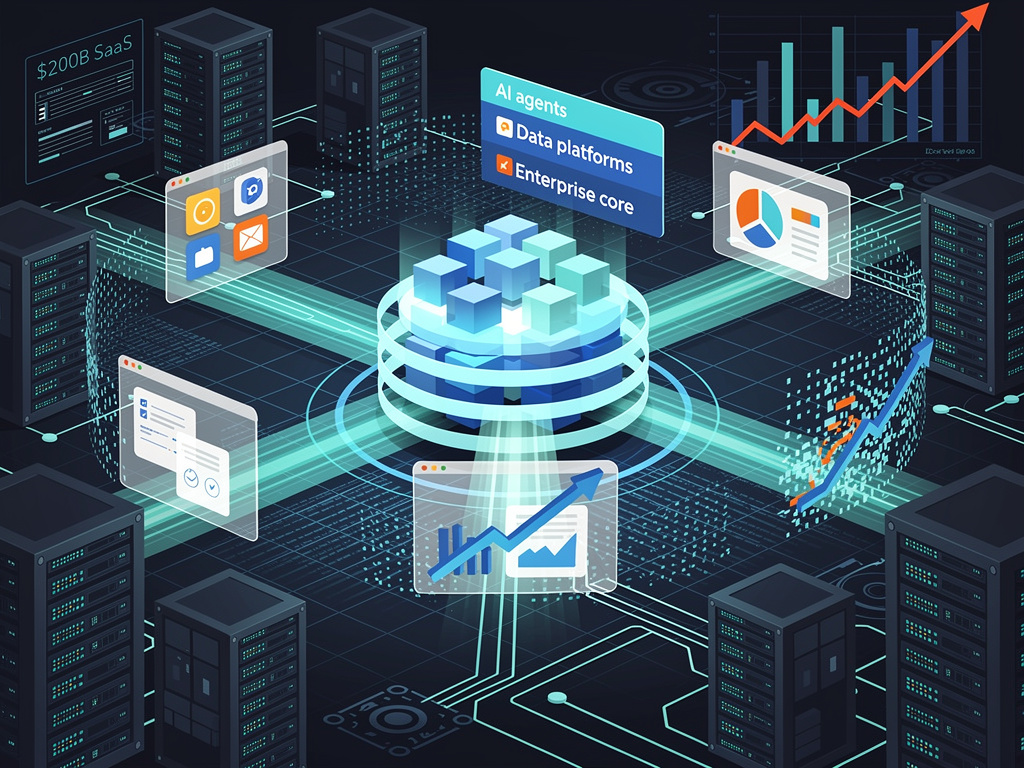
For more than two decades, Software-as-a-Service has been the dominant paradigm in enterprise technology — a model so entrenched that it reshaped how companies buy, deploy, and think about software. But according to Ali Ghodsi, the chief executive of Databricks, the $200 billion SaaS industry is approaching a moment of profound disruption. Not death, exactly, but something arguably worse for incumbents: irrelevance.
In a wide-ranging discussion reported by TechCrunch, Ghodsi laid out a vision of the near future in which AI agents — autonomous software systems capable of performing complex tasks with minimal human oversight — will increasingly replace the rigid, pre-built workflows that define today’s SaaS applications. It’s a thesis that has been gaining traction across Silicon Valley, but coming from the leader of a company valued at $62 billion, it carries particular weight.
From Point-and-Click to Prompt-and-Execute
The core of Ghodsi’s argument is deceptively simple. Traditional SaaS products are, at their heart, bundles of pre-defined workflows wrapped in user interfaces. A CRM tool like Salesforce, for instance, offers structured ways to manage leads, track deals, and forecast revenue. An HR platform like Workday provides templated processes for hiring, payroll, and compliance. These tools work well, but they are inherently constrained by the imagination of the engineers who built them.
AI agents, Ghodsi contends, will obliterate those constraints. Rather than navigating a series of menus and dashboards to accomplish a task, a knowledge worker could simply describe what they need — in natural language — and an AI agent would execute the workflow on the fly, pulling from underlying data platforms, APIs, and enterprise systems. The implication is stark: if the agent can do the work, the application layer becomes a vestigial organ.
Databricks’ Strategic Positioning in the AI Agent Era
This is not mere philosophical musing for Ghodsi. Databricks has been aggressively positioning itself as the foundational data and AI platform upon which these agents will operate. The company’s unified data intelligence platform — which combines data lakehouse architecture with AI model training and deployment capabilities — is designed to be the substrate that powers agentic workflows. If SaaS applications become less important, the data layer beneath them becomes more important. And that is precisely where Databricks lives.
As reported by TechCrunch, Ghodsi was careful to note that he does not believe SaaS is “dead” in the near term. Legacy contracts, regulatory requirements, and organizational inertia will keep traditional software platforms running for years. But he drew an analogy to the transition from on-premises software to cloud computing: the old model didn’t vanish overnight, but it steadily lost relevance as the new paradigm proved superior in cost, flexibility, and capability. AI agents, he suggested, will follow a similar trajectory — slowly at first, then all at once.
The Billion-Dollar Question: Who Owns the Agent Layer?
Ghodsi’s comments arrive at a moment of intense competition over who will control the emerging AI agent ecosystem. Microsoft has embedded its Copilot agents deeply into the Microsoft 365 suite. Google has been building Gemini-powered agents into Workspace and its cloud platform. Salesforce has launched Agentforce, a platform designed to let enterprises build and deploy autonomous AI agents within its ecosystem. And a growing cohort of startups — from Anthropic to Cognition to Sierra AI — are racing to build general-purpose and vertical-specific agent platforms.
The question of who “owns” the agent layer is not academic. It will determine the flow of hundreds of billions of dollars in enterprise IT spending over the coming decade. If agents are built on top of existing SaaS platforms, incumbents like Salesforce, ServiceNow, and Workday may actually strengthen their positions. But if agents are built on top of data platforms — pulling directly from data lakes, warehouses, and real-time streams — then companies like Databricks, Snowflake, and the hyperscale cloud providers stand to capture an outsized share of value.
Industry Voices: Skepticism and Validation
Not everyone in the enterprise technology world shares Ghodsi’s conviction. Some veteran SaaS executives argue that the “SaaS is dead” narrative is overblown, pointing out that AI agents still need structured data, governance frameworks, and compliance guardrails that SaaS platforms are uniquely positioned to provide. Benioff at Salesforce, for instance, has repeatedly argued that AI agents will enhance rather than replace SaaS, making existing platforms more intelligent and more valuable.
There is also the practical matter of trust. Enterprise buyers are notoriously cautious about handing critical business processes to autonomous systems. The gap between a demo of an AI agent booking a meeting and an AI agent autonomously managing a multi-million-dollar procurement workflow is enormous. Security, auditability, and accountability remain unresolved challenges that could slow the transition Ghodsi envisions. As multiple industry analysts have noted, the enterprise adoption curve for AI agents will likely be measured in years, not months.
Databricks’ Meteoric Rise and the Data Gravity Thesis
To understand why Ghodsi is making this argument now, it helps to understand Databricks’ trajectory. The company, founded in 2013 by the original creators of Apache Spark at UC Berkeley, has grown into one of the most valuable private technology companies in the world. Its $62 billion valuation, achieved in a late 2024 funding round, reflects investor confidence not just in its current business — which generates billions in annual recurring revenue — but in its potential to become the default platform for enterprise AI.
Databricks’ thesis rests on the concept of data gravity: the idea that as organizations accumulate more data in a single platform, the cost and complexity of moving that data elsewhere increases, creating a powerful moat. If AI agents need access to vast, well-governed datasets to function effectively — and they do — then the platform that houses that data becomes the center of gravity for the entire AI stack. Ghodsi is essentially arguing that the future of enterprise software is not applications but intelligence, and intelligence requires data.
The Competitive Chess Match With Snowflake and the Hyperscalers
Databricks is not alone in pursuing this vision. Snowflake, its most direct competitor in the cloud data platform market, has been making its own aggressive moves into AI. Under the leadership of Sridhar Ramaswamy, who took over as CEO in 2024, Snowflake has invested heavily in Cortex AI, its suite of AI and machine learning services built natively into the Snowflake platform. The company has also acquired several AI startups to accelerate its capabilities in areas like natural language querying and automated data engineering.
Meanwhile, the hyperscale cloud providers — Amazon Web Services, Microsoft Azure, and Google Cloud — are building their own integrated data and AI platforms that could potentially subsume the functionality of both Databricks and Snowflake. AWS’s Bedrock, Azure’s AI Studio, and Google’s Vertex AI all offer increasingly sophisticated tools for building and deploying AI agents, often tightly integrated with proprietary foundation models. The risk for Databricks is that the hyperscalers could use their distribution advantages and existing enterprise relationships to capture the agent layer before independent platforms can establish dominance.
What This Means for Enterprise Buyers and the Broader Market
For enterprise technology buyers, Ghodsi’s thesis raises uncomfortable questions. If AI agents will eventually replace many SaaS workflows, should organizations be rethinking their software portfolios now? Should they be investing more heavily in their data infrastructure — ensuring that their data is clean, well-governed, and accessible — rather than layering on additional SaaS applications? And how should they evaluate the growing number of AI agent platforms competing for their attention and budgets?
The honest answer is that it’s too early to make sweeping changes, but not too early to start preparing. Organizations that have invested in modern data platforms, strong data governance, and flexible integration architectures will be better positioned to adopt AI agents as they mature. Those that remain locked into rigid, siloed SaaS ecosystems may find themselves at a disadvantage — not because their software stops working, but because their competitors’ software starts thinking.
The SaaS Model Faces Its Most Existential Test Yet
Ali Ghodsi’s comments are, of course, self-serving. He runs a data platform company, and his vision of the future conveniently places data platforms at the center of the enterprise technology universe. But that doesn’t make him wrong. The history of technology is littered with dominant paradigms that seemed permanent until they weren’t — mainframes, client-server computing, on-premises software, and now, perhaps, SaaS.
As TechCrunch noted, Ghodsi’s framing — that SaaS isn’t dead but will become irrelevant — is perhaps the most nuanced and therefore the most credible version of this argument. It acknowledges the staying power of incumbents while insisting that the direction of travel is unmistakable. For the thousands of SaaS companies that have built their businesses on the assumption that pre-built workflows delivered through web browsers represent the pinnacle of enterprise software, it’s a wake-up call worth heeding. The software may keep running. But the world may simply stop caring.


 WebProNews is an iEntry Publication