
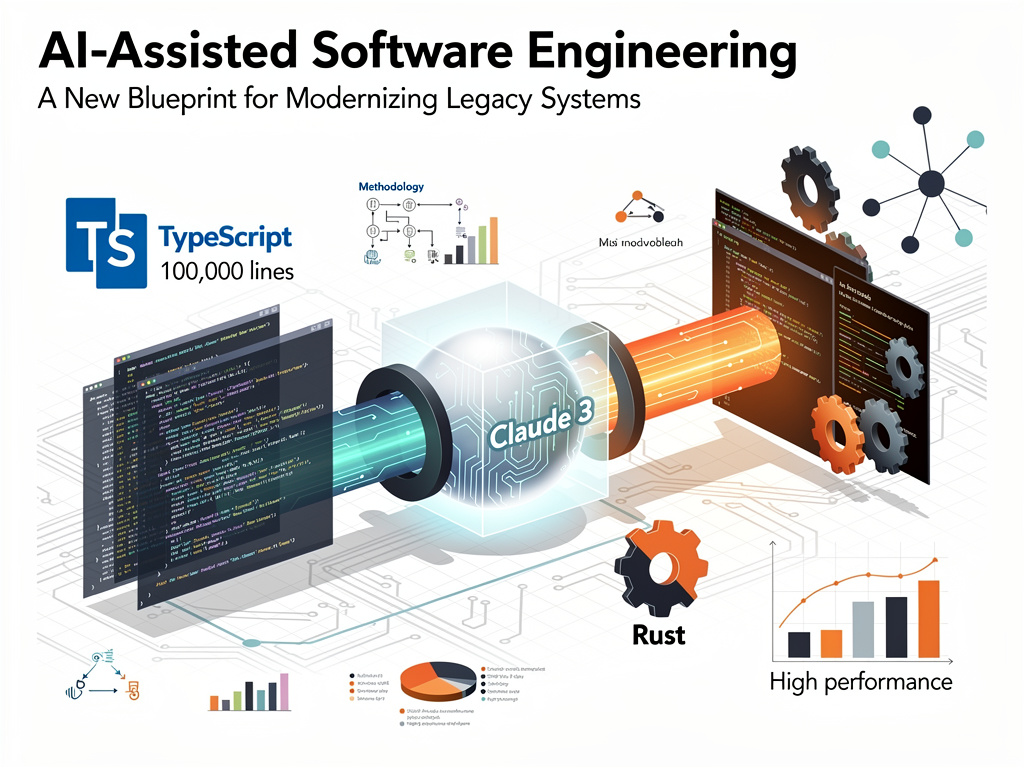
In the world of high-stakes software engineering, rewrites are the stuff of legend and cautionary tales. The decision to scrap an existing codebase in favor of a new one is often a multi-year, multi-million dollar bet that can sink teams. Yet, Christopher Chedeau, a principal engineer known in developer circles as Vjeux, undertook a challenge that would have been unthinkable just a year ago: he migrated a sprawling 100,000-line TypeScript application to the high-performance language Rust. He did it largely by himself. And he did it in about a month.
This feat was not accomplished through sheer force of will alone, but with a new and powerful partner: an artificial intelligence model from Anthropic known as Claude 3 Opus. The project stands as one of the most significant real-world demonstrations of how generative AI is moving beyond simple code completion to become a force multiplier for complex engineering tasks. It offers a glimpse into a new paradigm of software development, where a single expert, augmented by AI, can achieve what was recently the domain of entire teams, fundamentally altering the calculus of technical debt, performance optimization, and project timelines.
A High-Stakes Bet on Performance and AI
The impetus for the migration was a classic engineering problem: the relentless pursuit of speed. The application in question, a core component of the developer tool Replay.io, needed to be faster—not just incrementally, but orders of magnitude faster. While TypeScript, a popular language that builds on JavaScript, offers excellent developer ergonomics, its performance as an interpreted language has inherent ceilings. For the kind of data-intensive processing Replay.io handles, those ceilings were becoming a critical business constraint.
The target was Rust, a language prized by systems programmers for its blistering performance and memory safety guarantees, but also notorious for its steep learning curve. A manual rewrite would have been a monumental undertaking, fraught with risk and resource-intensive. Instead, Mr. Chedeau wagered that a state-of-the-art Large Language Model (LLM) could handle the lion’s share of the tedious translation work, a hypothesis that would test the very limits of AI-assisted development. The goal was to achieve a 100x speedup by moving from Node.js to a native Rust implementation, a figure that could transform the user experience.
Engineering the Perfect AI Prompt
Success did not come from simply feeding the AI chunks of code and hoping for the best. Mr. Chedeau meticulously engineered a sophisticated workflow centered on a detailed prompt that served as a comprehensive instruction manual for his AI partner. This master prompt, refined over time, explained the context of the migration, specified the source and target languages, and laid out explicit rules for the conversion. It dictated the use of specific Rust libraries, such as `serde` for data serialization, and instructed the model on how to handle idiomatic Rust patterns like error handling and data structures.
The process evolved into a highly efficient feedback loop. Mr. Chedeau would paste a TypeScript file into the prompt, and Claude 3 Opus would return its Rust equivalent. He would then run the Rust compiler, which would invariably find errors. These errors, however, served as a precise to-do list for the human expert. In a detailed breakdown of the project on his personal blog, he describes this symbiotic relationship as the key to the project’s velocity. The AI performed the laborious 90% of the translation, while he focused on the high-value work of architectural fixes and debugging the nuanced errors the AI could not resolve on its own.
The Economics and Productivity of an AI-Augmented Rewrite
The financial and productivity metrics of the project are perhaps its most disruptive aspect. The entire migration cost approximately $200 in API fees for Claude 3 Opus and an additional $20 for OpenAI’s GPT-4, which was used for ancillary tasks. This investment, less than the price of a high-end office chair, unlocked a level of productivity that defies traditional software development benchmarks. A project of this scale would typically be scoped for a small team over at least two quarters, carrying a six-figure price tag in engineering salaries alone.
By offloading the cognitive overhead of translation, Mr. Chedeau was able to sustain a remarkable pace, converting thousands of lines of code per day. The AI acted as an tireless junior programmer, flawlessly executing rote tasks and allowing the senior engineer to maintain focus on the architectural integrity of the system. This model flips the traditional resource allocation of such projects, suggesting that future migrations may be less about the size of the team and more about the skill of the lead engineer and the sophistication of their AI tools.
Navigating the Pitfalls of AI-Generated Code
The process, however, was far from a fully automated utopia. The AI, for all its power, was a flawed collaborator. Mr. Chedeau noted that the model would frequently “hallucinate” and invent functions that didn’t exist or misuse library APIs. Furthermore, it struggled with some of Rust’s most complex concepts, particularly the ownership and lifetime rules that are central to the language’s memory safety guarantees. The AI could produce code that looked plausible but was fundamentally incorrect in ways only an experienced Rust programmer could diagnose.
This reality has been a central theme in discussions across developer communities on platforms like X and Hacker News. The consensus is that Mr. Chedeau’s success was not just a testament to the AI’s capability, but to his own deep expertise. He was not a novice asking for help, but an expert directing a powerful, if sometimes erratic, tool. This underscores a critical takeaway for the industry: for the foreseeable future, AI’s role in complex engineering is one of augmentation, not automation. The senior engineer’s role evolves from a creator of code to a director and verifier of an AI’s prolific output.
A New Blueprint for Modernization and Migration
Despite the caveats, the project serves as a powerful new blueprint for enterprises burdened by legacy systems. Countless organizations are running critical infrastructure on aging codebases written in slower, less secure languages. The cost and risk associated with modernization have historically been prohibitive, locking these companies into a cycle of mounting technical debt. Mr. Chedeau’s work demonstrates that AI-assisted migration can dramatically lower these barriers.
What was once a daunting, multi-year strategic initiative could now be reframed as a focused, short-term project led by a single, highly skilled engineer. This shift has the potential to unlock immense value, allowing companies to upgrade their technology stacks to gain performance, improve security, and attract talent. The ability to rapidly port code from a language like TypeScript or Python to Rust, Go, or C++ could become a significant competitive advantage, enabling companies to innovate faster and operate more efficiently.


 WebProNews is an iEntry Publication