
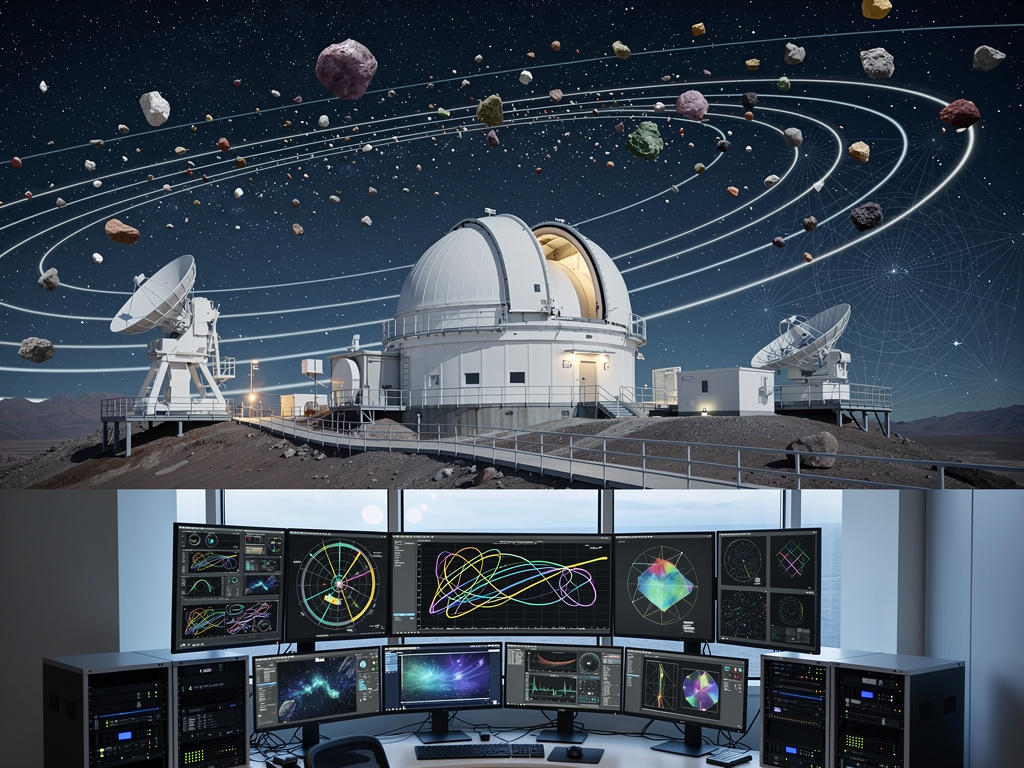
On a single night in late May, a telescope perched on a Chilean mountaintop did something no instrument in history has done: it identified more than 11,000 previously unknown asteroids in one observing session. Not over weeks. Not over months. One night.
The Vera C. Rubin Observatory, a joint project of the National Science Foundation and the Department of Energy, achieved this feat during an early phase of its commissioning period — before the telescope has even begun its primary ten-year survey of the southern sky. The haul represents the largest single-night discovery of asteroids ever recorded, and it’s a signal of what’s to come when the observatory reaches full operational capacity later this year.
The numbers alone are staggering. According to Gizmodo, the observatory detected 11,175 new asteroid candidates in the span of roughly six hours of observations. That count eclipses the previous record — held by the Catalina Sky Survey — by a wide margin. And the telescope wasn’t even trying particularly hard. It was running engineering tests.
A Camera the Size of a Small Car
What makes Rubin capable of such prodigious discovery rates is its 3,200-megapixel camera, the largest digital camera ever constructed for astronomy. Known as LSSTCam, the instrument captures images so wide and so detailed that each exposure covers an area of sky equivalent to about 40 full moons. That field of view, combined with the telescope’s 8.4-meter primary mirror and its rapid slewing capability, allows Rubin to scan enormous swaths of sky in a single night.
The telescope sits atop Cerro Pachón in Chile’s Coquimbo Region, at an elevation of roughly 2,700 meters. The site was chosen for its exceptionally dark skies and stable atmospheric conditions — factors that matter enormously when you’re trying to detect faint, fast-moving objects against the backdrop of space.
Rubin’s primary mission is the Legacy Survey of Space and Time, or LSST, a decade-long campaign to photograph the entire visible southern sky every few nights. The survey aims to catalog billions of galaxies, millions of supernovae, and — critically — the vast majority of potentially hazardous asteroids larger than 140 meters in diameter. Congress mandated that NASA find 90% of such objects by 2020, a deadline the agency missed by years. Rubin is expected to make a significant dent in that deficit.
But asteroid hunting is just one piece of a much larger scientific program. The observatory will also probe the nature of dark matter and dark energy, map the Milky Way’s structure in unprecedented detail, and detect transient optical events — things that go bump in the night sky. Exploding stars. Colliding neutron stars. Objects that appear and vanish within hours.
The 11,000-asteroid night demonstrates something important about Rubin’s design philosophy. Unlike most telescopes, which point at specific targets and stare, Rubin is built to survey. It moves quickly between exposures, taking two 15-second snapshots of each patch of sky before moving on. Software then compares the two images to identify anything that has shifted position — a telltale sign of a nearby solar system object. The approach is brute-force in scope but remarkably efficient in practice.
According to reporting by Gizmodo, the asteroids discovered during the commissioning run span a range of sizes and orbital types, from main-belt asteroids between Mars and Jupiter to near-Earth objects that pass closer to our planet. The Minor Planet Center, the international clearinghouse for asteroid observations, is processing the data. Confirmation of individual objects will take additional observations over the coming weeks and months, as astronomers track each candidate across multiple nights to pin down its orbit.
Why 140 Meters Matters
The threshold of 140 meters isn’t arbitrary. An asteroid of that size striking Earth would release energy equivalent to hundreds of megatons of TNT — enough to obliterate a major metropolitan area or, if it hit water, generate devastating tsunamis. NASA’s planetary defense strategy hinges on finding these objects years or decades before any potential impact, giving engineers time to mount a deflection mission. The DART spacecraft, which successfully altered the orbit of the asteroid moonlet Dimorphos in 2022, proved the concept works. But you can’t deflect what you haven’t found.
Current estimates suggest roughly 25,000 near-Earth asteroids larger than 140 meters exist. As of mid-2025, astronomers have cataloged about 40% of them. Rubin is expected to push that figure past 70% within its first few years of operation, and potentially higher as the survey accumulates repeated observations of the same sky regions.
The observatory’s data pipeline is itself a feat of engineering. Each night of observing will generate approximately 20 terabytes of raw data. Automated software will process this torrent in near-real time, issuing alerts within 60 seconds of detecting a transient or moving object. Those alerts will flow to astronomers worldwide, enabling rapid follow-up observations with other telescopes. The system is designed to issue roughly 10 million alerts per night once the full survey begins.
So what happens when you combine the world’s widest-field astronomical camera with the world’s fastest alert system and point it at the sky every clear night for a decade? You get a census of the solar system that dwarfs anything attempted before. The International Astronomical Union’s Minor Planet Center currently lists about 1.4 million known asteroids. Rubin is projected to discover an additional 5 to 6 million over the course of the LSST.
That’s not a marginal improvement. It’s a multiplication.
The commissioning phase, which began in earnest in early 2025, has already yielded scientific results beyond the asteroid haul. Engineers have been calibrating the camera’s optics, testing the telescope’s tracking systems, and verifying that the data pipeline can handle the expected volume. The 11,000-asteroid night was, in one sense, a byproduct of those tests. But it served as powerful validation that the system works as designed.
Rubin’s construction took more than two decades from initial concept to first light, and the project’s total cost exceeds $1 billion. The telescope was originally known as the Large Synoptic Survey Telescope before being renamed in 2020 to honor Vera Rubin, the astronomer whose observations of galaxy rotation curves provided some of the strongest early evidence for dark matter. She never received a Nobel Prize for the work, a fact widely regarded as one of the most conspicuous oversights in the history of the award.
The observatory now bearing her name is poised to address questions she helped frame. Dark matter constitutes roughly 27% of the universe’s mass-energy content, yet its nature remains unknown. By mapping the distribution of galaxies across billions of light-years and measuring how their light is distorted by intervening mass — a phenomenon called gravitational lensing — Rubin will constrain theoretical models of dark matter with a precision no previous survey could achieve.
And then there’s dark energy. The mysterious force accelerating the universe’s expansion. Rubin’s survey will track how the rate of expansion has changed over cosmic time, providing independent measurements that complement data from the European Space Agency’s Euclid mission and NASA’s Nancy Grace Roman Space Telescope, both of which are also conducting or planning large-scale surveys.
The asteroid discoveries, spectacular as they are, represent just one output of a machine built to do many things simultaneously. Every image Rubin takes contains information about asteroids, galaxies, stars, and transient phenomena all at once. The data will be public, available to any researcher anywhere in the world — a deliberate choice that reflects the project’s origins as a community-driven initiative within U.S. astronomy.
For planetary defense officials, the immediate priority is clear: find the objects that could threaten Earth, characterize their orbits, and determine which ones warrant closer scrutiny. Rubin won’t do this alone. NASA’s NEO Surveyor, an infrared space telescope designed specifically for asteroid detection, is scheduled for launch in 2028. Together, the two instruments should bring the census of potentially hazardous asteroids close to the 90% threshold Congress set a quarter-century ago.
But Rubin will get there first. And based on what happened on that single night in Chile, it’s going to get there fast.


 WebProNews is an iEntry Publication