
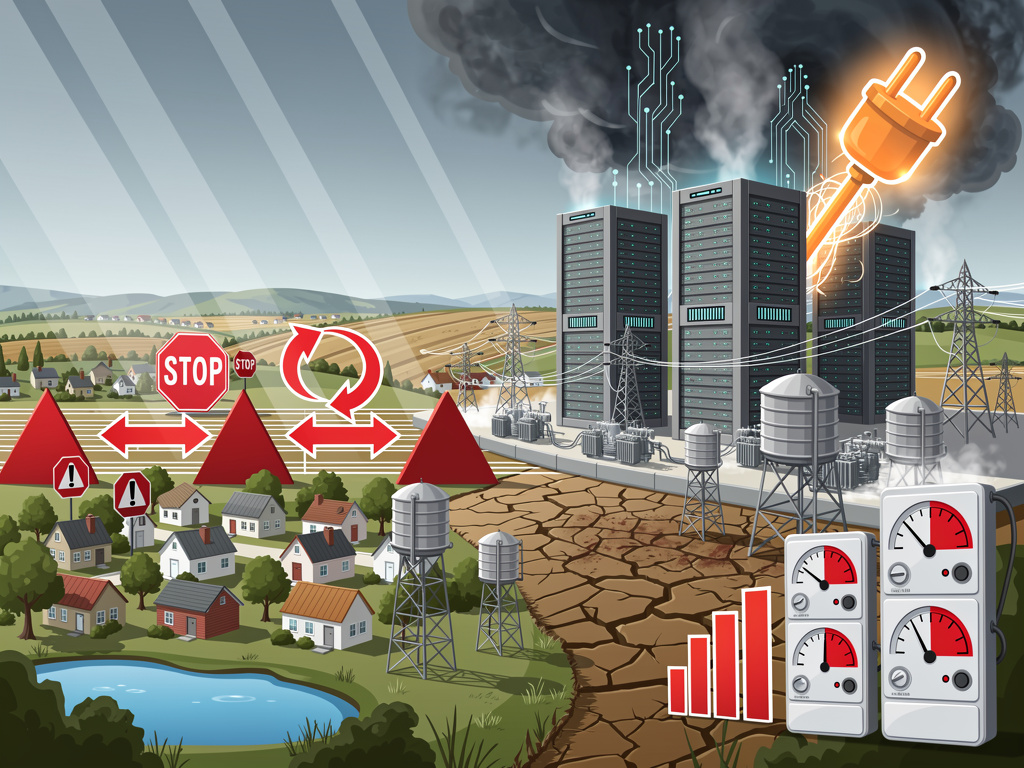
The lights flickered in Chesterfield County, Virginia, and residents started asking questions. Not about aging infrastructure or summer storms, but about something new — something massive being built on the edge of their neighborhoods. Data centers. Dozens of them. And the electricity they demanded was staggering.
Across the United States, a grassroots rebellion is gathering force against the explosive proliferation of data centers, those windowless warehouses of servers that power everything from streaming video to artificial intelligence. The opposition isn’t coming from environmental activists alone. It’s coming from homeowners, small-business owners, farmers, and local officials who say the facilities are devouring electricity, driving up utility bills, straining water supplies, and transforming rural communities — all while delivering remarkably few jobs.
As Futurism recently reported, protest movements have erupted in Virginia, Georgia, Indiana, Wisconsin, and several other states where Big Tech firms and colocation providers have targeted cheap land and available power. The pattern is consistent: a company quietly secures permits, local governments welcome the tax revenue, and residents discover too late that their power grid is being commandeered.
The numbers tell a stark story. Data centers in the U.S. consumed roughly 4.4% of total national electricity in 2023, according to the International Energy Agency. By 2026, that share could double. Lawrence Berkeley National Laboratory estimates that U.S. data center electricity consumption could reach 6.7% of total demand by the end of the decade — an increase driven almost entirely by AI workloads that require vastly more computational power than traditional cloud computing.
Virginia’s Loudoun County has become ground zero for this tension. It hosts the densest cluster of data centers on the planet — more than 300 facilities in what’s known as “Data Center Alley.” For years, county leaders celebrated the tax revenue, which helped keep residential property taxes among the lowest in the Washington, D.C., metropolitan area. But the expansion has metastasized into neighboring counties, and patience has worn thin.
In Prince William County, residents packed public hearings to oppose a proposed 2,100-acre digital gateway project. The development would have placed massive server farms adjacent to the Manassas National Battlefield, a Civil War site. The backlash was fierce. The county’s Board of Supervisors ultimately scaled back the project after thousands of residents signed petitions and showed up wearing matching T-shirts that read “Protect PWC.”
Georgia is another flashpoint. In Social Circle, a town of roughly 4,700 people about 45 miles east of Atlanta, residents organized against plans by a data center developer to build a facility that would consume as much electricity as the rest of the town combined. According to reporting by Futurism, locals worried that their already strained water supply — data centers use millions of gallons for cooling — couldn’t handle the additional demand. The town’s water system, they argued, was barely adequate for existing residents.
“We’re not anti-technology,” one Social Circle resident told local media. “We’re anti-being sacrificed for someone else’s profits.”
That sentiment echoes across state lines. In Indiana, residents of Westfield and other communities north of Indianapolis have pushed back against data center proposals from companies including Microsoft. The concerns are familiar: noise from industrial cooling systems running around the clock, diminished property values, and a disproportionate claim on local power generation. Microsoft has committed to spending billions on data center construction in Indiana, but community groups have demanded stricter zoning rules, noise ordinances, and environmental impact studies before any more shovels hit the ground.
Wisconsin has seen similar resistance. In Mount Pleasant — the same Racine County village where Foxconn once promised a transformative manufacturing hub that largely failed to materialize — skepticism about large-scale tech development runs deep. When data center proposals surfaced, residents who remembered the Foxconn debacle were in no mood to take promises of economic prosperity at face value.
The electricity question sits at the heart of nearly every dispute. Utilities across the country are scrambling to meet surging demand from data centers while simultaneously managing the retirement of aging coal plants and the slow buildout of renewable generation. Dominion Energy, which serves much of Virginia, has warned that demand in its service territory could grow by as much as 85% over the next 15 years, driven largely by data centers. The utility has proposed building new natural gas plants to keep up — a move that would directly undermine Virginia’s stated climate goals.
And ratepayers are watching their bills. In northern Virginia, residential customers have complained that the cost of grid upgrades necessary to serve data centers is being socialized across all ratepayers. The Virginia State Corporation Commission has scrutinized rate cases involving Dominion Energy, questioning whether residential customers are effectively subsidizing the tech industry’s power appetite. A similar dynamic has played out in Georgia, where Georgia Power has proposed significant rate increases partly to fund infrastructure needed for new data centers and industrial loads.
The water issue compounds the electricity problem. Data centers generate enormous amounts of heat, and most use evaporative cooling systems that consume vast quantities of water. Google disclosed that its U.S. data centers used approximately 5.6 billion gallons of water in 2023. Microsoft reported using about 6.4 billion gallons globally. In arid or drought-prone regions, this consumption directly competes with agricultural and residential needs. In The Dalles, Oregon — a small city along the Columbia River where Google operates a large data center campus — residents have long complained about the strain on local water resources, a tension first reported in detail by The Oregonian and since covered widely.
Jobs. That’s the other sore point. Data centers are extraordinarily capital-intensive but labor-light. A facility costing $1 billion to build might employ 50 full-time workers once operational. Compare that to a manufacturing plant of similar investment, which could employ hundreds or thousands. Communities that welcome data centers expecting an employment boom often find themselves with a hulking industrial neighbor that generates tax revenue but little else in terms of local economic activity. No bustling cafeteria. No shift changes flooding nearby restaurants. Just humming servers behind concrete walls.
Some local officials have begun to recalculate the bargain. In Loudoun County, Supervisor Michael Turner told Futurism that while data centers have been beneficial for the county’s bottom line, “there has to be a balance.” Other jurisdictions have gone further. Chesterfield County imposed a moratorium on new data center construction in 2023 to give planners time to assess cumulative impacts. Culpeper County, Virginia, did the same. So did several municipalities in Georgia and the Midwest.
The moratoriums have infuriated the data center industry, which argues that the facilities are essential infrastructure for the modern economy. The Data Center Coalition, a trade group, has lobbied state legislatures for streamlined permitting and tax incentives. Virginia, which already offers a sales tax exemption on data center equipment, has been among the most aggressive states in courting the industry. But even in Richmond, the political winds are shifting. A bill introduced in the 2024 Virginia General Assembly session sought to impose stricter environmental and community-impact requirements on data center developers, though it ultimately stalled in committee.
At the federal level, the Biden administration’s push to expand AI capabilities has added fuel to the fire. Executive orders promoting AI development implicitly require more data center capacity, and the Department of Energy has been studying ways to accelerate power delivery to tech facilities. But the administration has also faced pressure from environmental groups arguing that data center growth is incompatible with national emissions-reduction targets. The tension is unresolved.
Tech companies aren’t blind to the backlash. Microsoft, Google, and Amazon have all made high-profile commitments to power their data centers with renewable energy. Microsoft has signed the largest corporate clean-energy deal in history, committing to purchase renewable power equivalent to its consumption. Google has pledged to run on carbon-free energy 24 hours a day, seven days a week, by 2030. Amazon says it’s the world’s largest corporate buyer of renewable energy. But critics point out that these commitments often rely on renewable energy credits rather than direct physical connections to clean power, meaning the actual electrons flowing into data centers may still come from fossil fuel plants.
Nuclear energy has emerged as a potential solution. Microsoft signed a deal in 2023 to purchase power from a small modular reactor being developed by Constellation Energy. Amazon has invested in nuclear startups. Google has signed an agreement to buy power from Kairos Power, which is developing an advanced reactor design. But none of these reactors are operational yet, and the timeline for deployment stretches years into the future. In the meantime, natural gas remains the default backup.
The community opposition movement has found unlikely allies. Rural conservatives who distrust government overreach and progressive environmentalists who oppose fossil fuel expansion have discovered common ground in resisting data centers. In Virginia, Republican supervisors in rural counties have joined forces with Democratic activists to demand stricter oversight. In Georgia, farmers worried about water rights have teamed up with climate advocates. The coalitions are messy, sometimes contradictory. But effective.
Social media has amplified the resistance. Facebook groups and X (formerly Twitter) accounts dedicated to opposing specific data center projects have proliferated, sharing information about permit applications, zoning meetings, and environmental filings. The speed at which communities can organize has caught some developers off guard. Projects that might have sailed through approval five years ago now face months or years of public opposition.
Industry executives have started to acknowledge the problem, at least publicly. At a recent industry conference, a senior Microsoft executive said the company needs to be “a better neighbor” and committed to more transparent community engagement. Amazon Web Services has launched community benefit programs in several states, funding local schools and infrastructure projects. Whether these gestures are sufficient to quiet the opposition remains an open question.
The fundamental tension isn’t going away. AI workloads are growing exponentially. Every major tech company is racing to build more capacity. Goldman Sachs estimates that data center capital expenditures in the U.S. will reach $325 billion by 2030. That money has to go somewhere, and “somewhere” increasingly means communities that never asked for it.
Some analysts argue the backlash could eventually slow the AI boom itself — or at least redirect it. If permitting becomes too difficult in Virginia, developers will look to Texas, where land is cheap and regulation is light. If water constraints block expansion in the arid West, builders will target the Great Lakes region. The data centers will get built. The question is where, and at whose expense.
But there’s a deeper issue that the protests have surfaced, one that goes beyond any single project or community. It’s about who decides how shared resources — electricity, water, land — get allocated in a democracy. The tech industry’s argument is essentially utilitarian: data centers benefit everyone because they power the digital services everyone uses. The communities’ argument is more particular: we live here, we didn’t consent to this, and the costs fall on us while the profits flow elsewhere.
Neither side is entirely wrong. And that’s what makes this fight so hard to resolve.
For now, the protests continue. In Chesterfield County, a coalition called Citizens Against Data Center Expansion holds monthly meetings. In Social Circle, Georgia, residents monitor every zoning application. In Westfield, Indiana, yard signs opposing data centers dot the streets alongside campaign placards. The movement is decentralized, local, and stubborn — much like the communities it represents.
The tech industry built the modern internet by moving fast and asking permission later. That playbook is running into a wall. The wall is made of people.


 WebProNews is an iEntry Publication