
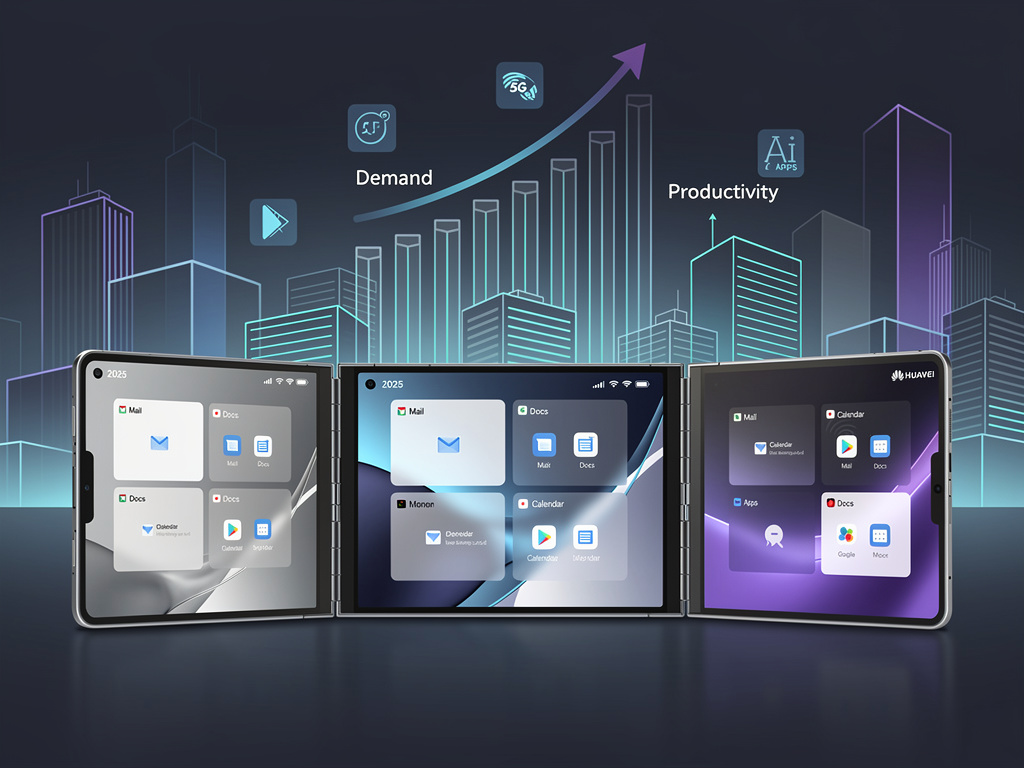
For years, the foldable smartphone market has been dominated by devices that fold inward along a vertical crease, opening up to reveal a modestly sized inner display roughly the dimensions of a small tablet. But a new wave of devices is challenging that convention. Wider foldable phones — those that unfold to deliver significantly more horizontal screen real estate — are staging a comeback, and industry insiders say this shift could reshape consumer expectations and competitive dynamics across the mobile hardware sector.
The trend is not entirely new. Huawei’s original Mate X, launched in 2019, folded outward and offered a generously wide display. But reliability concerns, software immaturity, and steep pricing pushed the industry toward more conservative designs. Samsung’s Galaxy Z Fold series became the template: a phone-sized outer screen and a roughly square inner display. Now, however, multiple manufacturers are revisiting the wider form factor with improved engineering, better materials, and a more mature software ecosystem to support it.
A Shift in Philosophy: From Square to Cinematic
As Android Police recently reported, wider foldable devices are making a notable comeback, driven by consumer demand for displays that better accommodate media consumption, productivity, and multitasking. The publication highlighted that while the roughly square aspect ratio of Samsung’s Galaxy Z Fold line has been the industry standard, it has always come with compromises — the outer screen is narrow and somewhat awkward for typing, while the inner display, though large, doesn’t always feel optimized for video or side-by-side app usage.
The wider fold addresses these shortcomings directly. By increasing the horizontal dimension of the unfolded display, manufacturers can deliver an experience that feels closer to a small laptop or a widescreen tablet. This is particularly appealing for users who rely on their foldable as a primary productivity device, running two full-sized apps simultaneously without the cramped feeling that plagues narrower designs. The wider outer screen also becomes more usable as a standalone phone display, reducing the need to constantly unfold the device for basic tasks.
OnePlus, Honor, and the Chinese Manufacturing Push
Chinese manufacturers have been at the forefront of this wider-fold movement. OnePlus made waves with its Open, which debuted in 2023 with a wider aspect ratio that earned widespread praise from reviewers and consumers alike. The device’s inner display offered a more natural viewing experience, and its outer screen was wide enough to function as a genuinely comfortable smartphone in its own right. The OnePlus Open demonstrated that wider foldables weren’t just a theoretical improvement — they were a practical one that users immediately appreciated.
Honor has followed a similar path. Its Magic V series has progressively embraced wider proportions, and the company’s latest entries in the foldable space have pushed the boundaries further. Huawei, despite its well-documented challenges with U.S. sanctions and limited access to Google services, has continued to iterate on wider foldable designs with its Mate X series, maintaining its position as a pioneer in the form factor. These Chinese OEMs have benefited from close relationships with domestic display suppliers like BOE and CSOT, who have invested heavily in flexible OLED panel production lines capable of producing wider, thinner, and more durable folding screens.
Samsung Feels the Pressure to Evolve
Samsung, long the dominant player in the global foldable market, now finds itself under increasing pressure to respond. The Galaxy Z Fold series, while commercially successful, has faced growing criticism for its relatively narrow outer display and its nearly square inner screen. Each successive generation has brought incremental improvements — thinner bezels, lighter weight, improved hinge durability — but the fundamental aspect ratio has remained largely unchanged since the original Galaxy Fold launched in 2019.
Industry analysts and leakers have suggested that Samsung is preparing a significant design overhaul for its next-generation foldable flagship. Reports circulating on X and across technology publications indicate that Samsung may finally widen the aspect ratio of both the inner and outer displays on an upcoming Galaxy Z Fold model, bringing it more in line with what competitors like OnePlus and Honor have already delivered. Such a move would represent a tacit acknowledgment that the market has shifted and that Samsung’s once-pioneering design language needs refreshing to remain competitive.
The Display Technology Making It All Possible
The resurgence of wider foldables is not merely a design preference — it is enabled by meaningful advances in display and hinge technology. Ultra-thin glass (UTG) has improved significantly since its early implementations, offering better durability and a more satisfying tactile experience compared to the plastic screen protectors that plagued first-generation foldables. Samsung Display and its competitors have developed UTG solutions that can withstand hundreds of thousands of folds without significant degradation, a critical milestone for consumer confidence.
Hinge engineering has also matured. Wider devices place greater mechanical stress on the folding mechanism, and early attempts at wide-format foldables sometimes suffered from uneven folding, visible creases, and premature wear. Today’s waterdrop and teardrop hinge designs distribute stress more evenly across the fold, resulting in a shallower crease and a more uniform display surface when unfolded. Companies like OnePlus and Honor have invested heavily in proprietary hinge systems that minimize the visible crease — a persistent consumer complaint — while maintaining structural rigidity over the device’s lifespan.
Software Maturity Is the Unsung Enabler
Hardware alone doesn’t explain the wider fold’s renaissance. Android’s support for large-screen and foldable devices has improved dramatically, particularly with Android 12L and subsequent releases that introduced purpose-built features for folding form factors. Google’s ongoing collaboration with Samsung and other OEMs through the Large Screen App Compatibility program has pushed developers to optimize their apps for a range of aspect ratios and screen sizes, reducing the software fragmentation that once made wider foldables feel like a compromise.
As Android Police noted, the wider aspect ratio also benefits from Google’s continued investment in tablet-style interfaces within Android, including a taskbar, improved split-screen multitasking, and drag-and-drop functionality between apps. These features are inherently more useful on a wider display, where two apps can run side by side at comfortable sizes. The result is a virtuous cycle: better software support makes wider hardware more appealing, which in turn incentivizes further software optimization.
Consumer Demand and the Premium Market Opportunity
From a market perspective, the push toward wider foldables reflects a broader trend in the premium smartphone segment. Consumers willing to spend $1,500 or more on a foldable device increasingly expect it to replace not just their phone, but also their tablet — and possibly even their laptop for light productivity tasks. A wider foldable that can comfortably display a spreadsheet, run a video conference alongside a notes app, or serve as a portable media center is a far more compelling value proposition than a device that merely folds in half for pocket convenience.
Market research firms have noted that foldable smartphone shipments, while still a small fraction of overall smartphone sales, are growing at double-digit rates year over year. The wider form factor could accelerate this growth by addressing one of the most common objections from potential buyers: that current foldables don’t offer enough of a usability advantage over traditional slab phones to justify their premium pricing. A device that genuinely transforms the user experience when unfolded — rather than simply offering a slightly larger screen — has a much stronger case to make.
What Comes Next for the Foldable Arms Race
Looking ahead, the competitive dynamics of the foldable market are poised to intensify. Google’s own Pixel Fold successor is rumored to adopt a wider aspect ratio, signaling that even the steward of the Android platform sees the wider form factor as the future. Apple, which has yet to enter the foldable market, is widely reported to be developing a device with a larger, wider display — a move that could validate the wider-fold approach and trigger a new wave of consumer adoption.
The implications extend beyond smartphones. Wider foldable technology could eventually migrate to laptops, where dual-screen and foldable-screen designs are already being explored by Lenovo, Asus, and others. The engineering lessons learned from making wider phone-sized foldables more durable, thinner, and crease-free will directly inform these larger-format devices.
For now, the message from the market is clear: wider is better, and the companies that recognized this early — OnePlus, Honor, Huawei — have established a meaningful lead in consumer perception and engineering expertise. Samsung, Google, and eventually Apple will need to respond decisively or risk ceding the most exciting segment of the smartphone market to hungrier competitors. The era of the narrow fold, it seems, is drawing to a close.


 WebProNews is an iEntry Publication