
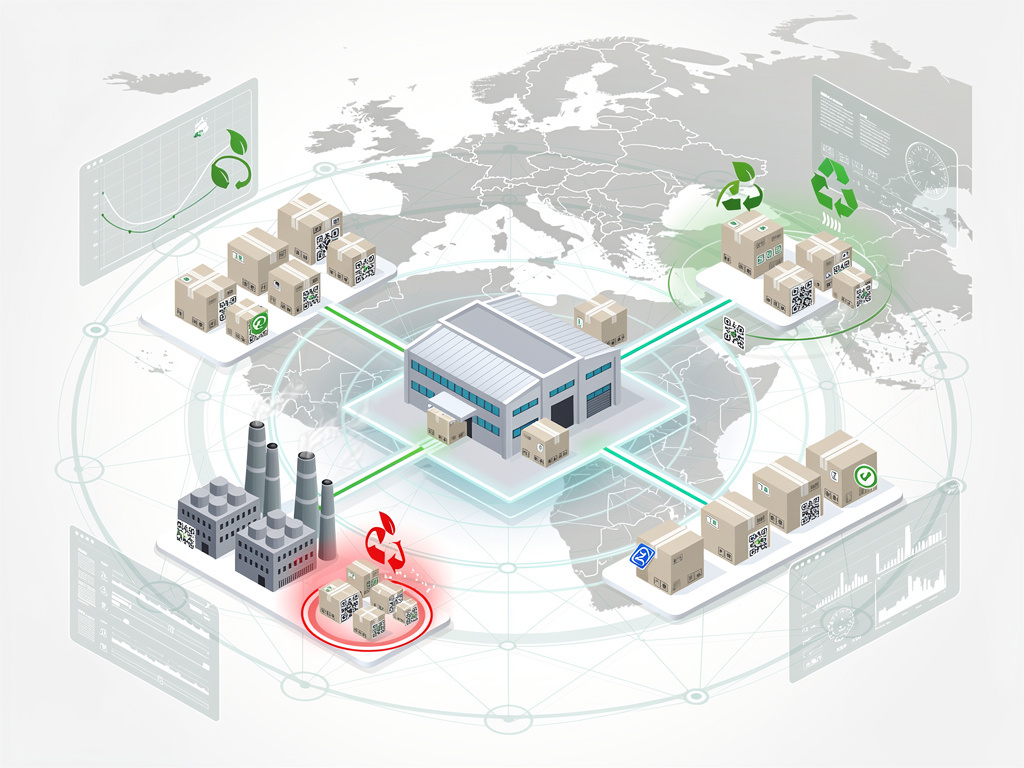
For years, retail executives talked about visibility. They wanted to see where their inventory was, how fast it moved, and when it would arrive. Dashboards proliferated. Real-time tracking became table stakes. But something has shifted — quietly, decisively — in how the most sophisticated retailers think about their supply chains. Visibility, it turns out, was never the destination. It was the on-ramp.
The new imperative is traceability. Not just knowing where a product is right now, but understanding where it’s been, what happened to it along the way, and being able to prove all of it on demand. The distinction sounds subtle. It isn’t.
As ERP Software Blog recently outlined, the shift from visibility to traceability represents the next evolutionary stage in modern retail operations — one driven by regulatory pressure, consumer expectations, and the hard-learned lessons of pandemic-era disruptions. Visibility tells you a shipment is delayed. Traceability tells you which supplier’s sub-component caused the delay, whether that component met safety specifications, and whether the finished product can still be sold in the European Union under its latest regulatory framework. The gap between those two capabilities is enormous, and it’s where billions of dollars in operational risk currently sit.
Retailers have spent the better part of a decade investing in systems that provide real-time snapshots of their supply chains. RFID tags, IoT sensors, cloud-based inventory management platforms — the technology stack is mature. What’s missing is the connective tissue that links those snapshots into an auditable, end-to-end record. A product’s full lifecycle story, from raw material to consumer’s hands.
This isn’t an abstract concern. The EU’s Digital Product Passport initiative, expected to begin phased enforcement by 2027, will require brands selling into European markets to provide detailed records of a product’s origin, materials, environmental impact, and recyclability. The U.S. is moving in a similar direction, albeit more slowly, with the FDA’s food traceability rules under FSMA 204 already imposing granular record-keeping requirements on food retailers. Fashion, electronics, pharmaceuticals — sector after sector is facing some version of the same mandate: prove your product’s history, or lose market access.
So the question facing retail CIOs and supply chain leaders isn’t whether to invest in traceability. It’s how fast they can get there, and what it will cost to retrofit systems that were built for a simpler era.
The technical challenges are significant. Most large retailers operate with a patchwork of enterprise resource planning systems, warehouse management platforms, and supplier portals that were never designed to talk to each other at the level of granularity traceability demands. A visibility system might track a pallet. A traceability system needs to track the individual item on that pallet, the batch of material it came from, the factory where it was assembled, the certifications that factory holds, and the transportation conditions it experienced in transit. That’s an order-of-magnitude increase in data capture, storage, and integration complexity.
Blockchain was supposed to be the answer. And in some narrow applications — diamond provenance, luxury goods authentication — it has delivered. But for mainstream retail, distributed ledger technology has proven too slow, too expensive, and too cumbersome for the volume and velocity of transactions involved. What’s emerging instead is a more pragmatic architecture: centralized data platforms with standardized APIs that allow different participants in a supply chain to contribute and access traceability records without rebuilding their own systems from scratch.
According to ERP Software Blog, modern ERP systems are increasingly being configured to serve as the backbone for traceability programs, ingesting data from suppliers, logistics providers, and quality assurance systems and structuring it into queryable, auditable formats. The key shift is from batch-level tracking to item-level tracking — a transition that requires not just new software capabilities but new data standards and new contractual relationships with suppliers who may resist the transparency that traceability demands.
Supplier resistance is, in fact, one of the biggest practical obstacles. Traceability doesn’t just flow downstream. It reaches backward into supply chains, demanding that tier-two and tier-three suppliers share information they’ve historically considered proprietary. A fabric mill in Vietnam. A chemical supplier in Germany. A logistics subcontractor in Memphis. Each one becomes a node in a traceability network, and each one has to be persuaded — or contractually required — to participate.
Large retailers have the purchasing power to compel compliance. Walmart, Target, and Costco have all implemented supplier data-sharing mandates of varying stringency over the past three years. But mid-market retailers face a harder path. They lack the leverage to force suppliers into new reporting frameworks, and they lack the IT budgets to build custom integration layers for every supplier relationship. For these companies, industry consortia and shared data standards — like those being developed by GS1, the global standards organization — may be the most viable route to traceability at scale.
The consumer angle is intensifying the pressure. Younger shoppers, particularly Gen Z and younger millennials, have shown a measurable willingness to pay more for products whose provenance they can verify. A 2025 survey by First Insight found that 73% of Gen Z consumers said they would pay a premium for sustainable products, but only if the sustainability claims were backed by verifiable data. Greenwashing scandals — from fast fashion brands claiming carbon neutrality to food companies mislabeling organic sourcing — have made consumers deeply skeptical of unsubstantiated claims. Traceability provides the receipts.
Not just metaphorical receipts. Literal ones. QR codes on product packaging that link to a product’s full traceability record are moving from novelty to expectation. Patagonia has done this for years with its Footprint Chronicles. Now companies like H&M, Zara’s parent Inditex, and Nike are building similar capabilities into their product lines — not as marketing stunts, but as core infrastructure investments tied to regulatory compliance and brand trust.
The financial implications are substantial. Implementing item-level traceability across a global supply chain is expensive. Estimates vary widely depending on the complexity of the product category and the maturity of existing systems, but industry analysts have pegged the cost for large retailers at anywhere from $50 million to $200 million over a three-to-five-year implementation cycle. That includes technology investment, supplier onboarding, process redesign, and the ongoing operational cost of maintaining traceability data at scale.
But the cost of not doing it is climbing faster. Product recalls without traceability are blunt instruments — entire product lines pulled from shelves because a retailer can’t isolate which specific batches are affected. The average cost of a food recall in the U.S. is $10 million, according to the Grocery Manufacturers Association. With granular traceability, that same recall might affect only a fraction of the inventory, reducing both direct costs and the reputational damage that comes with broad, visible recalls.
There’s a competitive dimension too. Retailers that achieve traceability first gain asymmetric advantages in speed of response, regulatory compliance, and consumer trust. Those that lag will find themselves locked out of markets — literally, in the case of the EU’s Digital Product Passport — or stuck paying premium prices to expedite compliance when deadlines arrive.
The technology vendors sense the opportunity. SAP, Oracle, and Microsoft Dynamics are all expanding their ERP platforms’ traceability capabilities. Specialized players like FoodLogiQ, Transparency-One, and Everledger are carving out niches in specific verticals. And a new generation of startups is building AI-powered traceability tools that can ingest unstructured data — shipping documents, certificates of origin, lab reports — and automatically construct traceability records without requiring manual data entry at every node.
AI’s role here deserves attention. The volume of data required for comprehensive traceability is staggering, and the traditional approach of asking every supply chain participant to manually enter data into a shared platform doesn’t scale. Machine learning models that can extract relevant information from existing documents, cross-reference it against known standards, and flag anomalies are making traceability more feasible for organizations that lack the resources to build bespoke systems. As ERP Software Blog noted, the integration of AI into ERP-driven traceability workflows is accelerating the timeline for adoption, particularly among mid-market retailers that previously considered full traceability out of reach.
And yet, technology alone won’t get retailers there. The organizational changes required are just as significant. Traceability touches procurement, logistics, quality assurance, legal, marketing, and IT. It demands cross-functional governance structures that most retailers don’t have. It requires new KPIs and new accountability frameworks. A supply chain team measured only on cost and speed has no incentive to invest in traceability. One measured on compliance, recall response time, and data completeness does.
Some of the most interesting work is happening at the intersection of traceability and sustainability reporting. The EU’s Corporate Sustainability Reporting Directive, which took effect in phases starting in 2024, requires large companies to disclose detailed information about their environmental and social impacts — including supply chain impacts. Traceability data is the foundation for those disclosures. Companies that build traceability for compliance purposes are discovering they can repurpose the same data for sustainability reporting, ESG investor communications, and consumer-facing transparency initiatives. One investment, multiple returns.
The grocery sector is furthest along, driven by food safety imperatives that long predate the current traceability trend. Walmart’s mandate requiring leafy green suppliers to participate in a blockchain-based traceability system — launched in 2018 — was an early signal. Since then, Kroger, Albertsons, and Ahold Delhaize have all invested heavily in traceability infrastructure, with a particular focus on fresh and perishable categories where the stakes are highest.
Fashion is catching up fast, propelled by the EU’s textile strategy and growing consumer activism around labor practices and environmental impact. The challenge in fashion is the extraordinary complexity of textile supply chains, which can involve dozens of participants across multiple countries for a single garment. Tracing a cotton t-shirt from field to store shelf requires following the cotton through ginning, spinning, weaving, dyeing, cutting, sewing, finishing, and distribution — each step potentially involving a different company in a different country with different data systems and different levels of willingness to share information.
Electronics faces its own version of this challenge, particularly around conflict minerals and rare earth elements. The Dodd-Frank Act’s conflict minerals provisions have been in place since 2012, but compliance has been uneven and largely based on self-reporting. Traceability technology offers a path to more rigorous verification, though the geopolitical complexities of mineral supply chains — many of which run through regions with limited digital infrastructure — make implementation particularly difficult.
What’s becoming clear is that traceability isn’t a single project with a defined endpoint. It’s a capability that retailers will need to build, maintain, and continuously expand as regulatory requirements evolve and consumer expectations escalate. The companies treating it as a one-time compliance exercise will find themselves perpetually behind. The ones building it as a core operational capability — embedded in their ERP systems, their supplier contracts, their data architecture, and their organizational culture — will be the ones that thrive.
The transition from visibility to traceability is, in many ways, a maturation of the retail industry’s relationship with data. Visibility was about collecting data. Traceability is about connecting it, contextualizing it, and making it actionable across the full lifecycle of a product. It’s harder. It’s more expensive. And it’s no longer optional.
Retailers that recognized this two years ago are already seeing returns — in faster recall response, in smoother regulatory audits, in stronger supplier relationships, and in consumer trust metrics that translate directly to revenue. Those still debating the ROI of traceability investments are running out of time. The regulatory deadlines are fixed. The consumer expectations are rising. And the competitive gap between traced and untraced supply chains is widening every quarter.
The era of just watching your supply chain is over. Now you have to prove what happened in it.


 WebProNews is an iEntry Publication