
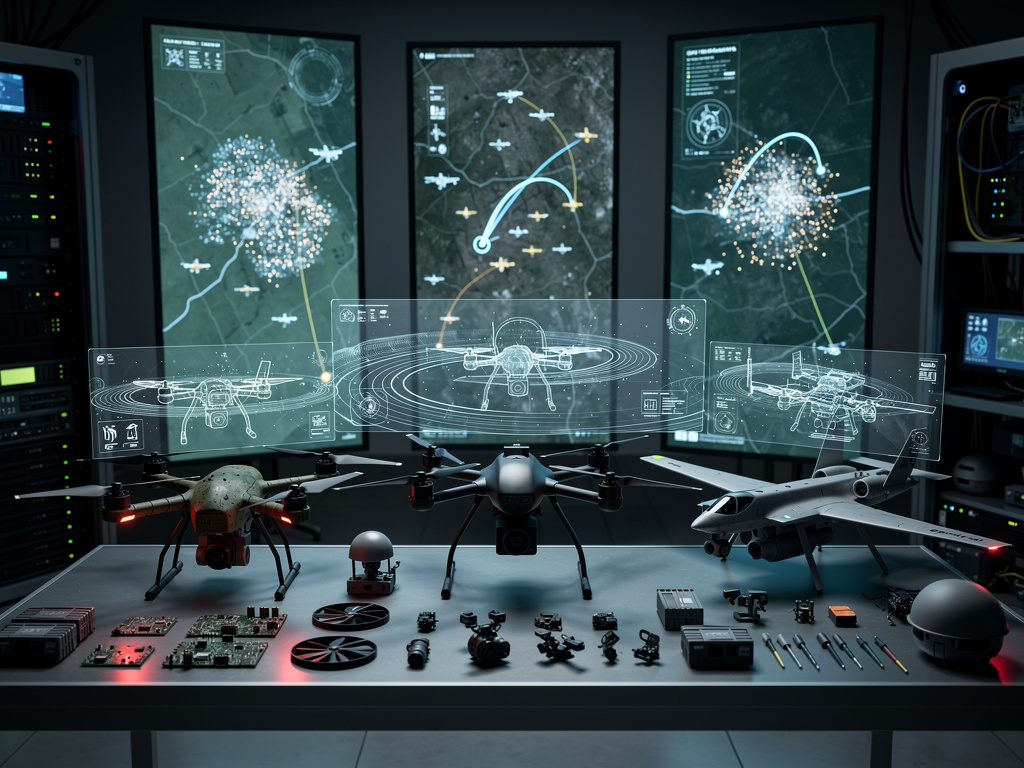
In the skies above Ukraine, a technological arms race unfolds at a pace unprecedented in modern warfare. Ukrainian interceptor drones—nimble aerial hunters designed to destroy incoming Russian attack drones—undergo constant modifications and upgrades, sometimes changing specifications within days to counter evolving enemy tactics. This rapid iteration cycle represents a fundamental shift in military technology development, where battlefield feedback loops measured in hours rather than years determine survival.
According to Business Insider, Ukrainian drone manufacturers and military units have established an unprecedented feedback mechanism that allows them to identify Russian countermeasures, develop solutions, and deploy updated systems to frontline units within days. This agility stands in stark contrast to traditional defense procurement cycles that typically span years or even decades. The consequence is a dynamic battlefield environment where yesterday’s cutting-edge technology becomes obsolete overnight, forcing both sides into a perpetual state of innovation.
The interceptor drones themselves represent a unique category of unmanned aerial vehicles, purpose-built to engage and destroy other drones mid-flight. Unlike traditional anti-aircraft systems that rely on missiles or gunfire, these aerial hunters use a combination of advanced sensors, artificial intelligence-assisted targeting, and increasingly sophisticated electronic warfare capabilities to locate and neutralize threats. Their importance has grown exponentially as Russian forces have escalated their use of Iranian-supplied Shahed drones and domestically produced variants to strike Ukrainian infrastructure, military positions, and civilian targets.
The Rapid Iteration Battlefield Laboratory
The speed of technological adaptation in Ukraine has transformed the conflict into what defense analysts describe as the world’s most advanced real-time testing ground for drone warfare. Ukrainian engineers and operators work in tight coordination, with frontline pilots providing immediate feedback on enemy tactics that reaches design teams within hours. This compressed development cycle allows manufacturers to push firmware updates, modify hardware configurations, and even redesign entire drone systems in response to specific Russian countermeasures.
One Ukrainian drone manufacturer interviewed by Business Insider described receiving reports of Russian jamming techniques in the morning and deploying countermeasures to operational units by evening. This responsiveness requires a complete reimagining of traditional military-industrial relationships, with engineers often working directly at forward operating bases and manufacturing facilities operating near combat zones. The result is a hybrid model that combines Silicon Valley-style agile development with military urgency, creating innovation cycles that would be impossible in conventional defense contracting environments.
Russian Countermeasures and the Escalation Spiral
Russian forces have not remained passive observers in this technological competition. Intelligence reports indicate that Russian electronic warfare units systematically analyze captured Ukrainian drones, reverse-engineer their systems, and develop targeted countermeasures. These efforts include sophisticated jamming systems, GPS spoofing technologies, and even decoy drones designed to waste Ukrainian interceptor resources on false targets. Each Russian innovation forces Ukrainian developers to respond, creating an escalation spiral that drives both sides toward increasingly advanced capabilities.
The electronic warfare dimension has become particularly critical, with both sides investing heavily in systems that can jam, spoof, or otherwise interfere with enemy drone operations. Ukrainian interceptor drones now incorporate frequency-hopping communication systems, AI-assisted navigation that functions without GPS, and advanced signal processing that can distinguish between genuine targets and electronic decoys. These capabilities, once the exclusive domain of high-end military aircraft, have been miniaturized and adapted for drones costing a fraction of traditional weapons systems.
The Economics of Asymmetric Aerial Combat
The financial calculus of drone warfare has fundamentally altered military strategic thinking. Ukrainian interceptor drones, typically costing between several thousand to tens of thousands of dollars, regularly destroy Russian Shahed drones valued at approximately $50,000 each, along with their payloads and the infrastructure damage they would have caused. This favorable cost-exchange ratio has made interceptor drones an economically attractive alternative to traditional air defense systems, which fire missiles costing hundreds of thousands or even millions of dollars per shot.
However, the economic equation extends beyond simple unit costs. The rapid obsolescence of drone systems means that Ukrainian forces must continuously invest in new variants and upgrades, creating ongoing development and production costs that can exceed the initial procurement expenses. Russian forces have attempted to exploit this dynamic by introducing frequent tactical variations designed to force Ukrainian developers into costly response cycles. The result is a war of attrition fought not just with hardware but with engineering resources and industrial capacity.
International Implications and Technology Transfer
The lessons learned from Ukraine’s interceptor drone program have not gone unnoticed by military establishments worldwide. NATO countries have dispatched technical teams to study Ukrainian systems and tactics, seeking to incorporate these innovations into their own defense strategies. The conflict has demonstrated that small, agile development teams working in close coordination with operators can outpace traditional defense contractors in specific technological domains, challenging long-held assumptions about military procurement and innovation.
This knowledge transfer extends beyond Western allies. Defense analysts express concern that the rapid dissemination of drone warfare techniques—both offensive and defensive—will proliferate to state and non-state actors globally. The relatively low cost and technical barriers to entry for basic drone systems mean that the innovations pioneered in Ukraine could appear in conflicts worldwide within months rather than years. This democratization of advanced military technology presents new challenges for international security frameworks designed for an era of expensive, state-controlled weapons systems.
The Human Element in Automated Warfare
Despite the increasing sophistication of artificial intelligence and automation in interceptor drones, human operators remain central to their effectiveness. Ukrainian pilots describe a demanding role that combines video game-like interface skills with split-second tactical decision-making under extreme stress. The psychological toll of this work—conducting multiple intercept missions daily, often while under fire themselves—has led Ukrainian military psychologists to develop new support protocols specifically for drone operators.
Training programs have evolved to match the rapid technological changes, with new pilots receiving continuous education on the latest systems and tactics rather than a single comprehensive course. This perpetual learning requirement represents another departure from traditional military training models, where soldiers might use the same weapon system throughout their entire service. Ukrainian drone operators must instead adapt to new interfaces, capabilities, and tactical doctrines on a near-constant basis, requiring cognitive flexibility that military psychologists are still working to understand and optimize.
Looking Forward: The Next Generation of Aerial Combat
As the conflict continues, both Ukrainian and Russian forces are developing increasingly autonomous systems that reduce reliance on vulnerable communication links and human decision-making. Ukrainian developers are working on interceptor drones capable of collaborative swarm behavior, where multiple units coordinate attacks without centralized control. These systems use mesh networking and distributed artificial intelligence to share sensor data and tactical information, creating a collective intelligence that exceeds the sum of individual units.
The trajectory of this technological evolution points toward a future where aerial combat occurs at speeds and scales beyond human comprehension, with AI systems making engagement decisions in milliseconds. Ukrainian engineers acknowledge both the military necessity and ethical complexity of this direction, noting that maintaining meaningful human control becomes increasingly challenging as autonomous capabilities advance. This tension between operational effectiveness and ethical constraints will likely define the next phase of drone warfare development, with implications extending far beyond the current conflict.
The Ukrainian interceptor drone program represents more than a tactical innovation in a single conflict—it demonstrates a new model for military technology development that prioritizes adaptability over perfection, speed over process, and continuous iteration over fixed designs. As defense establishments worldwide study these lessons, the fundamental assumptions underlying military procurement, development, and deployment face their most significant challenge in generations. The question is no longer whether other militaries will adopt similar approaches, but how quickly they can transform institutional cultures built over decades to match the agility demonstrated by Ukrainian forces operating under existential threat.


 WebProNews is an iEntry Publication