
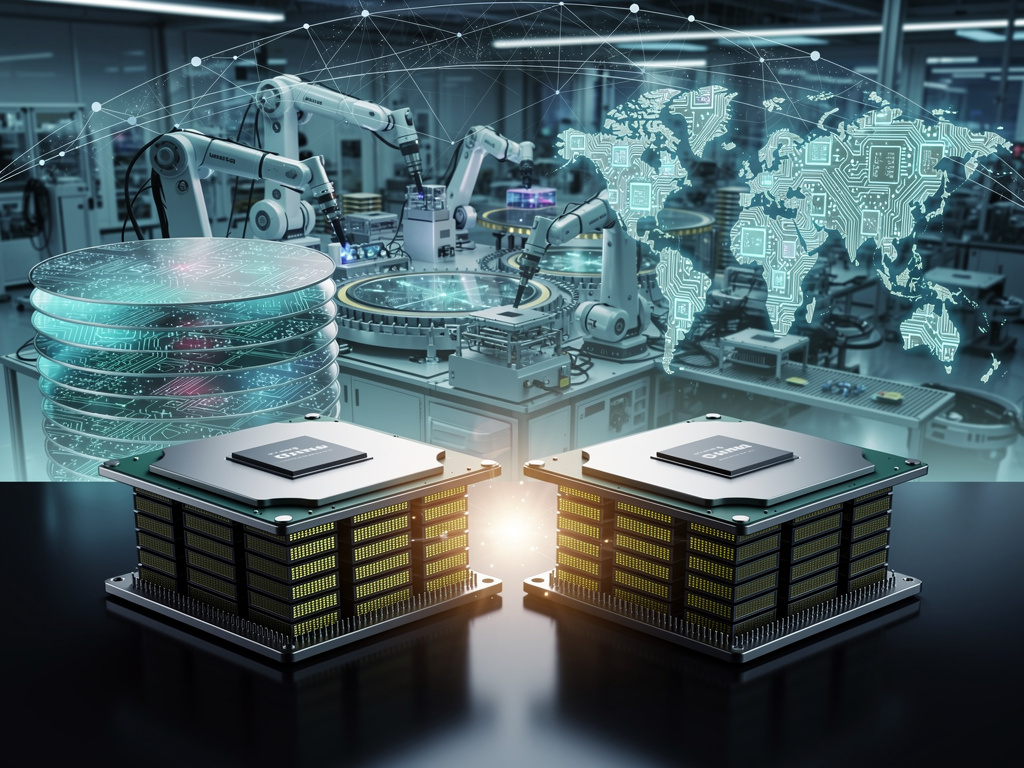
The artificial intelligence industry faces a new constraint that threatens to slow the breakneck pace of innovation: a critical shortage of specialized memory chips. As AI models grow exponentially in size and complexity, the semiconductor industry is scrambling to develop and manufacture the high-bandwidth memory required to keep pace with computational demands. At the forefront of this challenge stands an unlikely partnership between two technology giants seeking to reshape the memory supply chain.
According to CNBC, SoftBank’s subsidiary SaiMemory has joined forces with Intel to address the looming memory shortage through Intel’s Z-Angle program. This collaboration represents a strategic pivot for both companies as they attempt to position themselves at the center of AI infrastructure development. The partnership aims to accelerate the production of high-bandwidth memory (HBM) chips, which have become essential components in AI accelerators and graphics processing units that power large language models and machine learning applications.
The timing of this alliance reflects growing anxiety within the technology sector about memory supply constraints. While much attention has focused on the shortage of advanced logic chips and AI accelerators, industry insiders recognize that memory capacity increasingly determines the performance ceiling for AI systems. Without sufficient high-bandwidth memory, even the most powerful processors cannot operate at full capacity, creating a bottleneck that could stall progress across the AI ecosystem.
The Technical Challenge Behind AI Memory Demands
High-bandwidth memory differs fundamentally from conventional DRAM chips found in personal computers and smartphones. HBM stacks multiple memory dies vertically and connects them through thousands of microscopic connections, enabling data transfer rates that far exceed traditional memory architectures. This vertical integration allows AI processors to access vast amounts of data with minimal latency, a critical requirement for training and deploying large neural networks.
The manufacturing complexity of HBM has created a supply crunch that industry analysts warn could intensify throughout 2026 and beyond. Only a handful of companies worldwide possess the technical expertise and production capacity to manufacture these advanced chips at scale. South Korean giants Samsung and SK Hynix currently dominate the market, controlling an estimated 95% of global HBM production. This concentration of supply has left AI companies vulnerable to price fluctuations and allocation constraints as demand surges.
SoftBank’s Strategic Repositioning in Semiconductor Markets
SoftBank’s involvement through SaiMemory marks a significant expansion of the Japanese conglomerate’s semiconductor ambitions beyond its well-known investment in Arm Holdings. The company has been methodically building expertise in memory technology, viewing it as complementary to its broader AI infrastructure strategy. By partnering with Intel rather than attempting to build manufacturing capabilities independently, SoftBank demonstrates a pragmatic approach to entering a capital-intensive market dominated by established players.
The collaboration leverages Intel’s existing semiconductor fabrication facilities and technical knowledge while providing SoftBank with direct exposure to a critical component of the AI supply chain. Intel’s Z-Angle program, which focuses on advanced packaging technologies necessary for HBM production, offers a potential pathway to diversify the memory supply base beyond its current Asian concentration. For Intel, the partnership provides validation of its foundry strategy and access to SoftBank’s extensive network of AI companies that could become future customers.
Market Dynamics Driving Memory Innovation
The financial stakes in the memory market have escalated dramatically as AI applications proliferate. Industry estimates suggest that HBM prices have increased by more than 200% since early 2023, with lead times extending to six months or longer for large orders. This pricing power has translated into windfall profits for existing manufacturers, but it has also created urgency among technology companies to secure alternative supply sources and avoid dependency on a small number of vendors.
Major cloud computing providers including Amazon Web Services, Microsoft Azure, and Google Cloud have all reportedly entered into multi-year supply agreements with memory manufacturers to guarantee access to HBM for their AI infrastructure buildouts. These commitments, often worth billions of dollars, have effectively pre-allocated much of the available production capacity through 2027, leaving smaller AI companies and enterprises struggling to secure adequate supplies for their own projects.
Geopolitical Implications of Memory Supply Chains
The geographic concentration of HBM production in South Korea has raised concerns among policymakers in the United States and Europe about technological sovereignty and supply chain resilience. Recent trade tensions and export controls related to advanced semiconductor technology have highlighted the strategic importance of domestic production capabilities for critical components. The SoftBank-Intel partnership could serve broader policy objectives by establishing memory manufacturing capacity outside of Asia, though significant technical and financial hurdles remain.
Intel’s foundry ambitions have received substantial support from the U.S. CHIPS Act, which provides tens of billions of dollars in subsidies for domestic semiconductor manufacturing. While these funds primarily target logic chip production, advanced packaging capabilities necessary for HBM could benefit from the same infrastructure investments. The company has committed to spending more than $100 billion on new fabrication facilities in the United States, creating potential sites for future memory production if the SoftBank collaboration proves successful.
Technical Roadmap and Timeline Challenges
Despite the strategic logic behind the partnership, significant technical challenges must be overcome before SoftBank and Intel can meaningfully impact global memory supply. HBM manufacturing requires extraordinarily precise control over dozens of complex process steps, including through-silicon via creation, wafer thinning, and micro-bump formation. Intel has demonstrated competence in advanced packaging through its Foveros technology, but scaling these capabilities to mass production of HBM represents a substantial leap in complexity and volume.
Industry observers estimate that even under optimistic scenarios, new entrants to the HBM market would require three to five years to achieve production volumes comparable to existing manufacturers. This timeline suggests that the current supply shortage will persist well into the decade, potentially constraining AI development and deployment across numerous sectors. The window of opportunity for Intel and SoftBank depends partly on whether memory demand continues growing at current rates or whether architectural innovations reduce the memory intensity of AI workloads.
Alternative Approaches to the Memory Challenge
While expanding HBM production capacity represents one approach to addressing the memory shortage, researchers and companies are simultaneously exploring alternative memory technologies and system architectures that could reduce dependence on conventional HBM. Processing-in-memory designs, which integrate computational capabilities directly into memory chips, promise to reduce data movement and potentially lower overall memory requirements. Several startups have attracted venture funding to commercialize these concepts, though mainstream adoption remains years away.
Software optimization and algorithmic improvements offer another potential avenue for mitigating memory constraints. Techniques such as model compression, quantization, and sparse neural networks can significantly reduce the memory footprint of AI models without substantial performance degradation. Major AI labs have invested heavily in these efficiency improvements, partly in response to memory availability concerns. However, these approaches provide only partial relief, as the fundamental trend toward larger and more capable models continues to drive absolute memory demand upward.
Investment Implications and Industry Restructuring
The memory shortage has catalyzed a wave of investment and strategic partnerships across the semiconductor industry. Beyond the SoftBank-Intel collaboration, other technology companies have announced initiatives to secure memory supply or develop alternative solutions. The total capital committed to memory-related projects announced in the past 18 months exceeds $50 billion, reflecting the high stakes involved in controlling this critical technology.
For investors and industry participants, the memory market presents both opportunities and risks. Established manufacturers like SK Hynix and Samsung enjoy tremendous pricing power and profitability in the near term, but face the prospect of intensifying competition as new entrants emerge. Companies successfully navigating the technical challenges of HBM production could capture substantial market share and revenue, while those falling behind risk marginalization in an industry where scale and technical leadership prove increasingly decisive. The SoftBank-Intel partnership represents a significant test case for whether determined new entrants can disrupt the existing oligopoly in advanced memory production.


 WebProNews is an iEntry Publication